Chapter 13 The Final Rebellion, the Purposes of the Millennium, and Preparation Today
Chapter orientation The final rebellion reveals the limit of every institution: a just environment can restrain evil and make truth visible, but it cannot regenerate the human heart. |
|---|
13.1 Why a Rebellious Multitude as Numerous as the Sand of the Sea Still Appears
Section titled “13.1 Why a Rebellious Multitude as Numerous as the Sand of the Sea Still Appears”Tier B — Scriptural synthesis
Revelation 20 portrays a final rebellion after Satan is released, even though the world has experienced the public reign of Christ. This demonstrates that knowing a prophecy is not the same as believing it, acknowledging that Jesus exists is not the same as loving Him, and benefiting from a just order is not the same as willingly accepting His sovereignty.
The final rebels are more plausibly mortal descendants born during the Millennium who complied outwardly yet remained inwardly unregenerate than glorified saints who shared in the first resurrection. The rebellion exposes the human heart: evil cannot be explained only by bad institutions, poverty, ignorance, trauma, or demonic deception, even though all of these can intensify it. People remain responsible for allegiance to the King.
13.2 Why God Releases Satan
Section titled “13.2 Why God Releases Satan”Tier B — Theological synthesis with humility
Scripture states that Satan is released for a short time and deceives the nations; it does not give an exhaustive explanation of why. Several theological purposes can be inferred. The release makes hidden allegiance visible, demonstrates the justice of final judgment, reveals that external order cannot substitute for regeneration, and brings rebellion to a final and public defeat.
The release should not be used to portray God as tempting people into sin or taking pleasure in destruction. The deceiver acts according to his evil; the rebels act according to their refusal; and the King judges truthfully. The event brings the long conflict over sovereignty to its conclusion and clears the way for the final New Creation in which deception and death never return.
13.3 The Multiple Purposes of Christ’s Millennial Kingdom
Section titled “13.3 The Multiple Purposes of Christ’s Millennial Kingdom”Tier B–C — Scriptural synthesis and theological inference
The Millennium manifests Christ’s kingship within history, fulfills promises to Israel and the nations, entrusts governance to the saints, restores creation, demonstrates righteous public order, educates mortal populations, and brings every enemy under the King’s authority. It also reveals the limitations of external conditions and prepares the transition to the final New Creation.
No single purpose should absorb the others. The Millennium is not only a reward for saints, only an environmental restoration program, only a fulfillment of Israel’s promises, only a demonstration of government, or only a test of human hearts. It is a complex transitional kingdom whose common center is the public reign of Christ and whose endpoint is the dwelling of God with redeemed humanity forever.
1. Manifest the public kingship and justice of Christ.
2. Bring historical fulfillment to covenantal promises concerning Israel, the nations, land, and the Davidic King.
3. Entrust glorified saints with real governance and accountability.
4. Restore creation and reorder work, culture, education, and public life.
5. Teach mortal residents and descendants within a just public order.
6. Expose the human heart and the difference between external compliance and regeneration.
7. Bring hostile powers into final submission and prepare the transition to the New Creation.
13.4 Priorities for Preparation Today
Section titled “13.4 Priorities for Preparation Today”Tiers A–C — Explicit discipleship priorities with institutional application
The first preparation is regeneration, love of God and neighbor, holiness, hope, prayer, worship, truthfulness, and faithfulness in present responsibilities. No technical knowledge of future institutions can replace the life of discipleship. A person who understands every theory of millennial finance but does not love the King is not prepared to govern with Him.
The second preparation is capacity: gifts, vocation, biblical literacy, emotional maturity, conflict resolution, care, teaching, leadership, technical competence, and the ability to work across cultures. The third is institutional practice: transparent governance, mutual aid, responsible investment, secure housing, creation care, data restraint, appeal, and local resilience. These practices do not build the Millennium by human power; they train stewards to serve faithfully now.
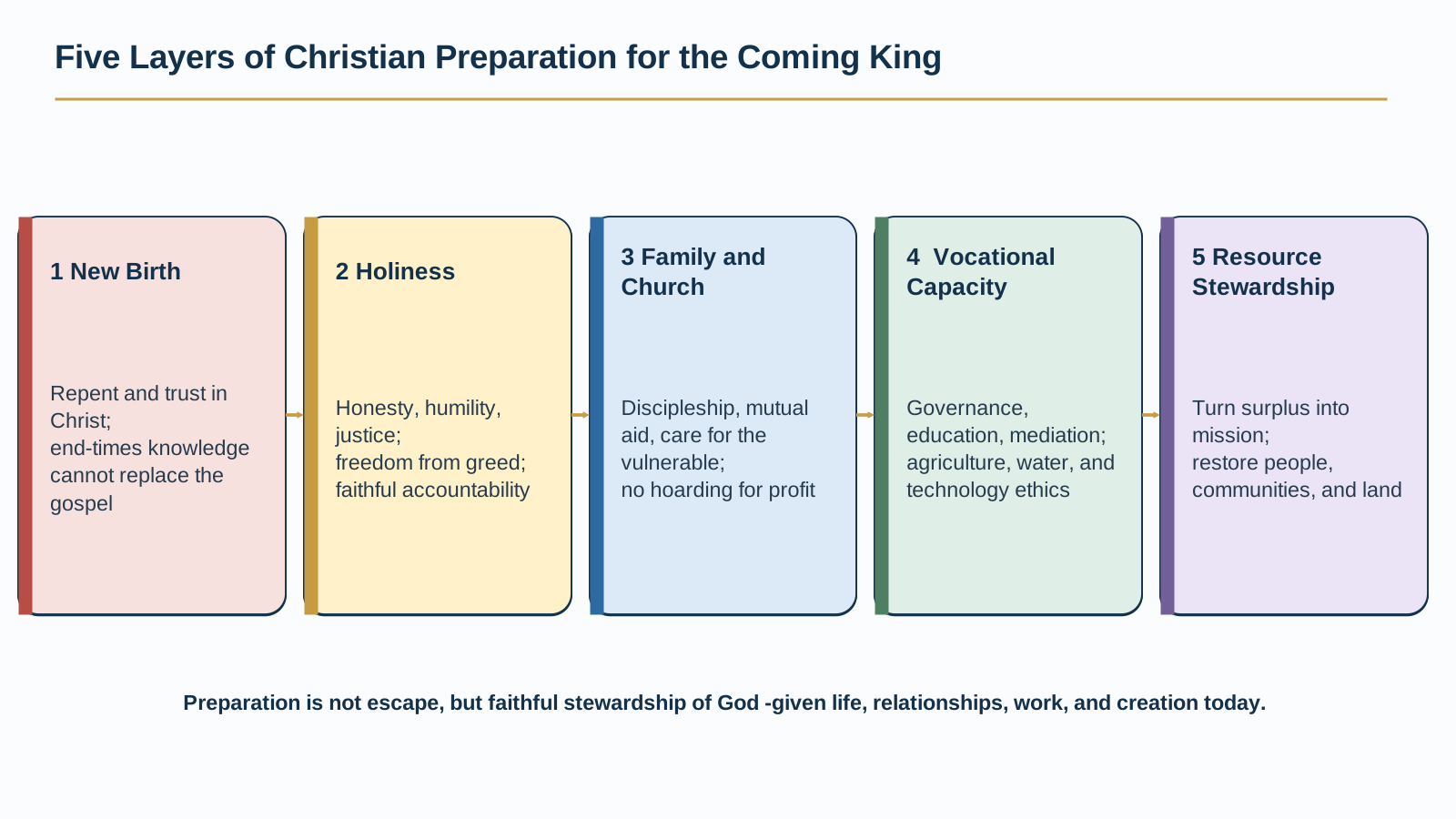
Figure — Five priorities for preparation today.
13.5 Institutional Practices That Can Begin Today
Section titled “13.5 Institutional Practices That Can Begin Today”Tiers A–C — Mixed evidence and practical inference
Churches can create mutual-aid networks for food, tools, transport, care, skills, employment, education, and emergency support. Families and enterprises can practice regular rest, refuse to purchase growth through chronic overwork, and treat land and environmental responsibility as part of worship. Assistance for people facing hardship can be interest-free, deferrable, income-sensitive, or forgivable where appropriate.
Corporate charters can include obligations to mission, workers, communities, and creation. Institutions can disclose beneficial ownership, related-party transactions, and monopoly risks. Investments can be evaluated by real public outcomes rather than asset appreciation alone. AI projects can include explainability, appeal, data minimization, and local backup. Cooperation between Israel and the nations can center on education, agriculture, technology, public health, and the common good rather than national mythologizing.