Historical Attachment 1 Rethinking God’s Economic Principles and Global Development Trends through the Pandemic
Edited English translation. The argument and section structure are preserved; repeated material has been consolidated and later corrections in the integrated white paper govern any conflict.
1. Disaster as a Call to Repentance and Institutional Examination
Section titled “1. Disaster as a Call to Repentance and Institutional Examination”Biblical disasters are never a license for believers to identify the guilt of particular victims with certainty. They do, however, interrupt ordinary confidence and expose whether a society has treated health, work, land, finance, and human life as limitless resources. A pandemic can reveal the fragility of highly concentrated supply chains, indebted households, precarious labor, and systems designed without reserves or mutual aid.
The appropriate response is not triumphal prediction but humility, lament, care for the sick, truthfulness, and examination of institutions. Christian reflection should ask whether economic success has been purchased through overwork, environmental degradation, exclusion of the poor, excessive leverage, or the assumption that efficiency eliminates the need for redundancy and local capacity.
The speaker was Rongen David Lin (David Lin). Drawing on earlier work in multinational technology companies, including IBM and SAP, and financial services, including Citibank and Merrill Lynch in Hong Kong, he approached the pandemic principally from economic and technological perspectives. Institutional titles and organizational identifiers from the earlier materials are omitted in this personal-author edition; the argument, figures, and source references are otherwise retained.
The talk opened with a greeting to the brothers and sisters gathered at a seminar organized by the Jubilee Economic Ethics Education Foundation and an invitation to respond and discuss the ideas afterward. “People often say, ‘We want to change the world,’” the speaker observed. “Sure enough, this pandemic has helped us change the world.” He then asked what opportunities within this upheaval God’s children must not waste.
Under the original subheading “An Eschatological Outlook: The Direction of the Future World,” the presentation began its substantive argument with a set of questions: What is the overall direction of the world, and what is the future direction of its economic system? Before deciding what to do, it argued, people must ask what conditions they presently inhabit and where history is going. Is the world moving toward universal harmony and peace, or toward injustice and continuing conflict? What trajectory will the economic system follow?
The presentation read Revelation as portraying increasing wealth and power for a very small minority alongside increasing exploitation and suffering for the majority. On that reading, the world as a whole tends toward injustice and conflict; only the return of Jesus Christ and the arrival of the new heavens and new earth can finally lift humanity from those conditions into true concord and universal peace. The source footnote directs the reader to Revelation 12–14 and 17–18.
Human life on earth is brief. The presentation compares it to a qualifying heat or practice session before a final race: before entering the condition in which humanity dwells with God, people are to practice how “to do justice, to love mercy, and to walk humbly with your God” (Mic. 6:8). Scripture already supplies many principles for practicing justice and mercy; the questions are whether humanity will put them into practice and whether God will intervene when it refuses.
Under the further subheading “Why Disasters Occur in the Bible,” the original named the worldwide flood and Noah’s ark (Gen. 6–9); the Tower of Babel, the confusion of languages, and humanity’s dispersion (Gen. 11:1–9); the destruction by fire of Sodom and Gomorrah and the deliverance of Lot (Gen. 19:1–29); the famine in Egypt and Joseph’s response (Gen. 41; 47:13–26); the ten plagues and the exodus under Moses (Exod. 6–11); and Great Babylon and the end-time disasters. For the final item, the source cites Great Babylon in Revelation 17–18, the seven seals in Revelation 6–7 and 8:1–5, the seven trumpets in Revelation 8:6–13 and chapters 9–11, and the seven bowls in Revelation 15–16.
The presentation says that God permits such disasters for one of two broad purposes: to address problems created in the past or to accomplish a future divine purpose. It further warns, from within its 2020 setting, that the judgment of Great Babylon and the end-time tribulation would be greater than the pandemic; it therefore treats the pandemic as only a beginning and anticipates that other disasters may follow.
2. Environmental Breathing Space and the Need for Designed Rest
Section titled “2. Environmental Breathing Space and the Need for Designed Rest”Periods of reduced travel and industrial activity offered visible examples of how quickly some forms of pollution could decline. Yet involuntary lockdown is not a sustainable Sabbath policy. The deeper lesson is that land, air, water, people, and infrastructure require scheduled rest, maintenance, and limits. If rest exists only when crisis forces production to stop, the system has failed to govern its own pace.
The Sabbath principle therefore challenges the idea that every increase in throughput is automatically good. Environmental restoration requires measurement, technology, regulation, local participation, and changes in consumption—not merely temporary inactivity. A just economy designs periods of renewal before ecosystems and households collapse.
Under an original heading that said God was using the pandemic to address environmental problems caused by humanity, the presentation called the pandemic an ecological “great adjustment.” The shutdown of ordinary human activity was, in its language, a “great rest” and “great cessation of work”: economic activity declined and some environmental conditions visibly improved. It illustrated the claim through five concrete cases and Figures 1–5.
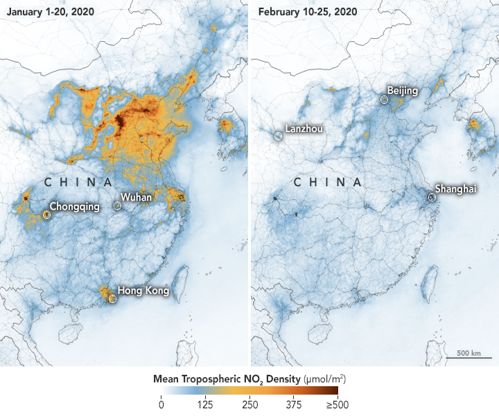
Figure 1 compares NASA satellite measurements of mean tropospheric nitrogen-dioxide density over China from 1–20 January 2020 on the left with 10–25 February 2020 on the right. The body attributes the report to CNN and says pollution over China fell markedly, with NASA identifying the pandemic-related economic slowdown as accounting for at least part of the decline. The yellow and dark-red areas that represented the highest concentrations were greatly reduced in the later image. The Chinese footnote links instead to a BBC Chinese report at https://www.bbc.com/zhongwen/trad/chinese-news-51694284.
Figure 1. Mean tropospheric NO₂ density over China, 1–20 January 2020 and 10–25 February 2020. The source image identifies Beijing, Lanzhou, Shanghai, Chongqing, Wuhan, and Hong Kong and uses a scale from 0 to at least 500 μmol/m².
The presentation next points to a nearly empty Miami Beach in Florida, whose sea appeared an unusually vivid blue while the crowds were absent (Figure 2). It then argues that excessive economic development had displaced animals, whereas stay-at-home restrictions gave them room to move through places people normally occupied. Citing a Unilad report and a Twitter post by Llandudno resident Andrew Stuart, it describes mountain goats wandering through the empty Welsh town as a sight not seen there for nearly a century (Figures 3 and 4). The Chinese source notes link to https://www.gvm.com.tw/article/72301 and https://reurl.cc/nnp3W2; the reproduced images credit Christopher Furlong/Getty Images and Andrew Stuart’s Twitter account.
Figure 2. An unusually empty Miami Beach and vivid blue water during the pandemic shutdown. Figures 3–4. Goats walking through the streets of Llandudno while residents remained indoors.
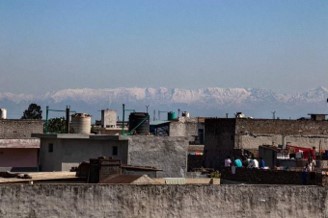
Finally, citing CNN, the presentation reports that residents of Punjab in northern India could see the Himalayas for the first time in almost thirty years after regional lockdowns and reduced economic activity lowered air pollution (Figure 5). The Chinese source note links to https://edition.cnn.com/travel/article/himalayas-visible-lockdown-india-scli-intl/index.html.
Figure 5. The Himalayas visible from Punjab, India, following the decline in air pollution during lockdown.
Taken together, the original presentation treated these scenes as rare environmental benefits that the pandemic brought to the earth.
Historical Attachment 1, Figure 1 — Reduced air pollution during the early pandemic shutdown period.

Historical Attachment 1, Figure 2 — Coastal water under reduced human activity.

Historical Attachment 1, Figure 3 — Animals appearing in a town during reduced human activity.

Historical Attachment 1, Figure 4 — Animals appearing in an urban street during reduced human activity.
Historical Attachment 1, Figure 5 — Himalayan visibility reported from Punjab after air pollution fell.
3. Economic Structures Exposed by Crisis
Section titled “3. Economic Structures Exposed by Crisis”The pandemic revealed the uneven distribution of liquidity, bargaining power, digital access, and the ability to work safely. Highly leveraged households and small enterprises faced fixed obligations even when income disappeared. Large institutions often had better access to credit and public support. This asymmetry illustrates why debt, interest, collateral, and emergency assistance cannot be evaluated only through contract formalism.
Biblical release does not deny responsibility; it prevents a temporary shock from becoming permanent servitude. Emergency support should distinguish inability from refusal, preserve basic housing and health, share losses transparently, and avoid transferring every cost to workers, tenants, or future taxpayers. Mutual aid, public support, insurance, risk-sharing finance, and orderly restructuring all have roles.
Under an original heading that said God was using the pandemic to adjust economic structures damaged by humanity, the source argued that one must first identify the economic order and principles God has given. It then organized its argument around three linked themes: economic order through the Sabbath and Sabbath Year; debt, interest, and what it called the myth of compound economic growth; and economic order through the Year of Release and Jubilee. It presented this not as an exhaustive biblical economics but as the author’s observation of the biblical material through the lens of his economics training.
Sabbath, the Sabbath Year, and economic pace
Section titled “Sabbath, the Sabbath Year, and economic pace”The most memorable feature of the pandemic, the presentation said, was forced rest. Drawing on his experience in financial investment, Lin described finance as morally neutral in itself: its effect depends on whether people use its instruments for good or evil. He nevertheless said that finance often produces “private gain from public loss.” An economic inflection point can become an exceptional opportunity to transfer wealth from a great many people to a small group, particularly when only actors near the economic or financial center recognize the turning point in advance. The more violent the fluctuation, the greater the opportunity for that minority; in major economic disasters, a few may reap extraordinary gains while the majority are dispossessed or exploited.
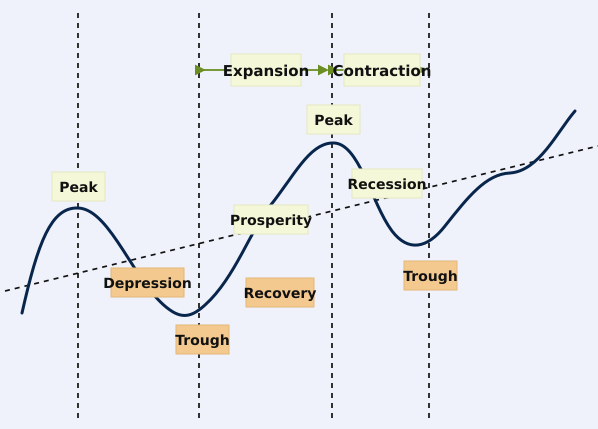
The presentation described the prevailing market cycle as continuous work and production creating excess supply, followed by the manufacture of unnecessary demand to absorb that supply. Supply is repeatedly created to satisfy excess demand and demand is repeatedly created to absorb excess supply. In its account, this cycle produces large bubbles and violent fluctuations, makes wealth extraction at turning points easier, and widens the gap between rich and poor. Figure 6 depicts the cycle through peaks, prosperity, recession, depression, trough, recovery, an expansion phase, and a contraction phase against a rising long-run trend. The presentation’s theological conclusion is that God’s economic order is intended to reduce such human-made volatility.
Figure 6. A stylized business cycle. English labels for the Chinese figure are: “Peak,” “Prosperity,” “Recession,” “Depression,” “Trough,” “Recovery,” “Expansion Phase,” and “Contraction Phase.” The dotted line represents a rising long-run trend.
The original counting of biblical rest begins with six days of work followed by one Sabbath day, then six years of cultivation followed by one Sabbath Year, and finally an additional rest in the fiftieth, Jubilee year—so that both the forty-ninth and fiftieth years are years of rest in the presentation’s scheme. It cites Leviticus 23:3; 25:1–7; and 25:8–17. On this basis, the speaker offered a teaching estimate that human beings are at rest for approximately 28 percent of the time. He added that work and production cease during this rest because God promises to provide what is needed, citing Leviticus 25:18–22.
Because this provision comes from God rather than additional human production, the presentation argues, it does not create needless supply; without excess supply, there is no need to manufacture excess demand. More proportionate supply and demand would make the economic system smoother, moderate the business cycle, inhibit bubbles, and make it harder for a minority to use volatility to extract other people’s wealth. It applies Psalm 46:10: “Be still, and know that I am God; I will be exalted among the nations; I will be exalted in the earth.”
The presentation also quotes 2 Timothy 3:16: “All Scripture is breathed out by God and is useful for teaching, for reproof, for correction, and for training in righteousness.” Because divine law is given for human good, it says, the Sabbath and Sabbath Year do more than give people time to rest and draw near to God: they allow both the land and the economy itself to rest.
Debt, interest, and compound growth
Section titled “Debt, interest, and compound growth”The seventh year is both a Sabbath Year and, in Deuteronomy, a Year of Release; the original asks why those two institutions coincide, citing Leviticus 25:1–7 and Deuteronomy 15:1–11. It introduces the question with two sayings popularly attributed to Albert Einstein: “The effect of compound interest is more frightening than an atomic-bomb explosion” and “What is the greatest force in the world? Compound interest.” From Einstein’s Jewish background, the speaker inferred that he must have read Scripture and known the Old Testament Year of Release. The presentation defines compound interest as adding each period’s interest to principal so that the enlarged principal itself earns interest in the next period.
Two numerical examples make the point. If the principal is $100, the annual rate is 7.5 percent, and interest compounds for ten years, then 100 × (1 + 7.5%)^10 ≈ 206.1: the original $100 becomes approximately $206. If the same amount compounds for twenty years, then 100 × (1 + 7.5%)^20 ≈ 424.8: the original $100 becomes approximately $425.
If the $100 is debt, the presentation asks, what does that growth mean for the debtor after ten or twenty years? It quotes Proverbs 22:7: “The rich rule over the poor, and the borrower is servant to the lender,” and argues that a borrower may become unable ever to repay. If the $100 instead represents GDP or a financial-market index that must compound at 7.5 percent every year, the presentation asks whether the economy or market will eventually become a vast bubble resembling the final condition of Great Babylon in Revelation 17–18.
The source therefore connects the command, “At the end of every seven years you shall grant a release” (Deut. 15:1), with an interruption of compounding. In its historical formulation, the Sabbath Year lets the real economy rest and stops people from forcing growth, while the Year of Release cancels debt and interest and stops a compound-interest bubble in the financial economy.
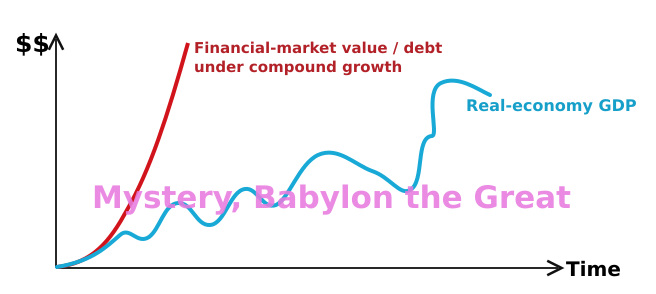
Figure 7 contrasts a steep red curve labeled “Financial-market value/debt under compounding” with a fluctuating blue curve labeled “GDP of the real economy,” both rising over time. Across the graph appear the words “Mystery, Babylon the Great,” recalling Revelation 17:5. The presentation says that the financial market’s value or debt will keep rising if it compounds without limit, while real GDP will also be forced upward if the economy is never permitted to rest; both trajectories conceal bubble risk.
Figure 7. Compound financial-market value/debt and real-economy GDP over time. English labels for the Chinese figure are “Financial-market value/debt under compounding,” “GDP of the real economy,” “Mystery, Babylon the Great,” and “Time.”
The presentation then quotes the opening of Revelation 18:17: “In one hour such great wealth has been laid waste.” Reading Revelation 18–19, it describes Great Babylon vanishing in an instant, like the great stone an angel hurls down in Revelation 18:21. It says the saints should not mourn that collapse but sing “Hallelujah,” echoing Revelation 19:1–7, because the appointed time of God’s coming has arrived.
Because human beings did not observe these commands, the 2020 presentation interpreted the pandemic shutdown as God’s own means of stopping overproduction, forced growth, debt expansion, and financial bubbles. It called the interruption an act of mercy that delayed an earlier collapse and gave humanity another opportunity, and on that ground urged gratitude to God.
Release, Jubilee, and repeated economic reset
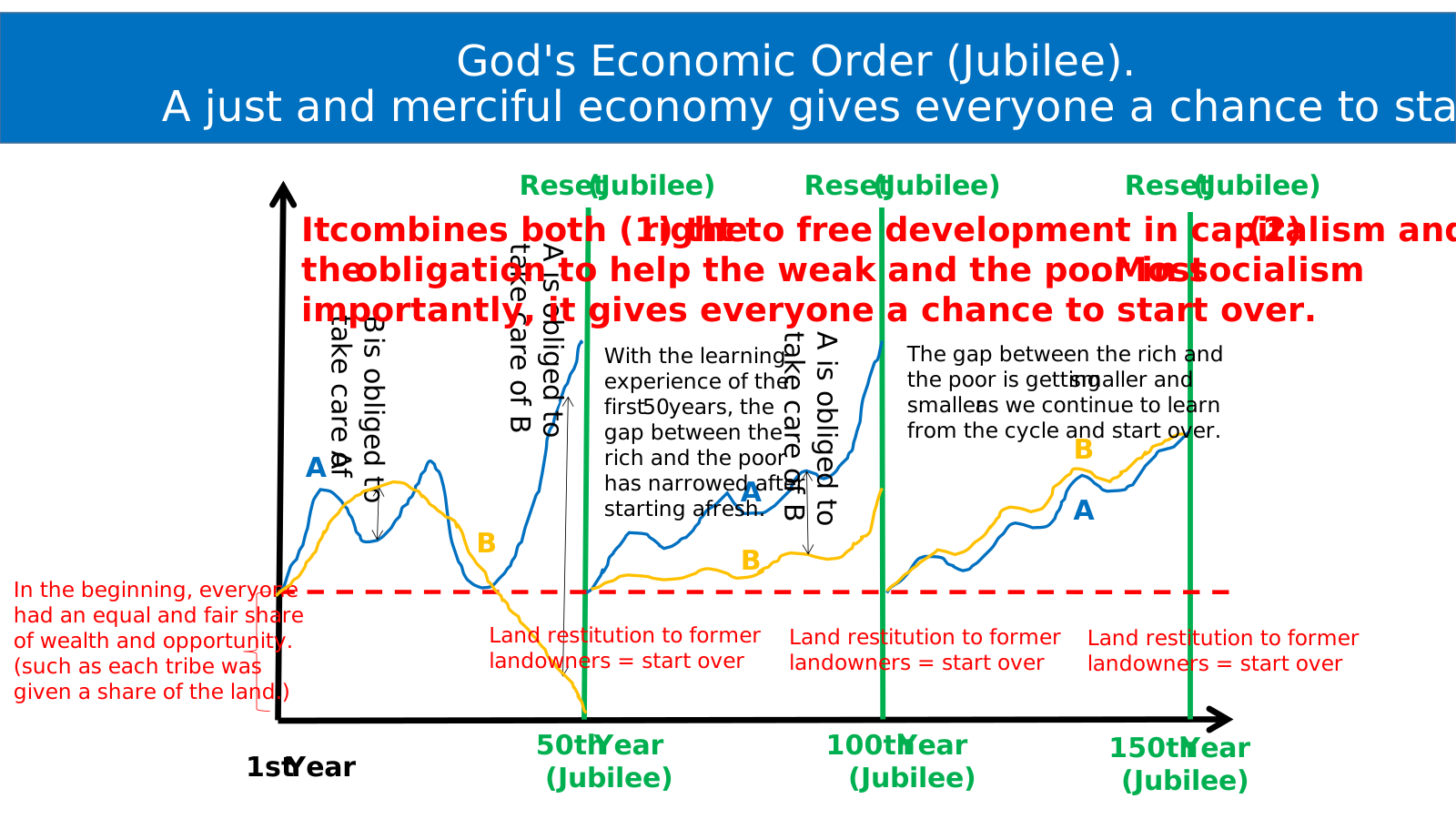
Section titled “Release, Jubilee, and repeated economic reset”The source next asks what economic system Scripture offers and answers: an economy that practices justice and loves mercy (Mic. 6:8). Figure 8 begins with the land allocation after the exodus. Moses gave territory east of the Jordan to two and a half tribes, and Joshua apportioned the land by lot among the remaining nine and a half tribes (Josh. 13–19). The presentation interprets each tribe’s inheritance as an initial opportunity: the red dashed baseline in the diagram represents an equal starting level of wealth and opportunity, after which persons A and B are free to develop differently during a fifty-year period.
During that freedom, some prosper and others fare badly. The source says those who prosper must care for those who do not, translating 2 Corinthians 8:13–14 as follows: “I do not mean that others should be relieved while you are burdened. Since you now have plenty, you should help those who are poor; when they have plenty and you are in need, they will help you. In this way both sides have the opportunity to help one another.” At Jubilee, the command “In this Year of Jubilee each of you shall return to your property” (Lev. 25:13) returns the productive asset—the land—to its prior holder and gives everyone another opportunity to begin.
In the first fifty-year cycle, A and B may rise or fall sharply and each, when better placed, has a duty to care for the other. In the second cycle, the presentation expects them to learn from the first fifty years, improve, and move toward greater stability while the more successful continues to care for the less successful. By the third cycle, repeated learning and renewed opportunity are expected to narrow the wealth gap further. The source portrays these recurring chances to begin again as a return to God’s economic order of justice and mercy and compares them to the new beginning God offers through Jesus Christ. It laments that humanity has not put what it calls this wise economics into practice.
Figure 8. Free development, mutual responsibility, and Jubilee reset. The title reads, “The right of free development found in capitalism, together with the obligation to help the weak and poor found in socialism.” Other English labels are: “At the beginning everyone has an equal and fair level of wealth and opportunity”; “B has a duty to care for A”; “A has a duty to care for B”; “Through repeated cycles of learning, the wealth gap becomes smaller”; “Land returns to its original holder”; “Reset Year”; and “Jubilee” at years 50, 100, and 150. The blue and yellow curves represent A and B.
The presentation consequently describes the biblical arrangement as neither capitalism nor socialism—“farther right than the Right and farther left than the Left.” It combines a right to free development, which the speaker illustrates through the six working years, with a duty for those doing well to assist those doing badly. If voluntary care still fails, the fiftieth-year restoration gives all parties a new beginning by returning land to its original holder.
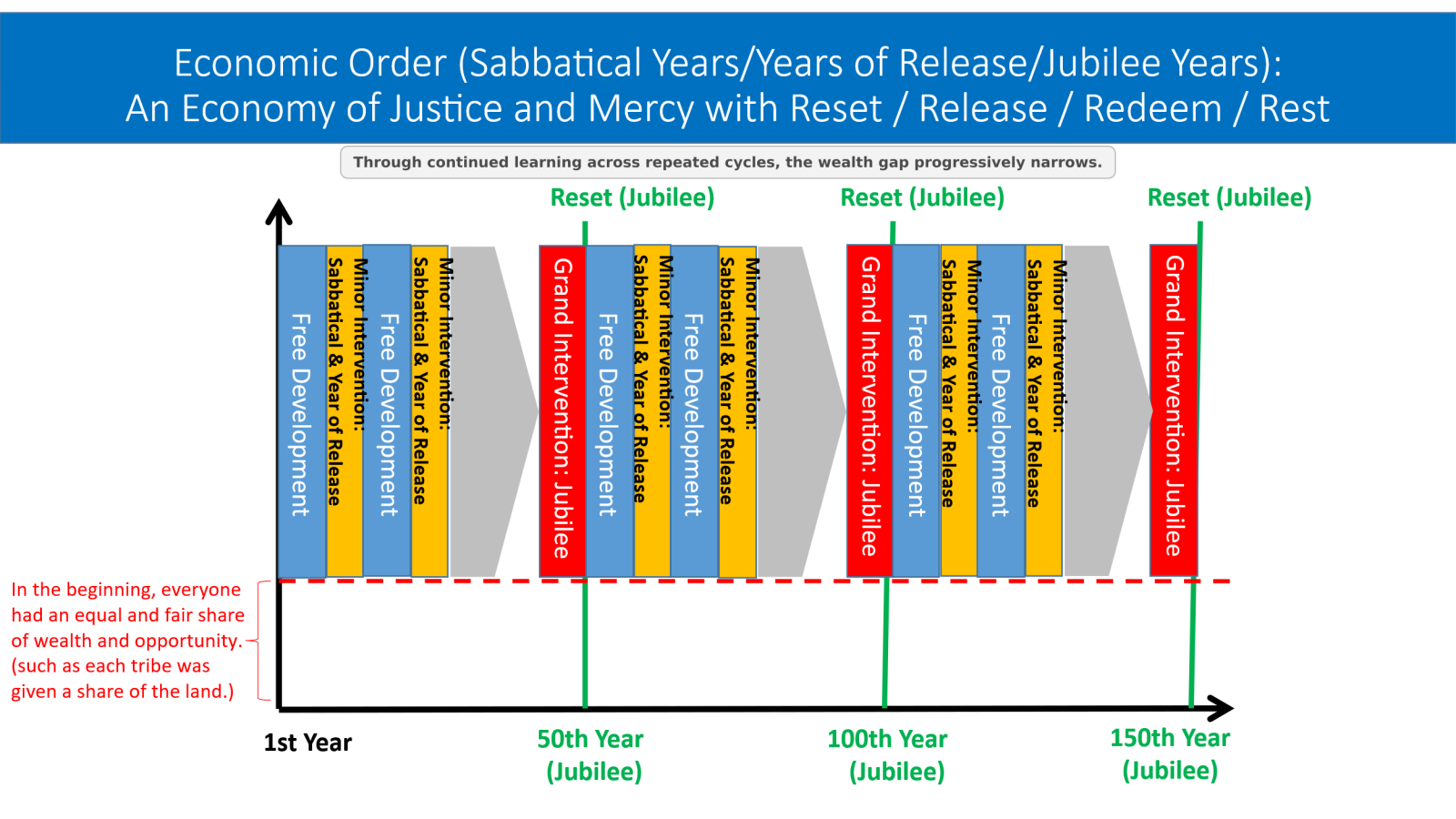
Within each fifty-year span, the source distinguishes “small interventions” from a “major intervention.” The fiftieth-year Jubilee resembles pressing a computer’s Reset button. Before it, each seventh-year Sabbath and Release provides a smaller adjustment: the real economy rests and compounding in the financial economy is interrupted. Figure 9 visualizes repeated periods of hands-off development, seventh-year release, and fiftieth-year Jubilee.
Figure 9. Small and major interventions over repeated Jubilee cycles. English labels for the Chinese figure are: “Hands off / free development” (blue); “Small intervention: Year of Release” (yellow); “Major intervention: Jubilee” (red); “Reset Year” (green); and “At the beginning everyone has an equal and fair level of wealth and opportunity.” Jubilee/Reset markers appear at years 50, 100, and 150.
The source summarizes this as a small adjustment every seven years joined to a major adjustment every fifty years. It regrets that human beings have not kept this order and closes the economic section with the author’s expectation that, when Jesus returns to govern the earth with his people, these principles will be used in that governance.
Historical Attachment 1, Figure 6 — Economic cycle of prosperity, overheating, recession, trough, and recovery (English translation).
Historical Attachment 1, Figure 7 — Divergence between financial claims and real-economy output (English translation).
Historical Attachment 1, Figure 8 — Jubilee and limits on inherited inequality.
Historical Attachment 1, Figure 9 — Sabbatical release and Jubilee cycles
4. Accelerated Digital Globalization
Section titled “4. Accelerated Digital Globalization”Remote work, online education, digital payments, telemedicine, cloud services, and platform commerce accelerated during the pandemic. These tools expanded access and continuity, but they also concentrated data, identity, payment, and market power. The same infrastructure that enables cooperation can enable surveillance, exclusion, manipulation, or dependence on a few platforms.
Christian discernment should therefore move beyond the binary claim that technology is either salvation or evil. The relevant questions are who controls the system, what purpose it serves, whether users can refuse or exit, how errors can be appealed, whether local backup exists, and whether data are minimized. Digital globalization must be paired with distributed resilience and accountable governance.
Having interpreted the pandemic’s environmental and economic adjustments, the source turned to the direction in which the whole world was moving. It described the pandemic as surface-level deglobalization but substantive acceleration of digital globalization. Drawing on the speaker’s technology background, it argued that large-scale adoption of digital tools made the world more, not less, connected. Its examples included remote work, digital currency, digital shopping, digital entertainment, telemedicine, digital education, the Internet of Things, connected vehicles, networks connecting people, the wider “Internet of Everything,” and the digital economy. It summarized the pandemic convention as: if something can be done without meeting face to face, do not meet face to face.
The source viewed that convenience with both delight and anxiety. Reading Revelation 12–13 as a warning about an evil unified world at the end of the age, it asked whether digital dependence could lead toward authoritarianism and unified control. In a live audience exercise, the speaker asked anyone who had never used Google to raise a hand; no one did. He then asked who had not used Line that day; again no one raised a hand. The point of the illustration was that whoever controlled platforms with that reach could exercise extraordinary power over the world.
Speaking as a programmer, Lin said that every architecture and system in the digital world can be penetrated. A malicious intruder could obtain an astonishing body of personal data and do grave harm. The presentation singled out government digital-identity programs, including Taiwan’s then-proposed New eID, and reported that even hackers opposed the proposal because, in their view, the system could be breached, exposing everyone’s data without leaving a trace.
The presentation then asked whether the infrastructure associated with the “666” mark of the beast in Revelation was already being prepared. Its author’s stated view was that the groundwork was already present and accelerating, although its adverse and evil effects had not yet appeared in full. The source footnotes again direct the reader to Revelation 12–13.
The source’s concise principle was that technology and finance are neutral instruments, but their practical character depends on the people who control them and the purposes for which they are used. It urged Christians to think more deeply about these structures rather than merely conforming to mainstream-media narratives. The section closed with Lin’s aphorism: “Epoch-making technologies often conceal unprecedented dangers, because we overlook human sinfulness.”
5. Christian Responsibility in a Period of Change
Section titled “5. Christian Responsibility in a Period of Change”Believers can strengthen households and communities through practical gifts: sharing food, tools, care, transportation, professional advice, education, employment information, and emergency funds; reducing waste; supporting vulnerable people; and developing skills that remain useful when markets are disrupted. The church should become a trustworthy node of relationship and service rather than a source of rumor or coercion.
Enterprises can design mission, worker, community, and environmental responsibilities into their charters. Investors can evaluate real public outcomes rather than asset appreciation alone. Educators can cultivate discernment, cooperation, and resilience. Technology professionals can build explainability, appeal, privacy, and distributed backup into systems. These practices do not construct the Millennial Kingdom by human power; they train present-day faithfulness.
The original presentation made a historically specific application to Taiwan under the title, “God preserved Taiwan as a Goshen; what does God want Taiwan to do?” It observed that, while much of the world was locked down, Taiwan was one of the few places where people could still move about freely. The speaker compared this with the distinction made during the plagues of Egypt: “On that day I will set apart the land of Goshen, where my people dwell …” (Exod. 8:22). Just as God preserved Israel in Goshen for a purpose, the source asks whether Taiwan had been preserved for a purpose as well. It recalls God’s command in Exodus 8:1: “Let my people go, so that they may serve me.”
The presentation listed several events from the first phase of COVID-19 in Taiwan and asked whether they were the work of human beings or of God. It said that schools with confirmed cases did not develop wider outbreaks; a woman working in an adult-entertainment venue reportedly had contact with more than seventy customers, none of whom was confirmed infected; and more than twenty sailors with confirmed infections reportedly did not transmit the virus to others while on leave.
It also noted that mainland China had prohibited mainland tourists from visiting Taiwan before the 2020 outbreak and asked what might have happened had large numbers arrived during the Lunar New Year. It recalled that Italy prohibited entry from both China and Taiwan before Italy’s own outbreak; although Taiwanese media objected at the time to Taiwan being treated as part of China, the speaker later asked whether Taiwanese travelers might otherwise have visited Italy and brought infections home. Finally, the presentation asserted that everyone in Taiwan had received the BCG vaccine.
The speaker interpreted those developments as acts of God rather than as events anyone could have planned in advance. He argued that God’s special preservation of Taiwan must have a reason and invited believers to pray for revelation concerning Taiwan’s future calling and the purpose of that preservation. The presentation quotes 1 Corinthians 2:10: “God has revealed these things to us through the Spirit, for the Spirit searches everything, even the depths of God.”
The final question in the original was, “In the last days, when God tells his people to come out of Great Babylon, what role should the apostles in Taiwan play?” The presentation urged vigilance because the world was moving toward digital control and rule. It quoted Revelation 18:4: “Come out of her, my people!” Taiwan is a technology island, it observed; Christians commissioned by God must therefore ask what they should do and what role they should play. The talk closed by inviting the audience to seek God’s will together in prayer and by thanking them for listening.
Source note. The Chinese attachment identifies the text as a summary of key points from the “Jubilee Biblical Economic Ethics Seminar” held on 14 November 2020.