Chapter 7 An Eschaton-Oriented Stewardship Economy
Chapter orientation God is the ultimate owner. Human beings exercise real but limited rights of use, benefit, management, and inheritance, all of which remain accountable to the King and bounded by an eschatological horizon. |
|---|
7.1 From Absolute Ownership to Entrusted Rights
Section titled “7.1 From Absolute Ownership to Entrusted Rights”Tier B–C — Scriptural synthesis and institutional inference
The earth and its fullness belong to the Lord (Psalm 24:1), and Leviticus 25:23 declares that the land must not be sold in perpetuity because Israel lives as sojourners and tenants with God. Human beings nevertheless receive real authority to cultivate, use, protect, enjoy, transfer, and inherit resources. Biblical stewardship is not the denial of property; it is the denial that property becomes autonomous sovereignty.
Entrusted rights are meaningful precisely because they carry responsibility. A household may need secure use of land and housing. A worker may legitimately enjoy the fruits of labor. An institution may need authority over equipment and funds. Yet no holder may turn those rights into permanent dominion over another person, perpetual control of necessities, or an immunity from public accountability. Rights are protected from arbitrary seizure and simultaneously limited by God’s ownership, the neighbor’s dignity, and the common good.
7.2 How a Known Endpoint Changes the Meaning of Wealth
Section titled “7.2 How a Known Endpoint Changes the Meaning of Wealth”Tier C — Institutional inference
Modern valuation often assumes indefinite continuity: corporations are treated as perpetual, land is expected to preserve a terminal value, and financial claims can compound across generations. A known millennial endpoint removes the theological basis for this assumption. Every present right to control, claim income, exclude others, or transfer an asset must end or be reauthorized before the final judgment.
This does not make material resources worthless. It changes their purpose. Land, buildings, tools, technology, money, and institutional authority are valuable because of the service, cultivation, protection, and fruit they can produce during the remaining term. Wealth is no longer the power to secure private control forever. It becomes temporary capacity that must be faithfully converted into life, justice, knowledge, care, restored creation, and communities able to serve the King.
7.3 Work, Income, and Enjoying the Fruit of Labor
Section titled “7.3 Work, Income, and Enjoying the Fruit of Labor”Tier B — Scriptural synthesis
Isaiah 65 and Micah 4 portray people building houses and living in them, planting and eating, sitting under vines and fig trees, and being free from fear. These images affirm the dignity of work and the right to enjoy its fruit. A stewardship economy is not a system in which all results are seized by a central authority or in which effort, skill, responsibility, and creativity are ignored.
At the same time, the fruit of labor cannot become a basis for exploiting those whose opportunities, health, family burdens, or abilities differ. Basic security and protection from dispossession belong alongside differentiated responsibility. The aim is neither absolute individualism nor compulsory sameness, but a social order in which people can work, contribute, enjoy, share, learn, and cooperate without being ruled by fear of losing the necessities of life.
7.4 Surplus as a New Entrustment
Section titled “7.4 Surplus as a New Entrustment”Tier C — Institutional inference
Surplus is not automatically evidence of greed, nor is it automatically private entitlement. A harvest above immediate need, an efficient technology, a successful enterprise, or a skilled person’s higher productive capacity can create genuine margin. The question is what happens next. In a Kingdom-oriented economy, surplus becomes a new entrustment to be allocated toward maintenance, future resilience, vulnerable people, education, mission, restoration, and new productive capacity.
This does not require every surplus to be centralized. Households, communities, enterprises, and public institutions may hold different reserves and responsibilities. Governance must distinguish prudent provision from hoarding, productive reinvestment from endless expansion, mission surplus from hidden private extraction, and voluntary generosity from coercive appropriation. Transparency and accountability reveal whether surplus is serving life or becoming a new structure of domination.
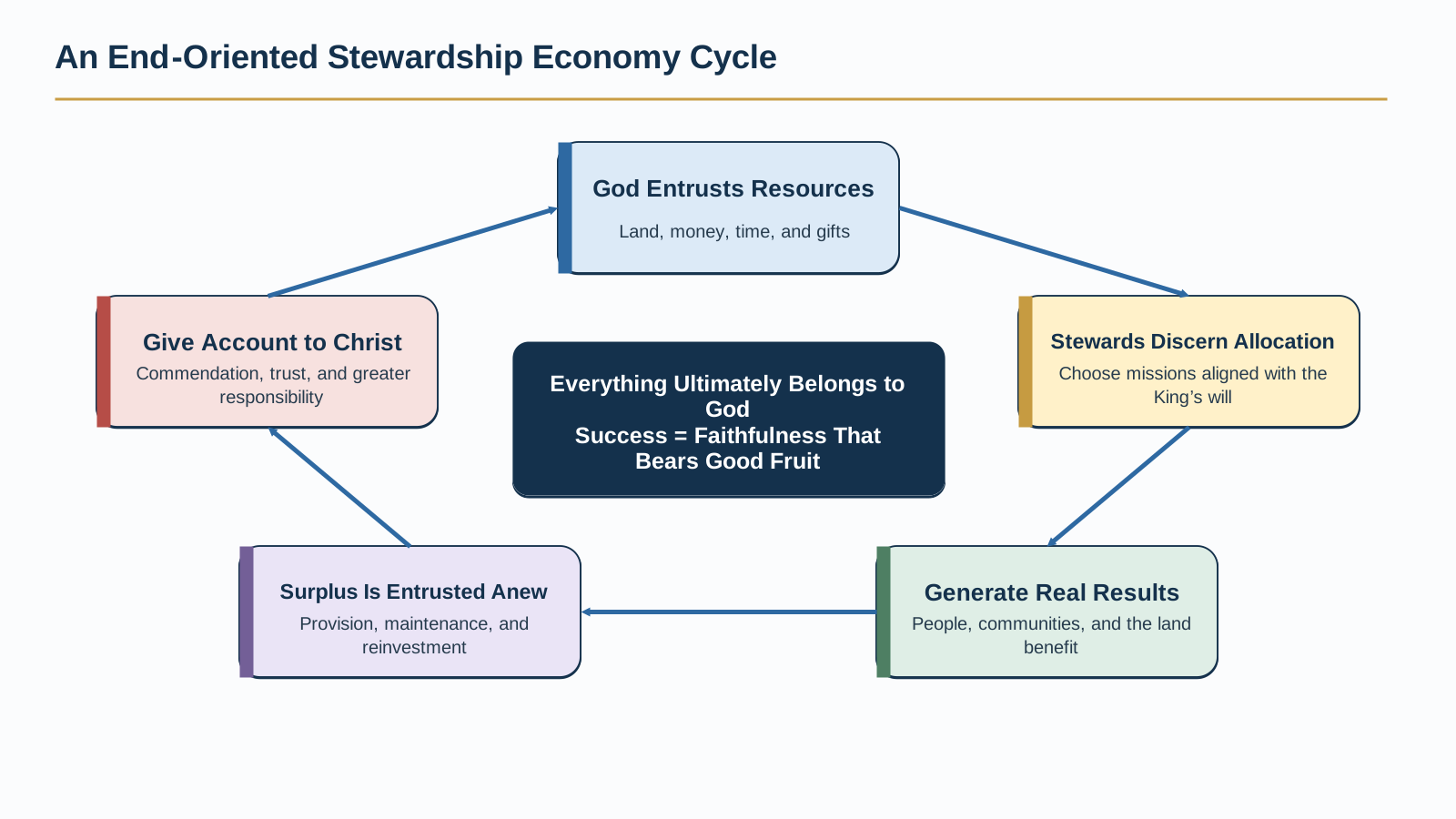
Figure — Eschaton-oriented stewardship cycle.
7.5 Reward, Commendation, and Greater Responsibility
Section titled “7.5 Reward, Commendation, and Greater Responsibility”Tier B — High-confidence synthesis
Jesus’ parables connect faithfulness with greater entrusted responsibility: authority over ten cities or five cities, and additional trust for those faithful in little (Luke 19:11–27; Matthew 25:14–30). First Corinthians 3 teaches that God gives the growth while each worker receives a reward according to his or her labor.
The deepest reward of the Millennium may therefore consist not in additional permanent assets but in the King’s commendation, joy, trust, and greater responsibility. Provision for daily life and differentiated compensation for different roles may still exist, but they are not the ultimate value. The steward’s question changes from ‘How much can I own?’ to ‘What can the King entrust to me, and what fruit will remain when every temporary right reaches its horizon?’
7.6 Cooperation and Differentiated Responsibility
Section titled “7.6 Cooperation and Differentiated Responsibility”Tier C — Institutional inference
One Master does not imply identical work, identical gifts, or identical compensation in every circumstance. The parable of the laborers in the vineyard primarily reveals the sovereignty of grace; it is not a universal wage formula. The ten and five cities show that differing histories of faithfulness can lead to differing responsibilities.
The Millennium can abolish predatory competition, fraud, destruction of rivals, and profit from weakness without abolishing excellence, comparison among proposals, specialization, accountability, or distinct callings. Cooperation is not passivity. It is the disciplined coordination of different gifts under one King, with basic security protected and greater responsibility matched by greater accountability rather than greater power to exploit.
7.7 The Common Millennial Expiration Date and the “Millennium Endpoint Effect”
Section titled “7.7 The Common Millennial Expiration Date and the “Millennium Endpoint Effect””Tier C — Institutional inference
The most consequential institutional feature of the Millennium is not only Christ’s personal reign but the common endpoint of the one-thousand-year order. Public offices, land-use rights, corporate charters, monetary claims, debt, income rights, concessions, and private powers of control cannot reasonably be presumed to remain under their current holders after the final judgment.
This does not mean that every person lives for the whole thousand years or that every contract has the same maturity. It means that the entire public order shares a final horizon. Modern finance often includes a perpetual terminal value; the Millennium Endpoint Effect removes that assumption. Time-limited rights may be valuable and transferable, but no permanent private claim can be carried through the eschatological endpoint as though the King and the new creation had no authority over it.
Core proposition All temporary institutional rights expire within the Millennium; all temporary value is subject to terminal-horizon erosion; and the steward’s mission is to convert temporary resources into Kingdom fruit before the account is rendered. |
|---|
7.8 Valuation by Remaining Harvest Years in Leviticus 25
Section titled “7.8 Valuation by Remaining Harvest Years in Leviticus 25”Tier C — Institutional analogy grounded in explicit text
Leviticus 25:15–16 requires land transactions to be priced according to the years remaining until Jubilee and the number of harvests still available. The farther the Jubilee, the more harvest rights remain and the higher the price; the nearer the Jubilee, the fewer remaining harvests and the lower the price. The buyer does not acquire permanent sovereignty over the land, but a finite stream of use and harvest rights.
This is Scripture’s most direct analogy for terminal-horizon erosion. Extended cautiously, it suggests that private rights in land, housing, enterprises, equipment, debt claims, or money should be valued by the use, service, or return that remains within the authorized term. Value after the common endpoint cannot be included in the present holder’s private claim. The analogy guides institutional thinking; it is not a direct command that every modern asset must use a single biblical pricing formula.
7.9 The Time-Hourglass Effect and Terminal-Horizon Erosion
Section titled “7.9 The Time-Hourglass Effect and Terminal-Horizon Erosion”Tier C — Institutional inference
The time-hourglass image describes finite rights whose remaining years drain away like sand. Two orchards may have the same annual quality and yield, but an orchard with one thousand years of remaining use carries more aggregate benefit than one with a single year. Even without applying an interest-rate discount, the number of years under the present holder’s control is consumed year by year.
Two forces operate simultaneously. Restoration, irrigation, education, improved management, and technology can increase current-period usefulness. At the same time, the remaining duration of every existing private right necessarily shortens. Productivity gains may temporarily offset erosion and raise current value, but they cannot create a permanent private terminal value beyond the endpoint. The created thing may flourish even as a particular holder’s right to control it approaches expiration.
Remaining Value of Temporary Rights(t) = the sum of benefits that the present holder may control from Time Point(t) to the common endpoint. Conceptual expression of remaining-term value; it is not a calibrated financial model. |
|---|
Private Terminal Value(t) at the common endpoint = 0 What reaches zero is the existing private claim beyond the endpoint, not necessarily the created thing itself. |
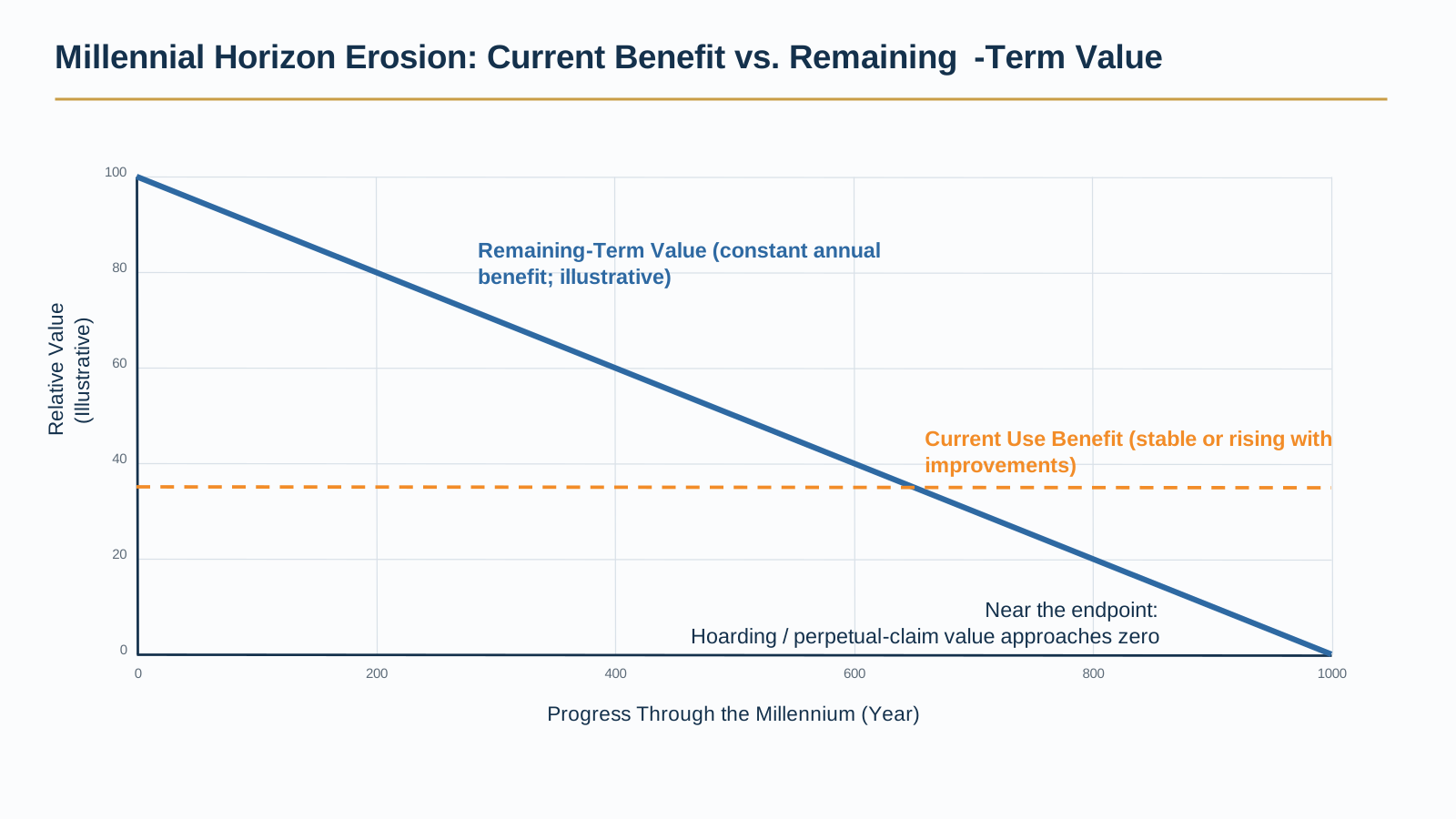
Figure — Terminal-horizon erosion: current-use benefit and total remaining-term value must be distinguished.
7.10 Creation Itself Must Be Distinguished from Private Rights of Control
Section titled “7.10 Creation Itself Must Be Distinguished from Private Rights of Control”Tier C — Conceptual boundary
When saying that value ultimately reaches zero, the object of the statement must be specified. Scripture does not fully explain whether orchards, land, cultures, cities, or relationships continue into the New Creation in purified or transformed forms. What cannot be presumed to cross the endpoint is the present holder’s right to buy and sell them, claim their returns, exercise exclusive control, or assign themselves an indefinite private monetary terminal value.
This distinction protects environmental and cultural work from nihilism. Restoring soil, educating children, creating art, and building trustworthy institutions matter even if present legal forms do not survive unchanged. The fruit of faithfulness can be remembered by Christ, while the current deed, share certificate, office, or bank balance expires.
| Item | Before the endpoint | Reasonable judgment after the endpoint |
|---|---|---|
| Orchard, land, or created resource | May grow, be restored, bear fruit, and serve people. | Whether it continues through God’s transformation is not for the present holder to decide. |
| Private rights to income and control | May be exercised and brought to account during the remaining authorized term. | Existing rights end and may not be presumed to continue as private sovereignty. |
| Corporations, equity, and debt claims | May organize resources and responsibility within a limited term. | May not become permanent claims in the New Creation. |
| Fruit of faithfulness, love, and justice | Produced through temporary resources and institutions. | May be remembered and rewarded in Christ’s judgment. |
7.11 The Three-Ledger Framework: Material Resources, Time Stewardship, and Kingdom Faithfulness
Section titled “7.11 The Three-Ledger Framework: Material Resources, Time Stewardship, and Kingdom Faithfulness”Tier C — Teaching and governance framework
The Three-Ledger Framework prevents every form of value from being compressed into one price. The ledgers interact, but they cannot be merged into a single number. The same act can look small in material terms, costly in time, and immense in faithfulness. The widow’s offering was materially small, yet Jesus judged it greater in relation to her livelihood and trust (Mark 12:41–44).
The Material-Resources Ledger records land, equipment, money, costs, energy, and output. The Time-Stewardship Ledger records time, attention, rest, relationships, care, calling, and opportunity cost. The Kingdom-Faithfulness Ledger concerns love, justice, mercy, motive, obedience, and fruit ultimately judged by Christ. Governments, banks, markets, and AI may help account for material resources; none may establish a universal exchange rate for motive, love, salvation, or faithfulness.
| Ledger | What it records | Legitimate uses | What it cannot determine |
|---|---|---|---|
| Material-Resources Ledger | Land, money, equipment, labor inputs, costs, output, energy, and measurable services. | Budgeting, allocation, maintenance, production, and accountability for waste. | A person’s worth, salvation, love, motive, or ultimate faithfulness. |
| Time-Stewardship Ledger | Time, attention, rest, care, relationships, calling, opportunity, and life stage. | Protecting Sabbath, evaluating overwork, recognizing care, and planning vocation. | A fixed monetary price for every hour or the spiritual value of sacrifice. |
| Kingdom-Faithfulness Ledger | Love, justice, mercy, truth, motive, courage, obedience, and fruit. | Discernment, repentance, testimony, and final accountability to Christ. | Mechanical scoring by government, employer, bank, church platform, or AI. |
7.12 Kingdom Value Has an Objective Standard but Cannot Be Monetized
Section titled “7.12 Kingdom Value Has an Objective Standard but Cannot Be Monetized”Tier B–C — Theological synthesis and governance boundary
Kingdom value is not merely subjective preference. Christ judges according to truth, the nature of each person’s entrustment, motive, faithfulness, and actual fruit. Mercy, justice, love, truth, and obedience are not interchangeable opinions. Yet their objective moral reality does not make them suitable for a uniform monetary price.
A bank cannot convert holiness into a credit score. A government cannot assign a currency value to worship. A company cannot buy a higher Kingdom rating by making a donation while exploiting workers. An AI system cannot infer the heart from behavioral data and issue spiritual privileges or penalties. The objective Judge is Christ; human institutions must evaluate observable responsibilities while preserving humility about motives and salvation.
7.13 Time Is a Crucial Entrustment, but Not the Only Currency
Section titled “7.13 Time Is a Crucial Entrustment, but Not the Only Currency”Tier C — Institutional inference
Because the Millennium has a shared endpoint, time becomes visibly scarce. A year cannot be stored for later, and every delay reduces the remaining horizon for service. This intensifies the moral importance of attention, rest, learning, relationship, and the sequencing of long-term projects.
Time should not, however, become a totalizing currency. People differ in health, age, calling, caregiving duties, and capacity. One hour of a parent caring for a disabled child cannot be priced as though it were identical to one hour of commercial labor. Time belongs in its own ledger, related to material resources and faithfulness but not reducible to either.
Time may be recorded for labor exchange, a time bank, or personal opportunity cost, but one hour of different work can require very different skill, responsibility, risk, and training. Large projects still consume land, energy, equipment, and materials. Time therefore cannot function as the single universal medium of exchange, and Sabbath itself refuses to reduce a person to a production machine.
7.14 Basic Autonomy plus Cooperative Interdependence
Section titled “7.14 Basic Autonomy plus Cooperative Interdependence”Tier C — Institutional inference
Isaiah 65 and Micah 4 portray households secure in their houses, vineyards, and work, with no one making them afraid. These images support basic autonomy: families should not lose housing, food, water, productive opportunity, or personal freedom through unemployment, monopoly, or predatory debt.
Basic autonomy does not mean household isolation. Water systems, medicine, education, cities, transport, disaster response, environmental restoration, and interregional supply require cooperation. A better model is cooperative interdependence: the foundations of life are protected, while people with different gifts coordinate work that individuals cannot accomplish alone. The vulnerable receive care, and those entrusted with greater capacity assume greater responsibility.
| Basic autonomy | Cooperative interdependence |
|---|---|
| Housing, food, water, work, and basic productive opportunity cannot be arbitrarily removed. | Large projects, education, medicine, environmental work, and transnational missions are undertaken together. |
| People need not surrender freedom merely to survive or accept unjust contracts for necessities. | Different gifts create division of labor, complementarity, learning, and mutual service. |
| Households can meet core needs and enjoy the fruit of their work. | Communities care for those who lack capacity and share tools, knowledge, reserves, and public infrastructure. |
7.15 God’s Provision Does Not Eliminate Resource Measurement
Section titled “7.15 God’s Provision Does Not Eliminate Resource Measurement”Tier C — Institutional inference
Divine provision does not mean that stewards need not know where resources come from, how much is used, or whether anything is wasted. Manna was gathered according to the number of people and a defined measure. A double portion was provided before the Sabbath, and hoarding contrary to God’s rhythm spoiled. After feeding the crowd, Jesus told the disciples to gather the fragments so that nothing would be lost (Exodus 16; John 6:12).
The Millennium may therefore measure water, land carrying capacity, agricultural output, materials, energy, transport demand, and population needs with great precision. Planning is not unbelief. God’s provision frees planning from fear, greed, secrecy, and permanent self-protection. Good measurement serves gratitude, equitable allocation, maintenance, and care for creation.
7.16 Basic Security and “Re-Allocable Margin”
Section titled “7.16 Basic Security and “Re-Allocable Margin””Tier C — Institutional inference
A just order secures food, housing, health, education, care, and meaningful access to work so that people are not compelled to sell their freedom for survival. Beyond the basic tier, differences in gifts, effort, responsibility, creativity, and outcomes may generate a re-allocable margin—resources not required for immediate necessities.
That margin can support mission, education, hospitality, environmental restoration, emergency reserves, experimentation, culture, and investment in future generations. It is not the same as unlimited disposable income or a private claim immune from community responsibility. The key governance question is whether the margin is freely and transparently stewarded or captured through monopoly, hidden rent, and inherited power.
7.17 Converting Temporary Value into Kingdom Fruit
Section titled “7.17 Converting Temporary Value into Kingdom Fruit”Tier C — Integrative institutional inference
Land, money, time, gifts, technology, and relationships are temporary entrustments. Their remaining term declines, but their usefulness can be converted into enduring fruit: love, justice, mercy, trust, education, culture, reconciled communities, restored creation, and faithfulness remembered by Christ.
The central strategy is not to extract the maximum before time runs out. It is to invest, serve, share, restore, teach, and cultivate according to the King’s will. Terminal-horizon erosion turns hoarding into a losing strategy. Faithful conversion uses what is passing away to build people, relationships, and works that bear witness to the New Creation.
| Temporary entrustment | Terminal-horizon erosion | Faithful conversion | Possible Kingdom fruit |
|---|---|---|---|
| Land, money, time, gifts, technology, and relationships. | The remaining years of control decline year by year. | Invest, serve, share, restore, teach, reconcile, and cultivate. | Love, justice, mercy, trust, culture, restored creation, and faithfulness remembered by Christ. |