Chapter 9 Money, Finance, Investment, and Enterprise Systems
Chapter orientation Money and finance are tools for coordinating material resources. They cannot price Kingdom faithfulness, become sovereign, or preserve permanent private claims beyond the common endpoint. |
|---|
9.1 Does the Millennium Need Money?
Section titled “9.1 Does the Millennium Need Money?”Tier C — Institutional inference
Scripture does not explicitly say whether the Millennium uses coins, digital balances, vouchers, accounting units, or no general currency at all. Mortal residents continue to work, build, plant, travel, administer cities, and coordinate resources across regions. Some common unit of account or exchange may therefore remain useful, especially for complex projects and trade among people who do not know one another personally.
The existence of money would not mean that today’s monetary system continues unchanged. Money must be separated from ultimate value. It may measure material claims, costs, and exchange; it cannot measure salvation, love, motive, holiness, or the King’s commendation. Because the Millennium has a common endpoint and basic needs should not be monopolized, money cannot provide permanent sovereignty or an unlimited store of private power.
9.2 Do Financial Institutions Continue to Have a Function?
Section titled “9.2 Do Financial Institutions Continue to Have a Function?”Tier C — Institutional inference
Several financial functions may remain even if predatory finance disappears: secure custody, payment, clearing, recordkeeping, risk assessment, pooling of resources, matching savers and projects, insurance, and financing of public works. A large irrigation system, hospital, transport network, housing program, or environmental restoration project may require coordination across time and participants.
The institutional form should change. Finance must become transparent service rather than a sovereign industry that manufactures dependency. Custodians should not speculate with entrusted funds without consent. Payment systems should permit appeal and local backup. Credit assessment should evaluate project viability without converting poverty into permanent exclusion. Public and cooperative forms may be appropriate where the benefits are shared and private extraction would create monopoly.
9.3 Interest and Risk Sharing
Section titled “9.3 Interest and Risk Sharing”Tier C — Institutional inference
Interest can compensate for time, administration, inflation risk, default risk, and foregone use of resources, but fixed compounding can also transfer risk from capital holders to vulnerable borrowers regardless of project outcome. Biblical prohibitions on exploiting the poor and the rhythms of release challenge a system in which survival crises become profitable and obligations grow without endpoint.
The Millennium may move fixed claims away from the center and toward risk-sharing, service fees, equity participation, leasing, profit-and-loss sharing, and capped or releasable credit. No single instrument is automatically just. Equity can concentrate control, leasing can extract rent, and service charges can hide interest. Each arrangement must be tested by purpose, duration, transparency, basic-needs protection, risk allocation, and public accountability.
9.4 Investment as Mission-Directed Resource Allocation
Section titled “9.4 Investment as Mission-Directed Resource Allocation”Tier C — Institutional inference
Investment is the allocation of present resources to produce future capacity. In a stewardship economy, it is not abolished. Land restoration, education, housing, health, technology, infrastructure, and cultural creation require patient commitment before benefits appear. The question is whether investment serves the King’s mission or creates a perpetual private claim on people and resources.
A mission-directed investment identifies the problem to be served, the affected community, the risks, the time horizon, the rights of participants, the treatment of surplus, and the exit or reauthorization process. Financial return may be one measure of sustainability, but it cannot be the sole measure of success. Genuine public outcomes, restored capacity, resilient institutions, and protection of the vulnerable belong within the investment mandate.
9.5 Does Risk Still Exist in the Millennium?
Section titled “9.5 Does Risk Still Exist in the Millennium?”Tier B–C — Scriptural synthesis and institutional inference
The public reign of Christ and the restraint of Satan greatly reduce deception, violence, and systemic injustice. Yet mortal residents, finite projects, weather, biological processes, human error, and the possibility of disobedience remain. Construction can fail, crops can vary, administrators can misunderstand, equipment can break, and people can refuse obligations.
Risk management therefore remains a form of stewardship. It includes diversified supply, reserves, maintenance, insurance or mutual protection, transparent contracts, stress testing, and orderly resolution. Risk should be borne by the party best able to control it and should not be hidden in opaque products or transferred entirely to the weakest participant. The existence of risk does not justify fear-driven accumulation; it requires disciplined, truthful preparation.
9.6 Comparing Four Enterprise Models
Section titled “9.6 Comparing Four Enterprise Models”Tier C — Institutional comparison
Scripture does not reveal a single corporate-law template for the Millennium. Several models can be compared according to mission, governance, residual claims, duration, and protection against domination. The purpose of comparison is not to canonize one form, but to make power and benefit visible.
Every model needs answers to the same questions: Who appoints leaders? Who owns or controls core assets? How are workers, users, communities, and creation represented? How is surplus used? Can the organization outlive its mission? What happens at expiry? How are conflicts of interest, monopoly, and insider advantage prevented?
| Model | Core design | Potential strength | Primary governance question |
|---|---|---|---|
| Christ-entrusted enterprise without private shares | Core assets are treated as entrusted to the mission; managers receive role-based provision; surplus returns to the mission. | Most directly prevents perpetual private residual claims. | Who appoints managers, and how are bureaucracy and unaccountable insiders prevented? |
| Cooperative or community co-governance | Workers, users, and communities participate in decisions and share results. | Benefits remain close to responsibility and use. | How can large, technically complex, or cross-national projects decide efficiently and protect minorities? |
| Term-limited mission shares | Income and governance rights exist for a defined term and are reviewed at expiry. | Can pool capital while limiting permanent control. | How are expiry valuation, equipment, knowledge, and renewal rights handled fairly? |
| Public-benefit stakeholder enterprise | Shares remain, but the mission includes workers, communities, creation, and public good. | Connects more readily with present legal systems. | Can shareholders still accumulate excessive control or capture public resources? |
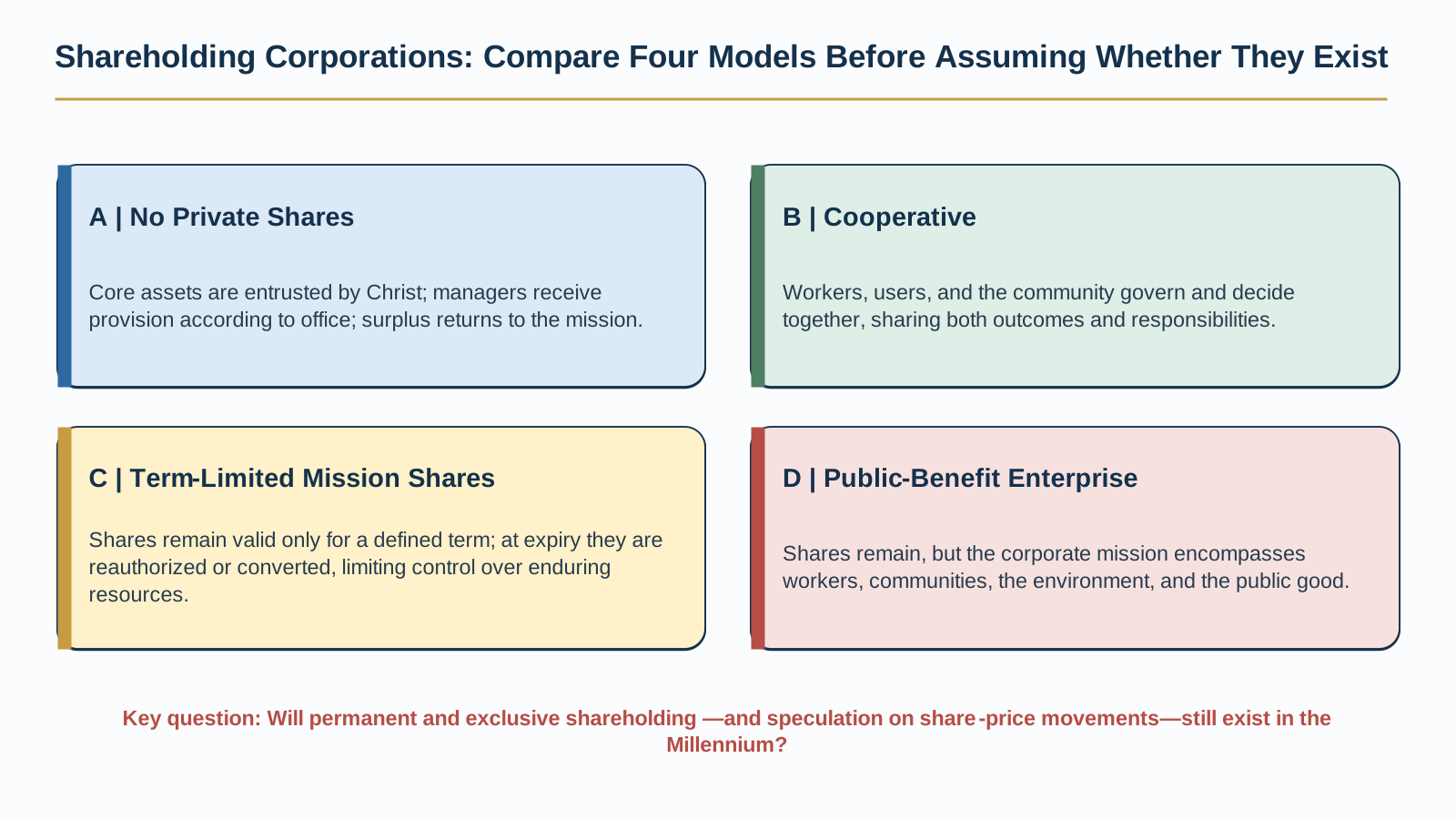
Figure — Four enterprise models compared under covenant and stewardship tests.
9.7 Perpetual Legal Persons and Mission Sunset Clauses
Section titled “9.7 Perpetual Legal Persons and Mission Sunset Clauses”Tier C — Institutional inference
Enterprises should not treat their own survival as the highest purpose. A charter can include a mission term, periodic reauthorization, expiry dates for land and natural-resource rights, rotation of governance authority, mission locks on surplus, and procedures for merger, dissolution, or transfer when the task is complete.
A reset need not destroy machines, buildings, technologies, or knowledge. It reexamines who controls them, for what purpose, under what obligations, and for whose benefit. The common endpoint of the Millennium removes the theological absolute from the ‘perpetual corporation,’ ‘perpetual shareholder,’ and ‘perpetual terminal value.’ An organization may continue only through renewed accountability, not because its charter has become an immortal sovereignty.
9.8 Talent and Real Productive Capacity over Purchasing Power Alone
Section titled “9.8 Talent and Real Productive Capacity over Purchasing Power Alone”Tier C — Institutional inference from stewardship teaching
The biblical talent was originally a unit of weight, but Jesus’ parable has also shaped the language of gifts and entrusted capacity. Purchasing power can fluctuate or disappear; knowledge, character, skill, relationships, practical wisdom, and real productive ability often provide deeper resilience.
This does not romanticize poverty or deny the need for material resources. It changes what communities invest in. Education, apprenticeship, health, care, repair, agriculture, translation, governance, and artistic capacity become portable forms of capital. A person should not be reduced to an account balance, and a community should not confuse high asset prices with the ability to produce, serve, restore, and endure disruption.
9.9 Distributed Mutual Aid and Local Resilience
Section titled “9.9 Distributed Mutual Aid and Local Resilience”Tier C — Institutional inference
Central coordination can achieve scale, but excessive concentration creates a single point of failure and a new power to exclude. Distributed mutual aid connects households, churches, farms, enterprises, schools, and local institutions so that food, care, tools, transport, housing, knowledge, and emergency response do not depend on one irreplaceable platform.
Local resilience is not isolationism. Regions still cooperate and share expertise, reserves, and infrastructure. The goal is polycentric capacity: multiple centers can act, information is portable, participants retain exit, and failure in one institution does not remove every path to life. This principle applies equally to money, data, energy, food, housing, and church-based assistance.
9.10 The Three Functions of Money under an Eschatological Horizon
Section titled “9.10 The Three Functions of Money under an Eschatological Horizon”Tier C — Institutional inference
Money is commonly described as a medium of exchange, a unit of account, and a store of value. The first two functions may remain useful in a complex mortal society. The third is transformed by the common endpoint. A balance may carry purchasing power during the remaining term, but it cannot preserve a private claim beyond the final judgment.
The functions should therefore be separated. A useful unit of account need not become an object of hoarding. A payment system need not grant permanent control over food, housing, or identity. A temporary store of value may support reserves and long projects, but it must remain bounded by release, anti-monopoly, transparency, and expiry or reauthorization.
| Function | Possible role during the Millennium | Eschatological limit |
|---|---|---|
| Medium of exchange | Coordinates transactions among people and institutions beyond close personal relationships. | Cannot become a gatekeeping system that denies basic life or worship. |
| Unit of account | Compares material costs, quantities, liabilities, and project alternatives. | Cannot price salvation, motive, love, holiness, or Kingdom faithfulness. |
| Store of value | Preserves temporary purchasing capacity for reserves and future projects. | Approaches zero as a private claim at the common endpoint; cannot create perpetual sovereignty. |
9.11 Money in Year 999: Exchange Value May Remain while Store-of-Value Function Approaches Expiry
Section titled “9.11 Money in Year 999: Exchange Value May Remain while Store-of-Value Function Approaches Expiry”Tier D — Exploratory thought experiment
If a medium of exchange remains near the end of the Millennium, it may still facilitate same-period transactions. A family could use a balance to obtain materials or services today. Yet a claim designed to preserve wealth for centuries loses meaning when the existing order is about to end. The private store-of-value function approaches expiry even if short-term exchange remains possible.
This scenario reveals the difference between use and hoarding. It also exposes two possible responses to the endpoint. One person may say, ‘Everything is ending, so consume without restraint.’ Another may say, ‘Time is short, so convert remaining resources into repentance, reconciliation, generosity, and Kingdom fruit.’ The final moral difference lies not in the currency form but in allegiance to the King.
9.12 Five Institutional Scenarios for a Medium of Exchange
Section titled “9.12 Five Institutional Scenarios for a Medium of Exchange”Tier D — Comparative scenarios
Because Scripture does not reveal a precise monetary architecture, several scenarios can be compared without treating any as prophecy. Each scenario must be tested by access, privacy, accountability, local resilience, monopoly risk, and its treatment of the common endpoint.
The relevant question is not merely whether the instrument is physical or digital. A paper currency can be monopolized, and a digital ledger can be decentralized and accountable. Conversely, a digital system can combine identity, payment, mobility, and eligibility into one coercive gate. Design must preserve refusal, appeal, alternative access, and a separation between material coordination and judgments about spiritual worth.
| Scenario | Description | Primary advantage | Primary risk |
|---|---|---|---|
| No general currency | Allocation through direct provision, reciprocal networks, and administrative accounts. | Reduces monetary hoarding and speculative finance. | Complex coordination, hidden favoritism, and dependence on administrators. |
| Public unit of account | A transparent accounting unit used for prices and budgets, with limited savings. | Makes costs visible while restricting accumulation. | Central authority may manipulate access or valuation. |
| Local and regional exchange units | Multiple interoperable units issued under local responsibility. | Resilience and proximity to real production. | Fragmentation, unequal convertibility, and local exclusion. |
| Mission-linked credits | Claims issued for specific projects, services, or time periods. | Aligns finance with purpose and expiry. | Can become opaque vouchers or privilege insiders. |
| Digital public ledger with offline alternatives | Auditable payments and records, combined with cash-like or local backup. | Efficiency, transparency, and continuity. | Surveillance, identity control, cyber concentration, and platform monopoly. |
9.13 Money Must Not Become an Official Price for Kingdom Value
Section titled “9.13 Money Must Not Become an Official Price for Kingdom Value”Tier B–C — Theological and governance boundary
Material accounting can recognize hours, materials, services, risk, and output. It cannot establish how much love, mercy, faith, courage, or obedience is ‘worth.’ The widow’s offering demonstrates that Christ judges relative entrustment and motive differently from market size.
A government, church, bank, company, or AI system must therefore not assign spiritual scores that determine money, status, housing, or access. Donations cannot purchase righteousness. High income cannot prove faithfulness. Low material output cannot prove unworthiness. Kingdom value has an objective Judge, but human institutions remain limited to observable responsibilities, transparent rules, and humble discernment.
9.14 An Underground Financial System: a Tier D Thought Experiment about the Return of Old-World Habits
Section titled “9.14 An Underground Financial System: a Tier D Thought Experiment about the Return of Old-World Habits”Tier D — Exploratory scenario, not prophecy
Even in a just system that guarantees basic needs, some people may still desire excessive pleasure, status, forbidden goods, secret power, or a life unrestrained by the King. They could recombine old-world money, private credit, gambling, scarcity, insider status, and hidden promises into underground exchange networks.
Revelation 20 does not say that an underground financial system organizes the final rebellion. The thought experiment therefore must not be taught as prophecy. Its value is diagnostic: money is not the root of rebellion. The root is refusal to be ruled by Christ. Even without official currency, people can create an alternative sovereignty through reputation, relationships, prohibited goods, secret oaths, or control of access.
Teaching boundary This is a thought experiment for discernment and testing—not prophecy or creed. |
|---|
9.15 Credit Behavior under a Seven-Year Release: a Technical Thought Experiment
Section titled “9.15 Credit Behavior under a Seven-Year Release: a Technical Thought Experiment”Tier D — Technical exploration
A traditional behavioral money-multiplier illustration shows how reserve behavior affects deposit expansion. If lenders expect eligible claims to be released at the end of a seven-year cycle, they may shorten maturities, increase reserves, change pricing, or withdraw from vulnerable borrowers as the release date approaches. The illustration demonstrates that release changes behavior on both sides of the balance sheet.
The formula cannot prove that credit disappears, that the money multiplier reaches a particular value, or that inflation vanishes. A workable system would need public or mutual backstops, long-term project finance, protection for depositors, anti-discrimination rules, and differentiated treatment of hardship support, ordinary consumption, and productive investment. The model is useful only when its assumptions and limitations are explicit.
Money Multiplier = [1 + Cash-to-Deposit Ratio] ÷ [Required Reserve Ratio + Excess Reserve Ratio + Cash-to-Deposit Ratio] Traditional behavioral teaching model; not a complete description of modern money creation. |
|---|
Excess Reserve Ratio(t) = Risk-Aversion Coefficient × Expected Debt-Release Rate(t) Illustrative behavioral assumption. |
Adjusted Money Multiplier(t) = [1 + Cash-to-Deposit Ratio] ÷ [Required Reserve Ratio + Risk-Aversion Coefficient × Expected Debt-Release Rate(t) + Cash-to-Deposit Ratio] Exploratory formula; not a forecast or revealed millennial policy. |
Formula variable definitions
Section titled “Formula variable definitions”| Variable | Meaning in the formula |
|---|---|
| Money Multiplier / Adjusted Money Multiplier(t) | The multiple of deposits and credit that one unit of base funding can support under the stated assumptions. |
| Cash-to-Deposit Ratio | The ratio of cash held by the public to bank deposits. |
| Required Reserve Ratio | The minimum reserve proportion required of financial institutions. |
| Excess Reserve Ratio(t) | The proportion voluntarily retained at time t above the legal minimum. |
| Expected Debt-Release Rate(t) | The degree to which claims are expected at time t to become unenforceable or reduced in the release year. |
| Risk-Aversion Coefficient | Sensitivity with which an institution translates expected release risk into additional reserves. |
Actual results also depend on cash preferences, reserve arrangements, capital constraints, loan maturities, public institutions, supply shocks, and monetary velocity. Under some parameter combinations an illustrative multiplier may even fall below one. These equations are behavioral thought experiments, not a sufficient model of modern money creation.
9.16 Fixed Claims Move away from the Center: Mercy, Shared Risk, and Finite Credit
Section titled “9.16 Fixed Claims Move away from the Center: Mercy, Shared Risk, and Finite Credit”Tier C — Institutional inference
For households facing poverty, illness, disaster, or essential housing need, assistance should move toward mercy, grants, interest-free support, income-sensitive repayment, and claims that can be released. For ordinary productive activity, capital can be provided through shared-risk arrangements, leases, cooperative finance, revenue participation, or term-limited credit.
The purpose is not to abolish every obligation, but to prevent fixed claims from becoming the central organizing power of society. A creditor should not receive a guaranteed compounding return while every project risk is transferred to the borrower. At the same time, recipients remain responsible for honesty, diligence, disclosure, and agreed use. Mercy and responsibility meet in finite, transparent, and purpose-linked finance.
9.17 Equity, Leasing, and Build–Operate–Transfer Are Not Automatically Just
Section titled “9.17 Equity, Leasing, and Build–Operate–Transfer Are Not Automatically Just”Tier C — Institutional boundary
Replacing debt with equity does not automatically produce justice. Equity can create permanent control, insider dilution, and pressure for endless growth. Leasing can extract rent from necessities indefinitely. Build–operate–transfer arrangements can privatize public gains while transferring losses or end-of-life liabilities to the community.
Every instrument must be tested by the duration of control, treatment of basic needs, allocation of risk, transparency of fees, rights of users, limits on related-party transactions, residual value, and the final transfer or reauthorization process. The form of the contract matters less than whether it aligns authority, responsibility, return, and public accountability.
Governance tests for financing form
Section titled “Governance tests for financing form”| Governance test | Institutional requirement |
|---|---|
| Are basic needs protected? | Housing, water, food, energy, and medical care must not be wholly removed because of inability to pay. |
| Who bears failure? | The entire downside must not be shifted to the weaker party. |
| Are rights permanent? | Rights over land, natural resources, governance, and returns require terms and periodic review. |
| Does monopoly arise? | Provide exit, alternatives, transparent pricing, and public accountability. |
| Where does surplus flow? | Support life, maintain assets, care for the community, and reinvest in mission rather than enable permanent private extraction. |
9.18 Housing as a “Remaining Use Right”
Section titled “9.18 Housing as a “Remaining Use Right””Tier C — Institutional inference
A dwelling can be understood not only as perpetual land title but as a bundle of rights for a defined remaining term: occupancy, maintenance services, a purchase option, subletting under conditions, transfer, and beneficial use. This makes the time horizon visible and separates secure residence from speculative control of land forever.
Remaining-use-right valuation also clarifies that improvements can increase current quality while the remaining term still shortens. A family may receive stable long-term housing without claiming a perpetual private terminal value. The housing model developed in Chapter 10 turns this principle into transparent payments, portable equity, formula pricing, fair repurchase, and multi-stakeholder governance.
9.19 Public Infrastructure, Public Debt, and Project Finance
Section titled “9.19 Public Infrastructure, Public Debt, and Project Finance”Tier C — Institutional inference
Large public works may outlast an annual budget and require resources before benefits are fully realized. Rather than relying exclusively on general sovereign debt and fixed compounding claims, finance can be linked to the project’s life, service capacity, beneficiaries, environmental limits, and transparent public outcomes.
Possible structures include public trusts, cooperative infrastructure, revenue-limited bonds, service concessions with expiry, shared-risk funds, and project-specific securities. All require safeguards against hiding liabilities, privatizing monopoly rents, underfunding maintenance, and leaving future residents with obligations after the related asset or right has expired. The maturity of finance should match the useful life and authorized term of the project.
9.20 From an Ownership Class to a Stewardship Class
Section titled “9.20 From an Ownership Class to a Stewardship Class”Tier C — Institutional inference
A society centered on perpetual claims tends to produce an ownership class whose power comes from controlling land, shares, debt, data, and access. A stewardship civilization evaluates leaders and resource holders by service, competence, integrity, fruit, and willingness to give an account. Authority becomes a responsibility that expires, not an identity that guarantees permanent privilege.
The shift does not abolish expertise or differentiated responsibility. It subjects them to mission. Those who manage more resources carry greater obligations of disclosure, care, maintenance, mentoring, and succession. The faithful steward prepares others, builds institutional resilience, and can relinquish control without destroying the mission.
This transition does not abolish family inheritance, private use, or lawful returns within a finite term. It limits the claim that one household can convert temporary stewardship into an unrestricted right of permanent control over later generations.
Land, water, energy, and essential corridors were not privately created. Those who manage and improve them may receive reasonable compensation for service and risk, but they may not use permanent control to extract unlimited rents from descendants.
From asset-owner identity to stewardship identity
Section titled “From asset-owner identity to stewardship identity”| Asset-owner identity | Stewardship identity |
|---|---|
| I own it, so I may claim from it permanently. | God entrusted it, so I am responsible to use it faithfully within a term. |
| Wealth exists to preserve private control. | Resources exist to produce good fruit for people, community, land, and the Kingdom. |
| Inheritance freezes control across generations. | Education, character, and gifts may be passed on; control of basic resources is reset and remains accountable. |
| Scarce resources support monopoly rent. | Management return may exist, but survival resources created by God must not be monopolized permanently. |
9.21 Integrating Investment, Appreciation, and Terminal-Horizon Erosion
Section titled “9.21 Integrating Investment, Appreciation, and Terminal-Horizon Erosion”Tier C — Integrative judgment
Productive appreciation may remain. Restored soil, maturing orchards, education, better transport, improved housing, and useful technology can increase present value and service capacity. Terminal-horizon erosion operates at the same time: every existing private right has fewer years remaining and no perpetual terminal claim beyond the endpoint.
The correct judgment is therefore neither ‘all appreciation is unjust’ nor ‘every increase belongs forever to the investor.’ Returns should recognize real contribution, risk, maintenance, and innovation within the authorized term. They should be limited by public resources, basic-needs protection, the rights of workers and users, and the final transfer or reauthorization of control. Investment is faithful when temporary gain becomes durable capacity and Kingdom fruit rather than entrenched domination.