Historical Attachment 2 Biblical Economic Principles: Walking Humbly with God toward an Economy of Justice and Mercy
Edited English translation and expansion of the original teaching materials. Later distinctions and evidence tiers in the integrated white paper should be treated as authoritative for this edition.
1. An Eschatological Frame for Economic Ethics
Section titled “1. An Eschatological Frame for Economic Ethics”Economic tools are not sovereign. Money, credit, ownership, corporations, markets, states, and technology can coordinate genuine work, but they can also magnify greed, conceal risk, and convert survival needs into control. Biblical economic ethics asks who owns ultimately, who bears risk, who is protected, what has a term, and whether failure becomes permanent.
The two possible directions are not simply capitalism versus socialism. One direction intensifies concentration, debt, surveillance, extraction, and the commodification of every relationship. The other seeks stewardship, truthful measurement, shared responsibility, rest, redemption, and renewed opportunity under God’s ownership.
Reading Method and Scope
Section titled “Reading Method and Scope”This attachment distinguishes three levels of claim. First, a scriptural principle asks what the biblical text directly commands or reveals and must be judged by the text in context. Second, the author’s analysis connects those principles with modern economic problems and should be read as theological, ethical, and institutional analysis. Third, a policy extrapolation asks how a principle might operate in a modern economy or in the Millennium; it is a model for discussion, not a claim that one implementation is uniquely mandated by Scripture.
Accordingly, the modern policy applications and links to end-times institutions developed here are the author’s theological and institutional inferences. In particular, the estimates of “28 percent rest” and “18 percent mercy giving,” the simplified money-multiplier example, the interpretation of the pandemic as forced rest, and proposals connecting Jubilee with modern housing or millennial institutions are pedagogical estimates or policy extrapolations rather than formulas expressly fixed by the biblical text.
1.1 Two World Trajectories
Section titled “1.1 Two World Trajectories”Before Christ’s public return, Revelation’s horizon allows for wealth and power to become increasingly concentrated, with a very small number gaining greater capacity to control while many bear deeper exploitation and suffering. Economic ethics must therefore ask more than how an individual manages money. It must ask whether an entire institutional order moves people toward freedom, mutual responsibility, and peace or toward debt, monopoly, and domination. Human power and institutional design cannot be assumed to make injustice and war disappear by themselves; the attachment’s governing eschatological claim is that only Christ’s return can finally set the order right.
1.2 Nine Interrelated Biblical-Economic Themes
Section titled “1.2 Nine Interrelated Biblical-Economic Themes”The inquiry proceeds through nine connected themes:
1. the economic rhythm represented by the Sabbath day and Sabbath year; 2. limits on debt, interest, and compound growth; 3. the fresh-start mechanisms of the year of release and the Jubilee; 4. land, land value, housing prices, and rights of redemption; 5. justice, mercy, and mutual aid in economic life; 6. the relation between human responsibility, including risk management, and God’s sovereignty; 7. diligent work and genuine production, in contrast to rapid enrichment; 8. the distinction between God’s ultimate ownership and humanity’s delegated stewardship; and 9. offerings, provision for those in need, and the sharing of resources.
Together they pose one question: how can economic life honor both human responsibility and divine sovereignty without making rapid enrichment, perpetual indebtedness, or asset monopoly its organizing center?
1.3 Economic Tools and the Ethics of Governance
Section titled “1.3 Economic Tools and the Ethics of Governance”Finance and technology can increase transparency and support people in vulnerable situations. They become instruments of control when they manufacture information asymmetry, shift losses onto others, or concentrate access to the necessities of life.
An interpretive comparison with Babylon must therefore proceed by structural traits - concentration, luxury, exploitation, deception, control, and eventual collapse - rather than by announcing that Scripture has directly named a present country, bank, market, currency, or technology.
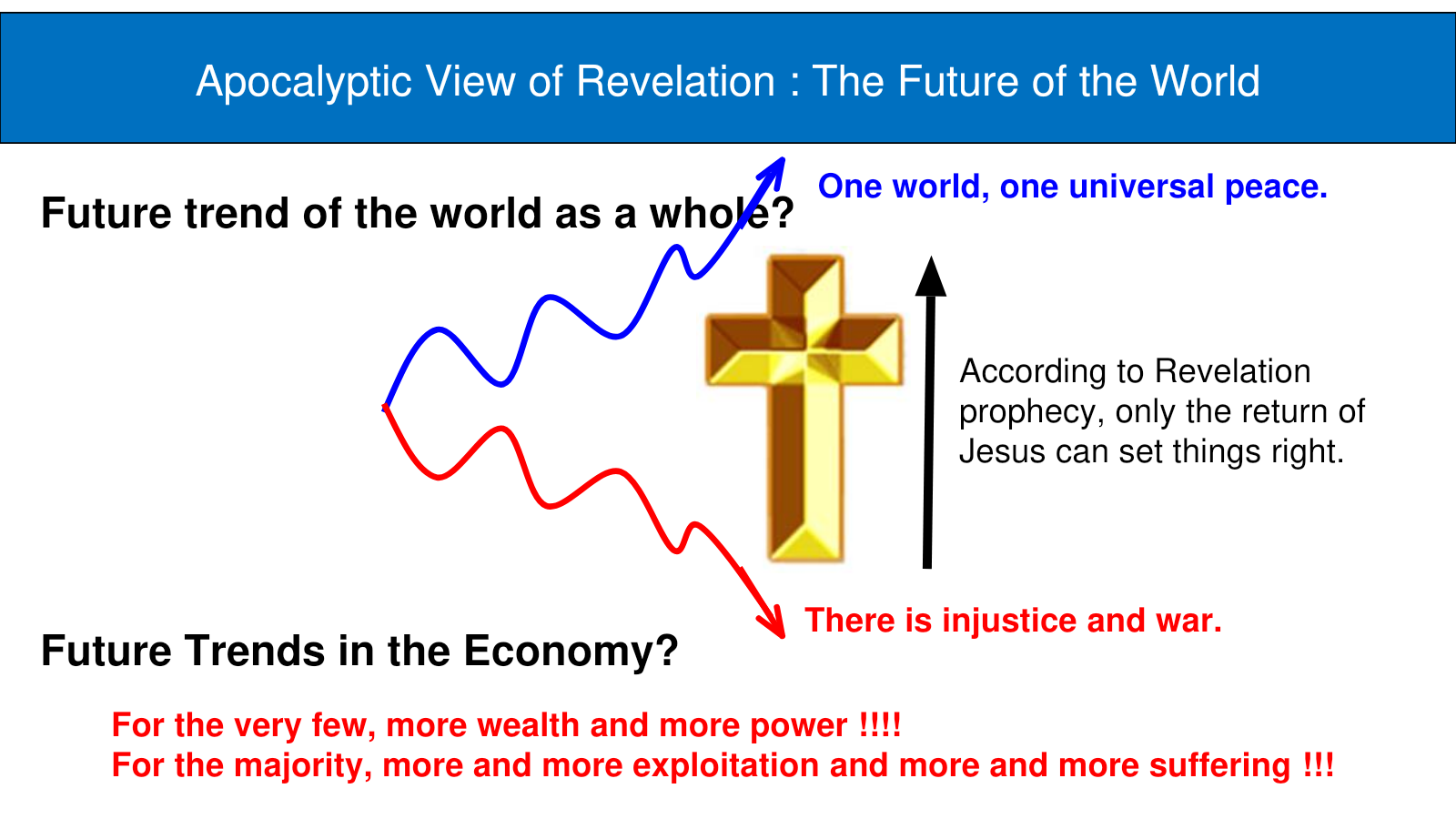
Historical Attachment 2 — Revelation’s eschatological frame for the future of the world.
2. Inflation, Supply, Demand, and Economic Cycles
Section titled “2. Inflation, Supply, Demand, and Economic Cycles”Inflation can arise from monetary expansion, supply disruption, energy and commodity shocks, changing expectations, market power, fiscal choices, and excessive demand. It should not be reduced to one mechanism. Likewise, recession can reflect both insufficient demand and the correction of overproduction, malinvestment, leverage, or speculative excess.
The ethical issue is distribution. Inflation harms households differently according to income, debt, assets, bargaining power, and access to necessities. Policy should distinguish productive capacity from financial claims and protect basic needs without pretending that price signals or public budgets are costless.
2.1 Three Dimensions of Inflation
Section titled “2.1 Three Dimensions of Inflation”The analysis separates three dimensions that interact in price formation:
-
Supply. Labor, land, equipment, raw materials, and energy shape productive capacity. When these inputs contract or become more costly, supply can fall and prices can rise. The policy question is how to build resilience without obtaining low prices through limitless resource extraction.
-
Demand. Demand concerns both willingness and ability to buy. The ethical question is which demands express real need and which are manufactured by advertising, anxiety, or status competition to absorb excessive production.
-
Money and credit. The monetary dimension concerns the pace at which media of exchange and credit claims expand. It raises questions about who has authority to create and allocate new purchasing power and who receives it first.
2.2 Examples of Supply Shock
Section titled “2.2 Examples of Supply Shock”COVID-19 and the Russia-Ukraine war illustrate how disruptions to labor, energy, logistics, and raw materials can raise production costs, reduce the supply of goods, and place upward pressure on prices.
2.3 Overproduction, Manufactured Demand, and the Business Cycle
Section titled “2.3 Overproduction, Manufactured Demand, and the Business Cycle”An economy can enter a self-reinforcing loop: production must keep expanding to preserve growth, and additional demand must then be manufactured to absorb the resulting output. When businesses, financial institutions, and governments all treat continuing expansion as the measure of success, the economy can move from prosperity to a peak, then through recession to a trough, before stimulus begins another expansion. Those with superior access to policy information, capital, and leverage may buy assets cheaply or shift losses during the turn, while ordinary households bear unemployment, inflation, mortgage stress, and declining purchasing power.
The business cycle is not intrinsically equivalent to exploitation. The concern is that highly unequal access to information, capital, leverage, and loss protection can turn cyclical volatility into a mechanism by which wealth moves from the many to the few.
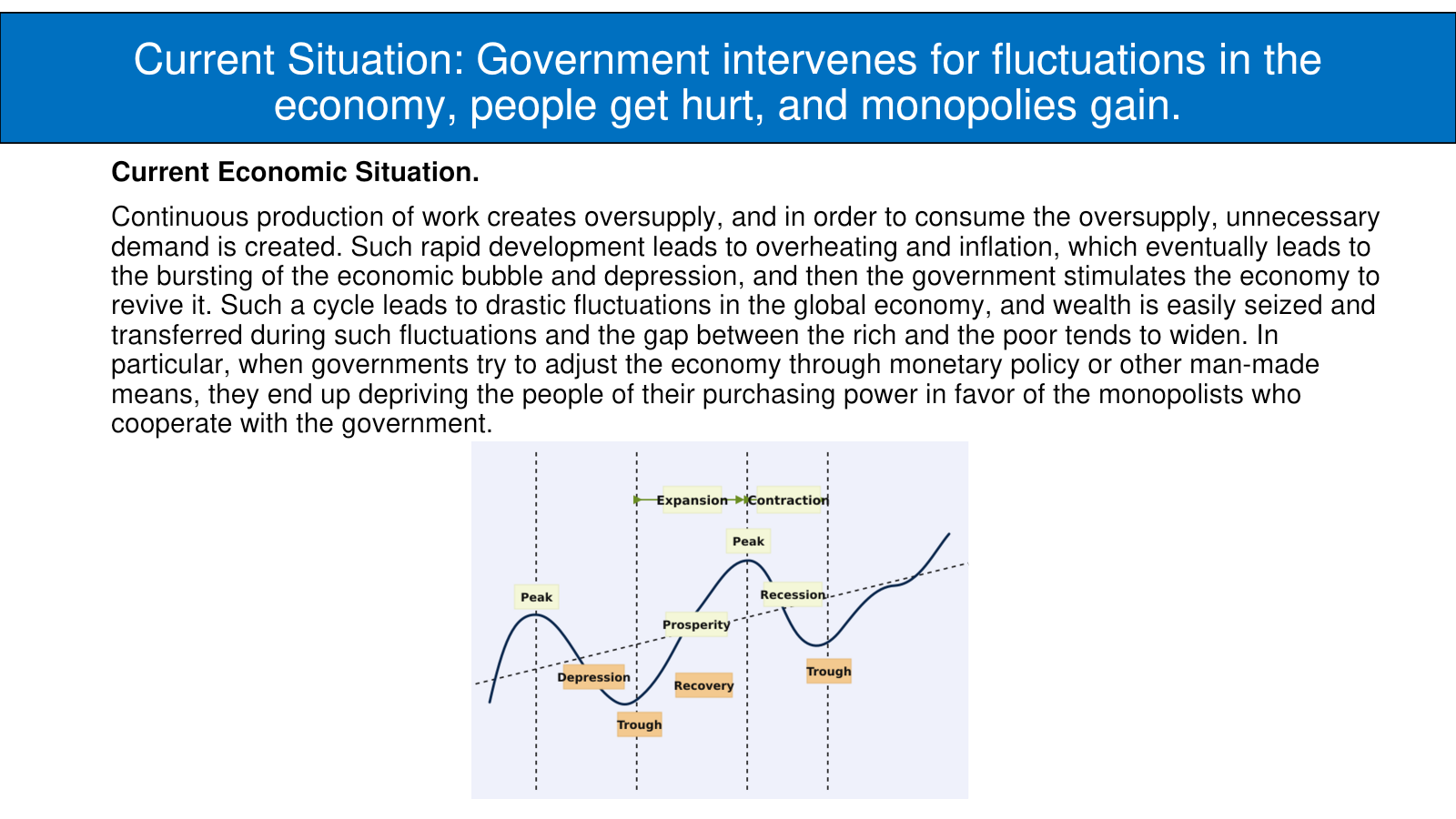
Historical Attachment 2, Figure 2-1 — Prosperity, peak, recession, trough, and recovery.
3. Sabbath Rhythms and Economic Pace
Section titled “3. Sabbath Rhythms and Economic Pace”Sabbath is more than private leisure. It limits masters, workers, households, animals, land, and production. It declares that provision does not depend on uninterrupted extraction. A modern application may include humane work schedules, maintenance cycles, soil recovery, ecological limits, family time, worship, and the refusal to treat GDP growth as the only measure of success.
Illustrative percentages used in earlier teaching materials were pedagogical, not commands directly stated in Scripture. Any modern calculation must be separated from the biblical text and tested against actual household, agricultural, and institutional conditions.
3.1 Rest as Worship, Trust, and an Economic Rhythm
Section titled “3.1 Rest as Worship, Trust, and an Economic Rhythm”The weekly Sabbath is first a time for worship, remembrance of creation, and trust in God (Exodus 20:8-11; Leviticus 23:3). The Sabbath year extends that rhythm to land, agriculture, and the community (Leviticus 25:1-7).
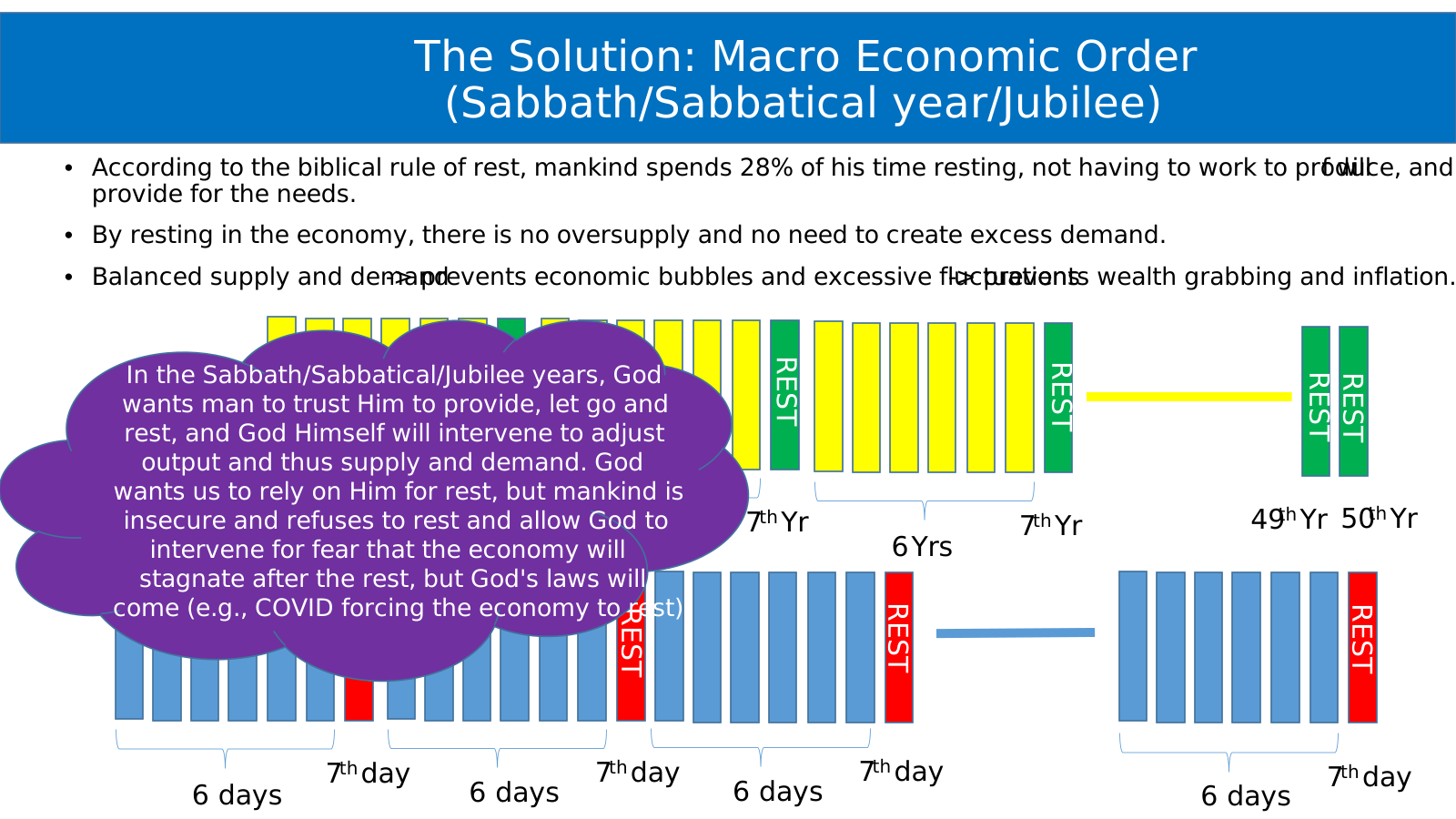
Historical Attachment 2, Figure 3-1 — Sabbath, sabbatical years, and Jubilee as a rhythmic teaching model.
3.2 The Illustrative “28 Percent Rest” Calculation
Section titled “3.2 The Illustrative “28 Percent Rest” Calculation”The original teaching materials superimpose the rhythm of every seventh day, every seventh year, and the forty-ninth and fiftieth years to produce an illustrative estimate that approximately 28 percent of time is assigned to rest. This is not a divinely mandated modern labor-share formula, nor is it equivalent to a contemporary statistical calculation of working time. Its teaching purpose is to show that biblical rest is not an occasional interruption but a recurring feature of the ordering of time, land, and institutions.
3.3 Rest and Provision
Section titled “3.3 Rest and Provision”Leviticus 25:18-22 links the land’s rest with confidence in God’s provision. Stopping cultivation does not mean abandonment by God. Human beings nevertheless resist stopping because insecurity makes rest feel like stagnation. If every form of security depends on uninterrupted production and expansion, the economy leaves no room for land, bodies, families, and relationships to recover.
3.4 The Pandemic as an Interpretation of “Forced Rest”
Section titled “3.4 The Pandemic as an Interpretation of “Forced Rest””The shutdowns and economic slowdown associated with COVID-19 may be read, cautiously, as an example of forced rest that also gave parts of the environment breathing space. The experience showed that a sudden reduction in human activity changes environmental conditions, supply chains, family life, and patterns of work, forcing society to reconsider whether nonstop growth is the only conceivable order. This is a theological interpretation of an event, not a scriptural declaration about the event’s meaning.
Further policy questions include crop rotation, limits on resource extraction, industrial off-seasons, recognition of care work, and ecological carrying capacity. A modern translation should not simply declare that every nation must suspend production according to the calendar of ancient Israel.
4. Mutual Aid, Mercy, and Community Responsibility
Section titled “4. Mutual Aid, Mercy, and Community Responsibility”Tithes, offerings, gleaning, hospitality, debt release, and care for Levites, immigrants, orphans, and widows reveal that economic life includes structured responsibility for neighbors. Mutual aid is not only one-directional charity. Each person may have needs in one season and gifts in another.
A healthy community distinguishes voluntary offerings, contractual dues, public taxes, emergency mutual aid, and additional generosity. Confusing them can create either coercive spirituality or free riding. Transparency, multiple-person oversight, privacy, and the right to appeal are essential.
4.1 From Personal Yield to Communal Provision
Section titled “4.1 From Personal Yield to Communal Provision”Deuteronomy 26:12 directs the third-year tithe to the Levite, the resident alien, the orphan, and the widow so that they may eat within the towns and be satisfied. Care for people in need is thus placed within the community’s ordered economic rhythm rather than left solely to sporadic private generosity.
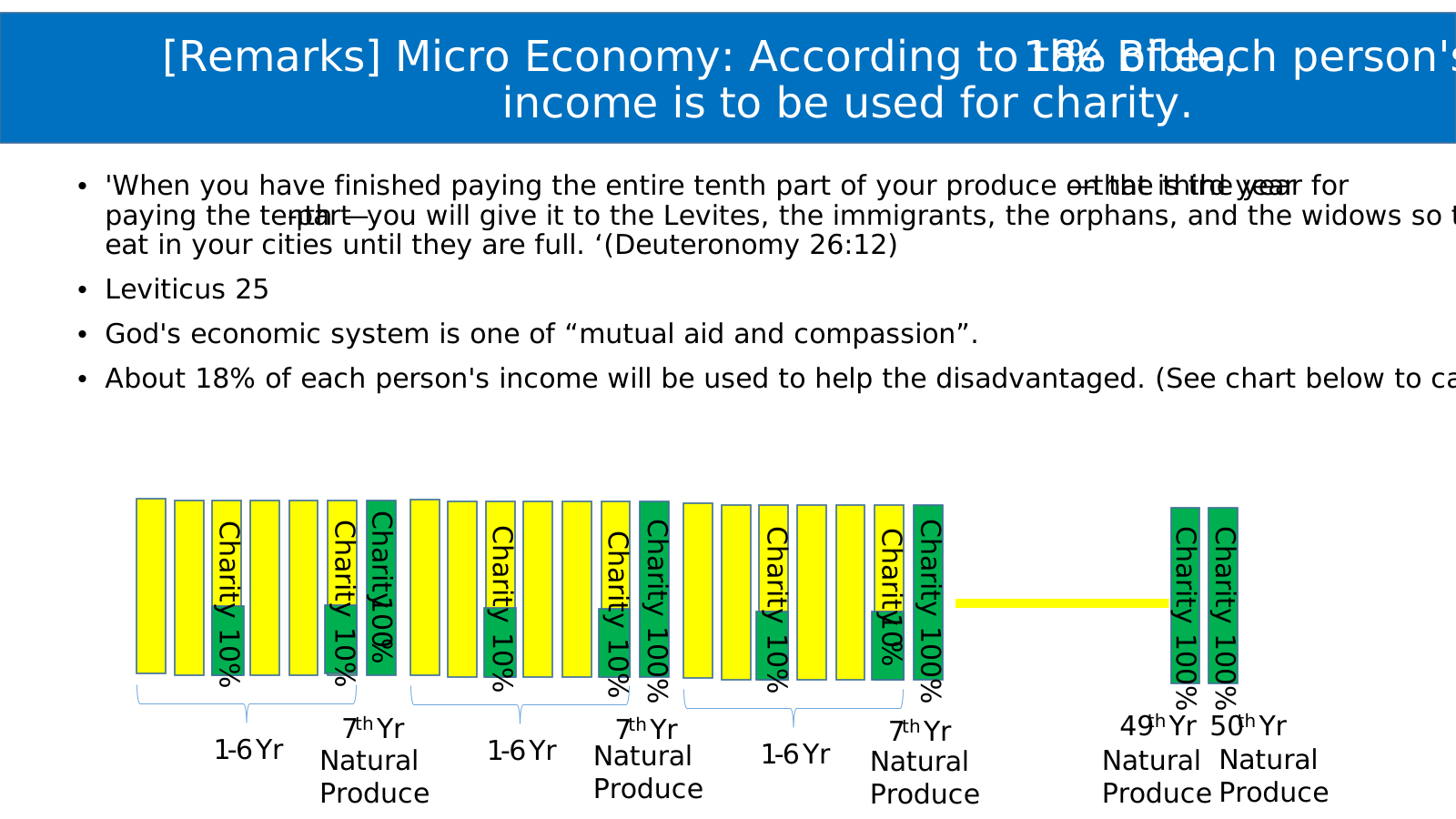
Historical Attachment 2, Figure 4-1 — Produce, setting apart, sharing, and community provision.
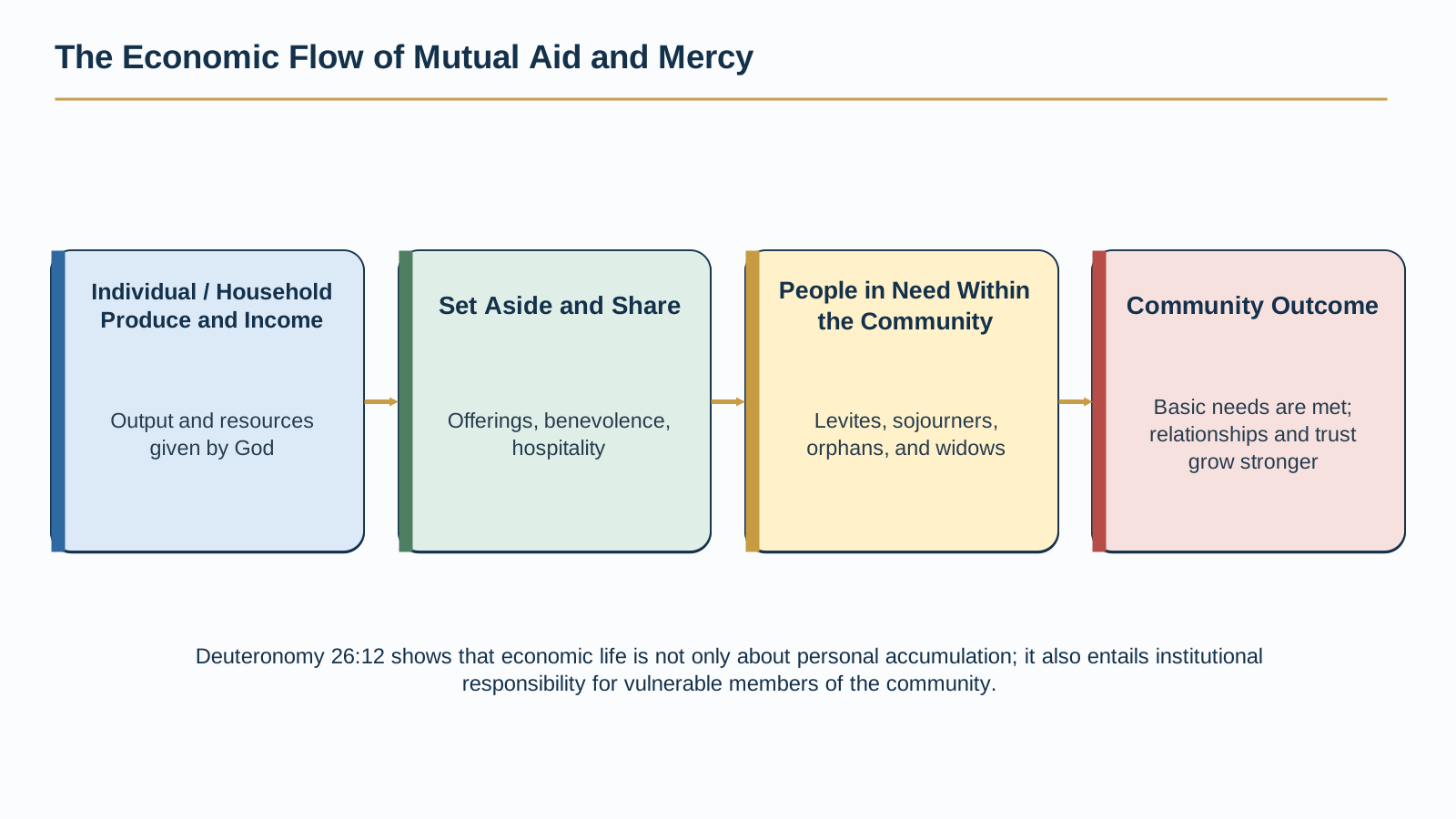
Historical Attachment 2 — A concise flow of mutual provision from households to shared responsibility.
4.2 The “18 Percent Mercy” and “10 + 18 = 28” Teaching Illustration
Section titled “4.2 The “18 Percent Mercy” and “10 + 18 = 28” Teaching Illustration”The teaching materials estimate that roughly 18 percent of personal income might be directed to mercy giving, drawing illustratively on patterns of tithing in different years and on natural yield. They then place a 10 percent offering to God together with 18 percent for mercy, yielding 28 percent, alongside the separate “28 percent rest” illustration. The spiritual point is that both worshipful giving and provision for others ultimately arise from God’s provision. Neither 18 percent nor the 10-plus-18 equation is a fixed tax, offering rate, or universal rule derivable from a single passage.
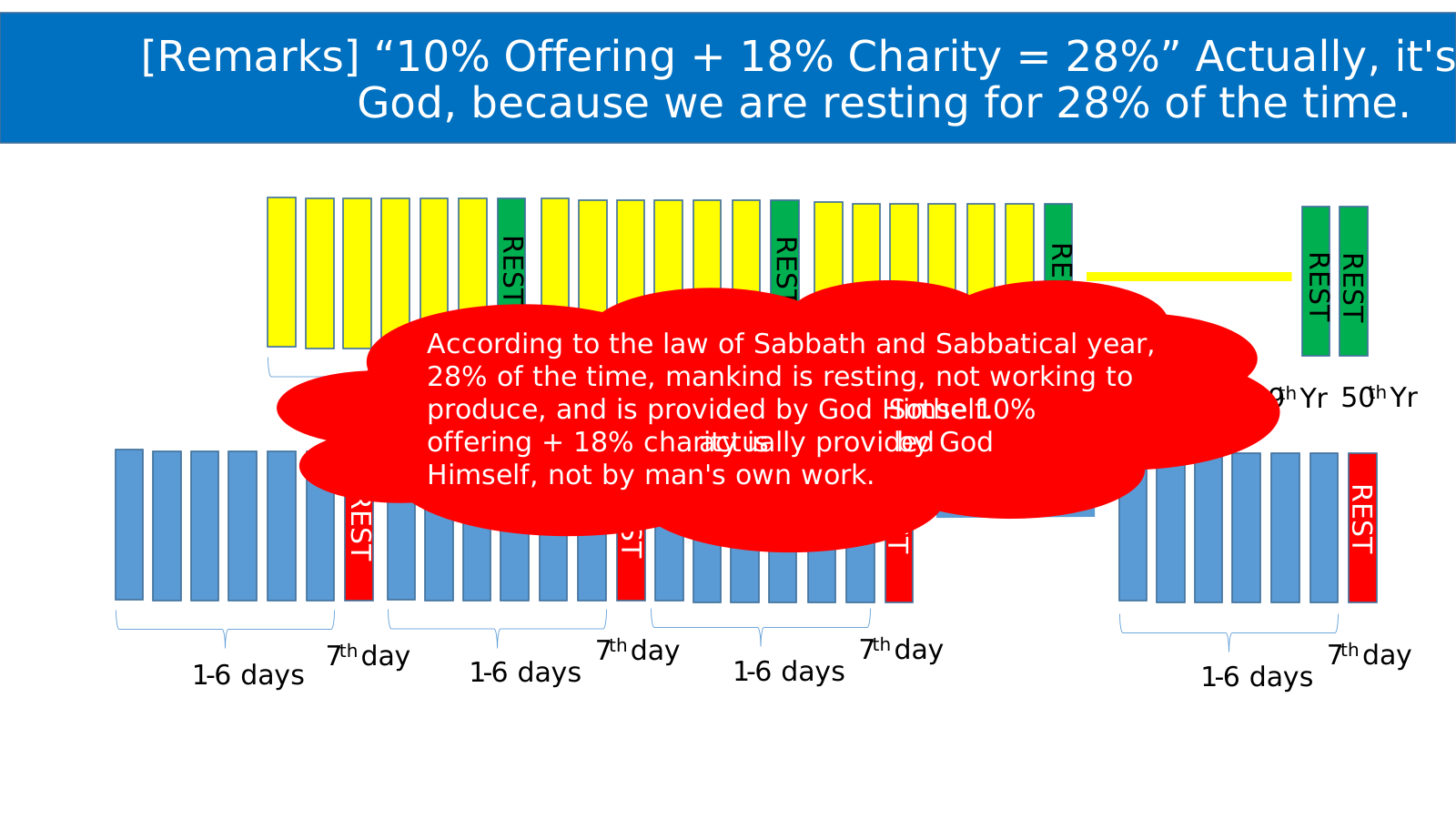
Historical Attachment 2 — 10 percent offering plus 18 percent mercy as a teaching illustration.
4.3 Mutual Aid as Reciprocity and Restoration
Section titled “4.3 Mutual Aid as Reciprocity and Restoration”The “fair balance” of 2 Corinthians 8:13-15 means that present abundance supplies present need and that circumstances may later reverse. A system of aid should therefore avoid permanently labeling people by a season of need.
Practical expressions include:
-
meeting immediate needs through food banks, community meals, school nutrition, and emergency living funds;
-
restoring capacity through vocational training, job matching, shared tools and equipment, and social enterprise;
-
preventing permanent dependency through rotating aid, skill exchange, mutual insurance, and cooperatives; and
-
reporting clearly the sources of resources, standards of distribution, beneficiaries, and results.
5. Debt, Interest, Money Creation, and Financial Bubbles
Section titled “5. Debt, Interest, Money Creation, and Financial Bubbles”Compound interest is mathematically powerful. It can reward patient investment, but when applied to survival crises, impossible debts, or asymmetric contracts, it can make claims grow faster than the real capacity to produce. Modern bank money creation and shadow finance can expand purchasing power and liquidity, yet also separate financial valuation from underlying goods, services, and repayment capacity.
The ethical question is not whether every loan is sinful. It is whether fixed claims ignore risk, whether lenders are protected while borrowers absorb all shocks, whether basic needs are monetized at moments of desperation, and whether public rescue socializes losses after private gains have been extracted.
5.1 Compound Growth: A Numerical and Ethical Illustration
Section titled “5.1 Compound Growth: A Numerical and Ethical Illustration”At an annual compound rate of 7.5 percent, principal of 100 grows to approximately 206 after ten years and approximately 425 after twenty years: 100 x (1.075)^10 ≈ 206 and 100 x (1.075)^20 ≈ 425. This scale gives mathematical content to the ethical concern already described. Proverbs 22:7 captures the resulting relation of power: “the borrower is servant to the lender.” Deuteronomy 23:19-20 and 15:1-11 belong to the wider scriptural context for interest, debt, mercy, and release.
The familiar claim that Einstein called compound interest the world’s greatest force should not bear argumentative weight. The case should rest on the mathematics and institutional effects, not an uncertain celebrity attribution.
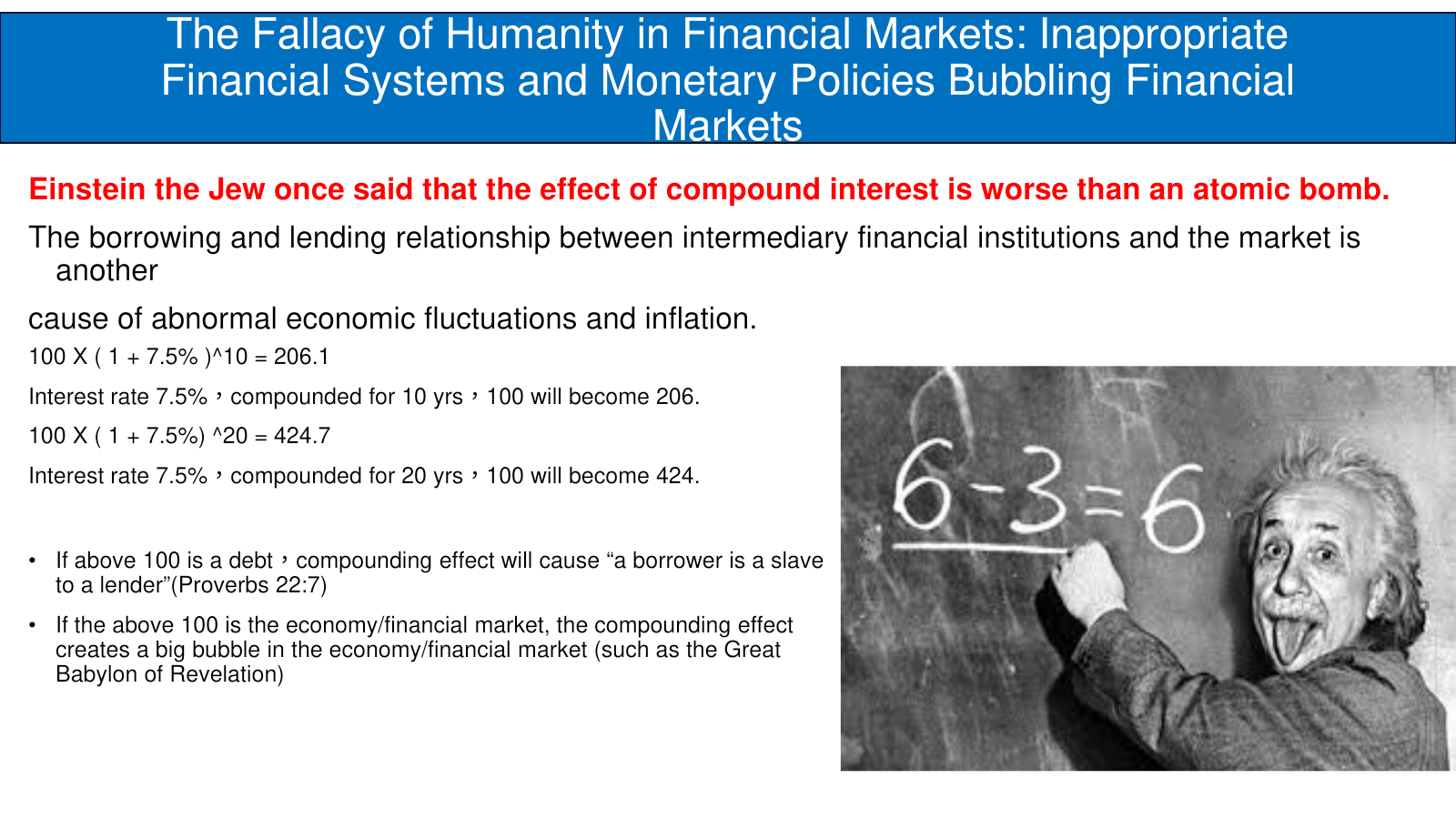
Historical Attachment 2 — Compound interest and the ethics of financial-market expansion.
5.2 The Traditional Money-Multiplier Teaching Model
Section titled “5.2 The Traditional Money-Multiplier Teaching Model”With a 10 percent reserve ratio, an initial deposit of 100 is used to illustrate successive layers of deposit and lending: a bank retains 10 and lends 90; the next layer retains 9 and lends 81; subsequent displayed layers are 72.9 and 65.61. The first five amounts shown in the teaching diagram sum to 100 + 90 + 81 + 72.9 + 65.61 = 409.51. The example is meant to show how one base amount can support multiple layers of deposits, loans, and claims.
Modern money creation is more complex than this fractional-reserve classroom model. Central-bank reserves, capital-adequacy rules, creditworthy demand, bank balance sheets, and regulation all matter. The diagram must therefore not be read as proof that forgiving all debt would mechanically return the money supply to 100.
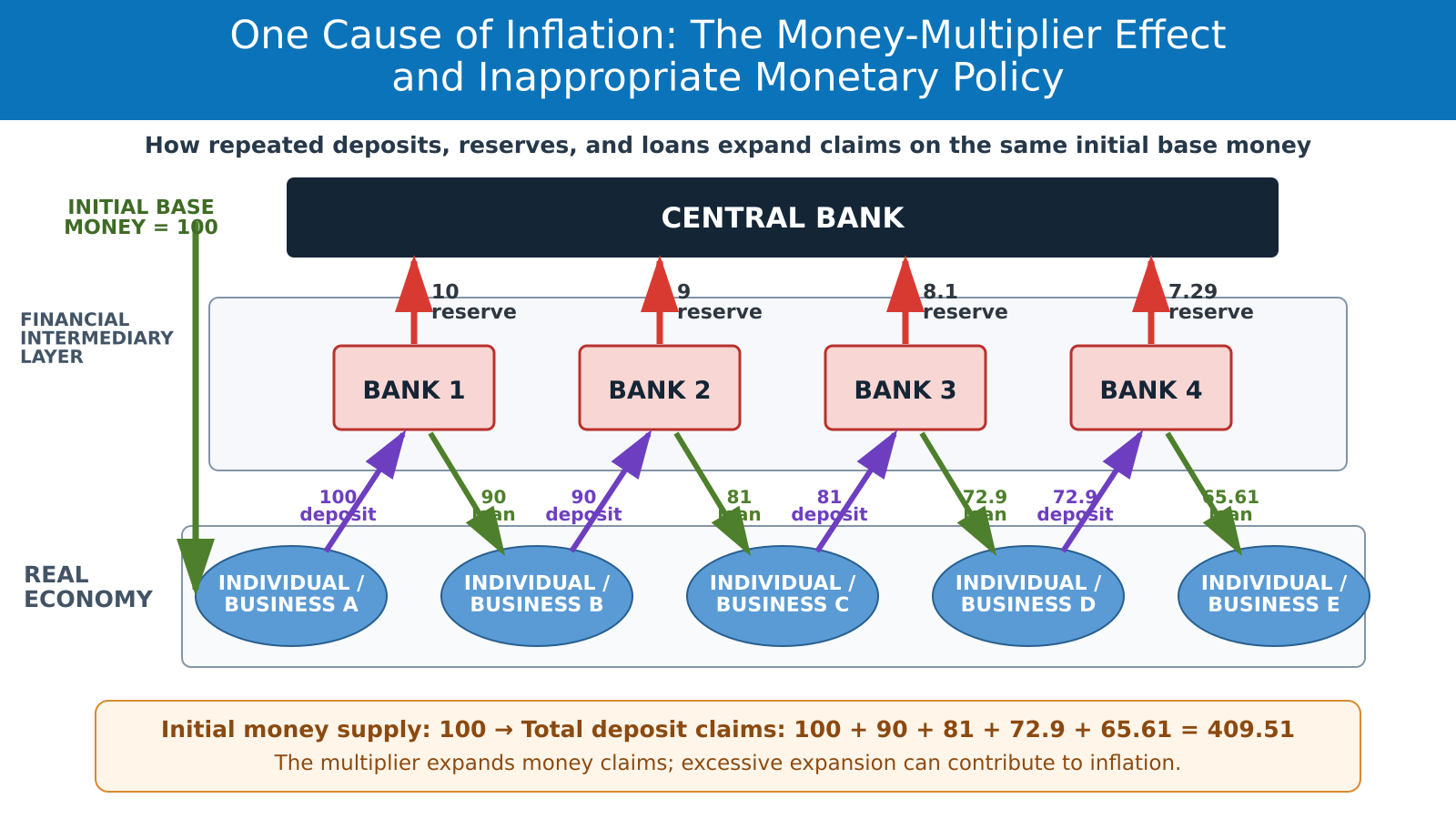
Historical Attachment 2, Figure 5-1 — Simplified traditional money-multiplier model (English translation).
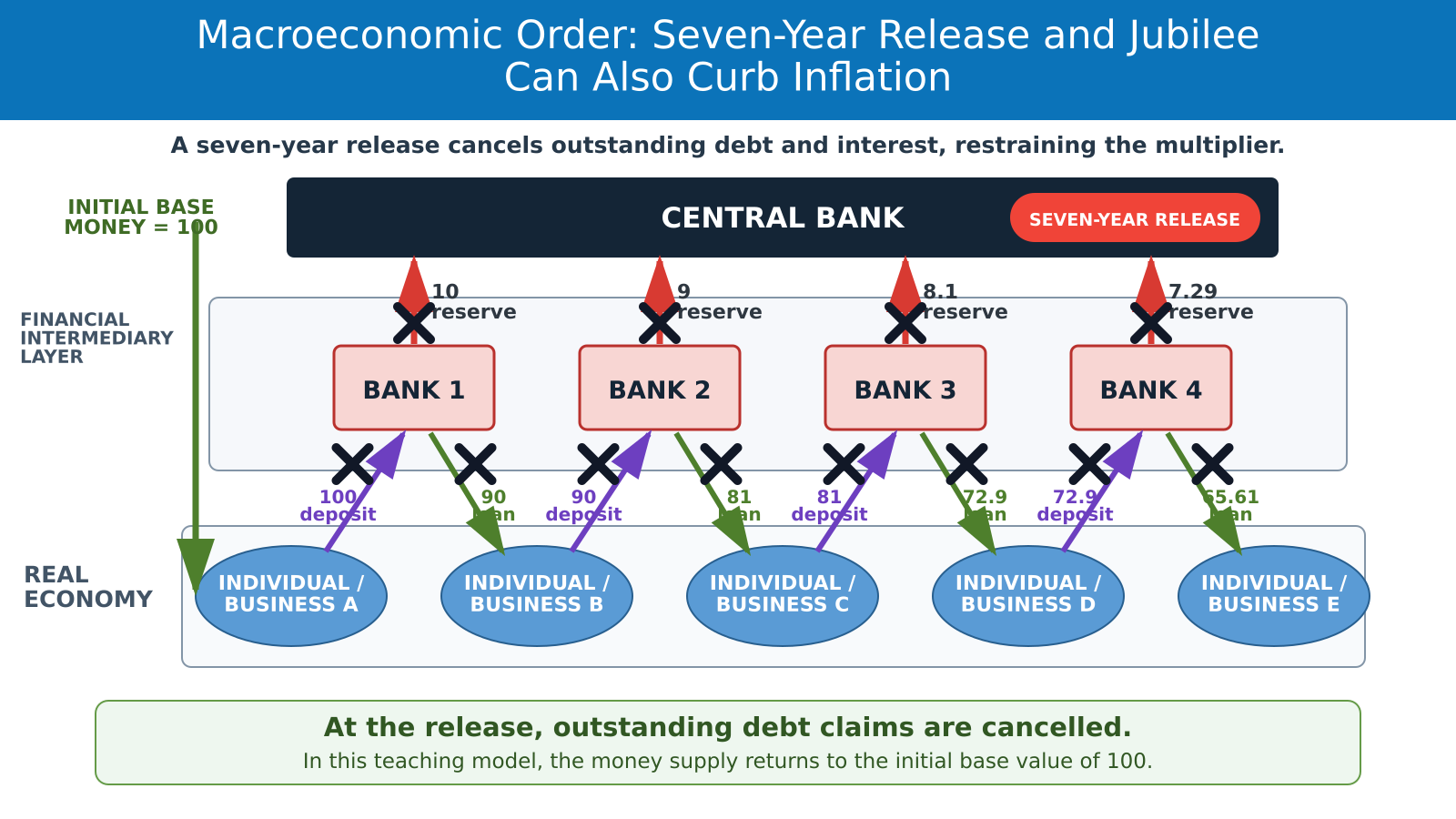
Historical Attachment 2 — Seven-year release applied to the teaching multiplier model (English translation).
5.3 Shadow Banking and Property Leverage
Section titled “5.3 Shadow Banking and Property Leverage”A stylized flow among local governments, developers, finance companies, homebuyers, and mortgage lenders shows how shadow finance and real-estate leverage can simultaneously generate measured GDP, developer profit, financial spreads, and household debt. So long as property prices rise, each participant may appear to gain. When the cycle reverses, heavily mortgaged households and the financial system often bear the combined risk of falling asset values and fixed repayment claims.
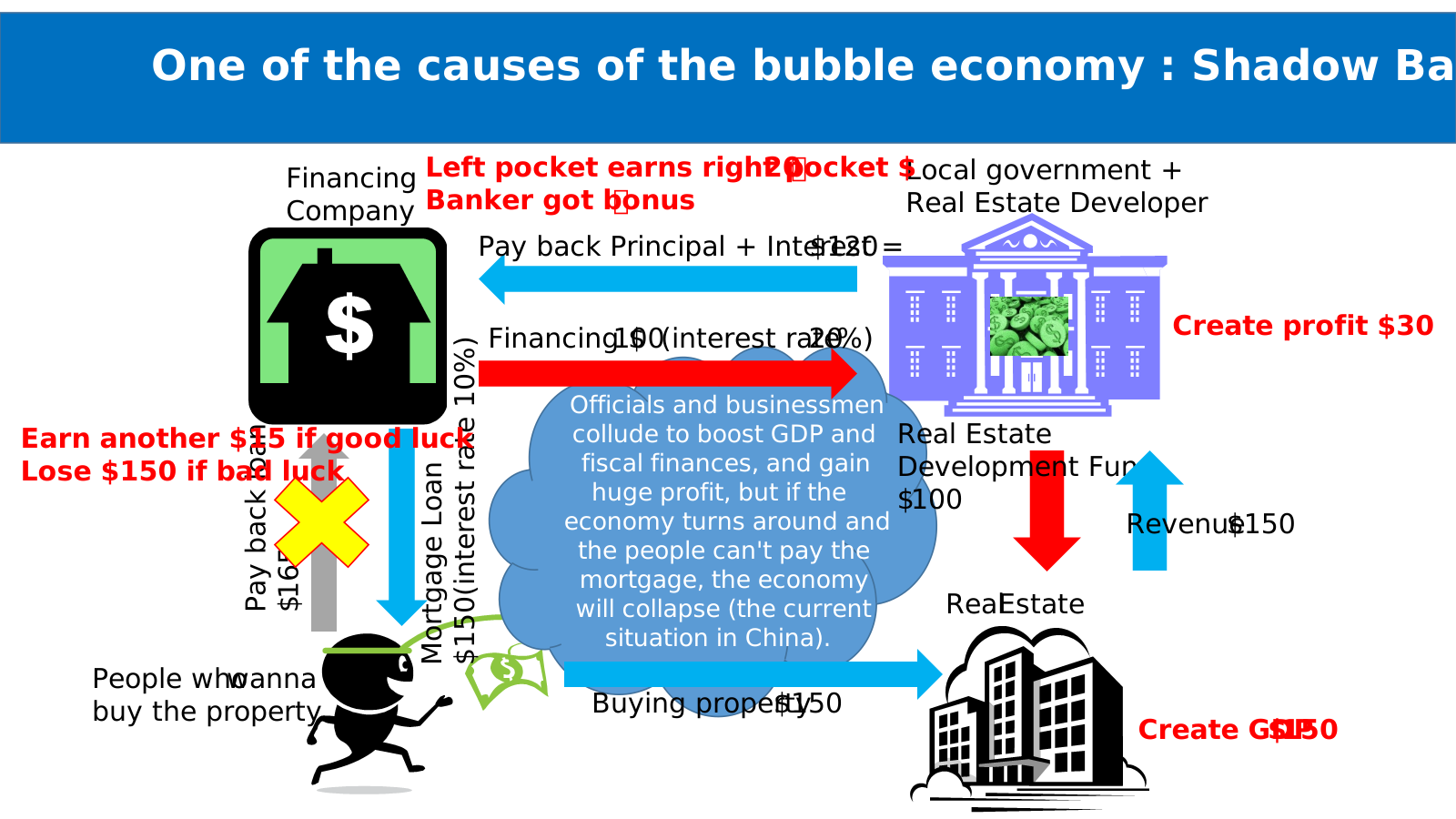
Historical Attachment 2, Figure 5-2 — Shadow banking, real-estate development, and household mortgages.
5.4 The Separation of Real Output and Financial Value
Section titled “5.4 The Separation of Real Output and Financial Value”Real output and the market value of financial assets and debts can follow increasingly separate paths. Physical production remains constrained by land, energy, labor, raw materials, and ecological conditions, while financial claims can grow through interest, refinancing, and leverage. When promises denominated in money outrun the real goods and services available to honor them, vulnerability to bubbles and collapse rises.
Revelation 17-18 may be used to reflect on systems marked by luxury, transnational control, deception, and sudden collapse, including the dynamics of financial bubbles. It does not warrant the simple declaration that one contemporary financial market is Babylon.
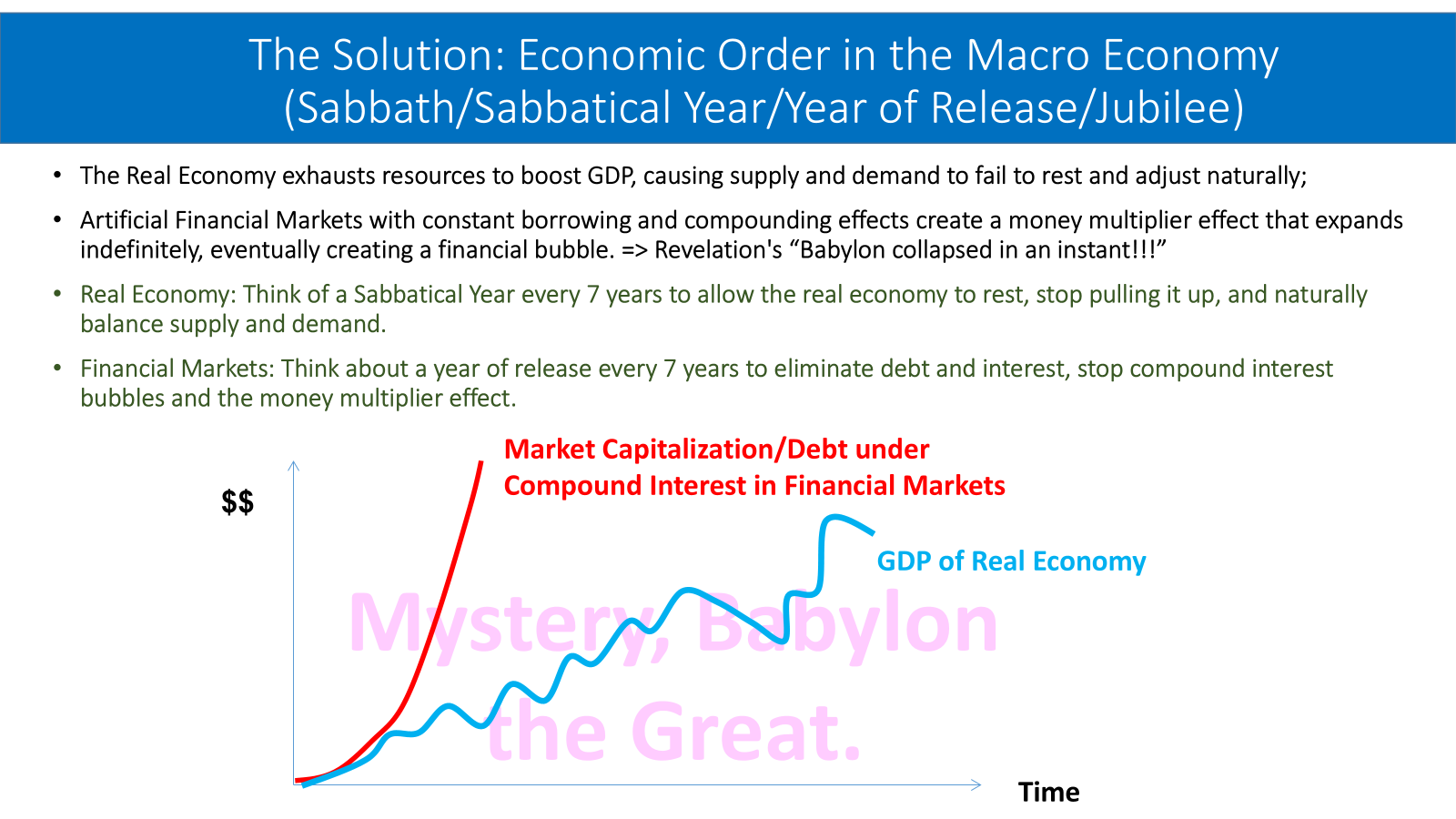
Historical Attachment 2 — Real output and financial claims under periodic release.
6. Release, Redemption, Jubilee, and the Four-R Framework
Section titled “6. Release, Redemption, Jubilee, and the Four-R Framework”Release prevents debt from becoming permanent bondage. Redeem preserves a path to recover land, livelihood, liberty, and the foundations of life. Reset prevents control and failure from hardening across generations. Rest interrupts endless production and domination. Together, the four movements offer a diagnostic framework for modern contracts and institutions.
Implementation is complex. A debt release affects lenders, depositors, pensions, public budgets, and future access to credit. Redemption rules affect owners, residents, maintenance, and investment. Reset can become arbitrary confiscation if not governed by transparent terms. Biblical direction must therefore be translated through careful risk allocation and due process.
6.1 Seven-Year Release
Section titled “6.1 Seven-Year Release”Deuteronomy 15:1-11 establishes a release every seven years. As a recurring smaller adjustment, release prevents debt and interest from accumulating without limit and keeps a temporary failure from becoming permanent subordination. Modern institutional analogies may include consumer-debt restructuring, a genuine fresh start after bankruptcy, limits on usury, no- or low-interest arrangements for vulnerable borrowers, and restrictions on passing debt claims from one generation to the next. These are translations of a covenantal principle into present institutions, not the text’s own modern policy code.
6.2 Jubilee, Land Return, and a New Beginning
Section titled “6.2 Jubilee, Land Return, and a New Beginning”Leviticus 25:8-24 restores family land transferred through poverty to its place in the inherited order. The teaching model follows two people, A and B, through a fifty-year cycle: ability, choice, work, and circumstance may produce real differences within the cycle, but Jubilee prevents those differences from hardening into a permanent class stripped of productive foundations. Repeated cycles are not merely repeated restarts; they are occasions to learn more mature stewardship and mutual responsibility from the preceding period.
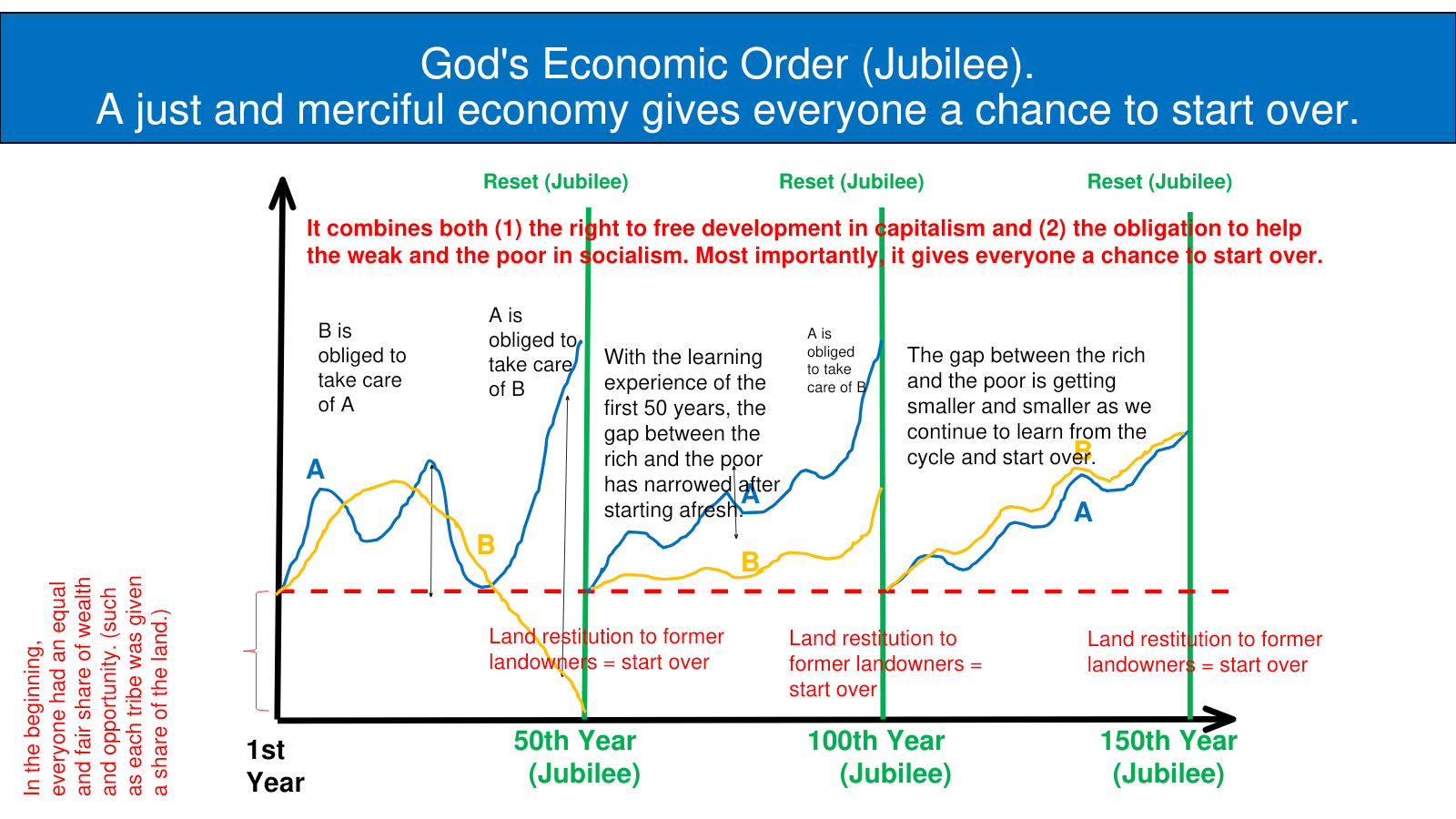
Historical Attachment 2, Figure 6-1 — Jubilee, renewed opportunity, and reduced intergenerational hardening.
6.3 The Four-R Heuristic
Section titled “6.3 The Four-R Heuristic”Rest, Release, Redeem, and Reset are not offered as the only possible translation of the biblical terms. They are a teaching and policy heuristic that draws together the Sabbath year, the year of release, redemption, and Jubilee for institutional analysis.
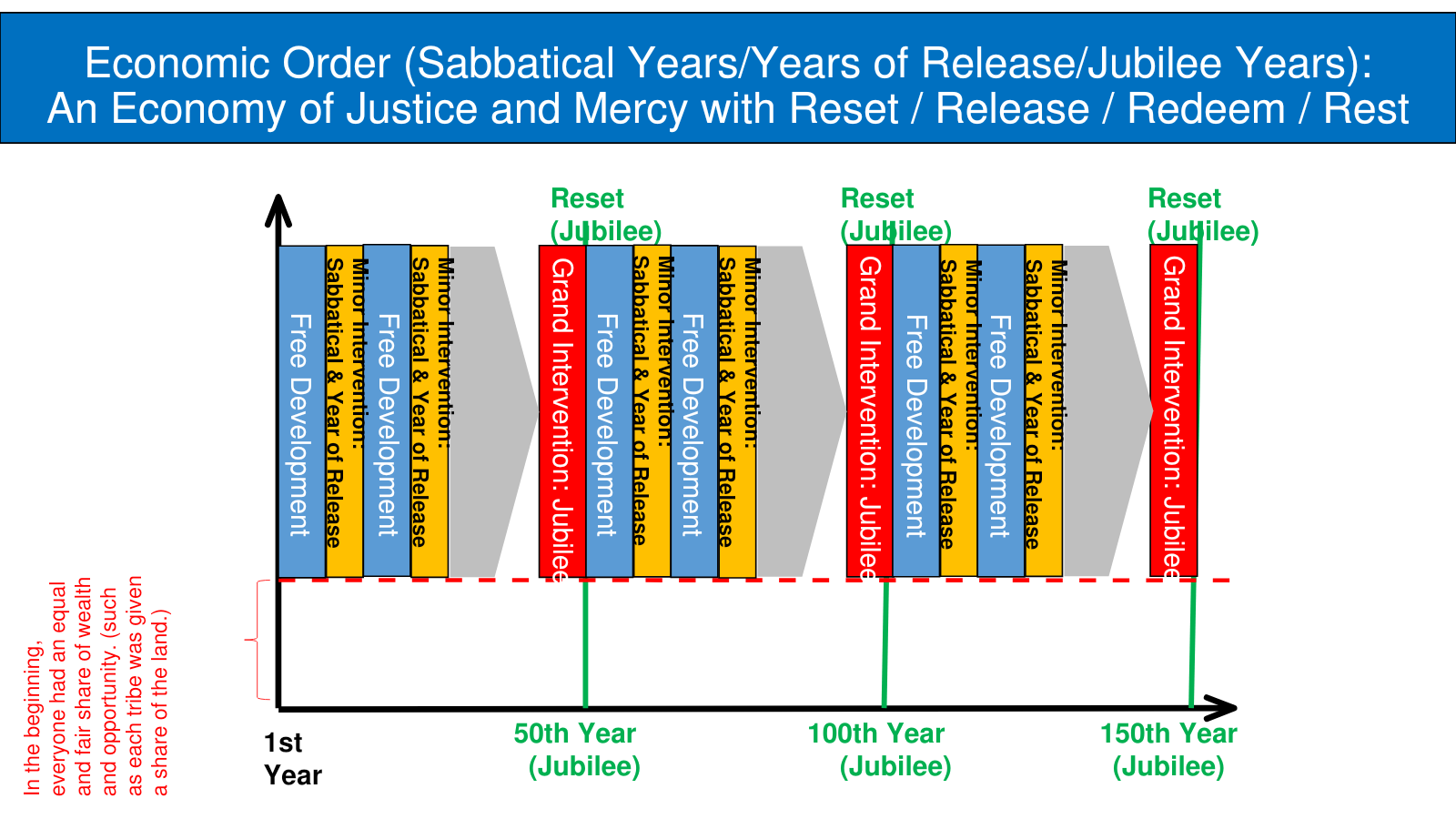
Historical Attachment 2, Figure 6-2 — Rest, Release, Redeem, and Reset.
6.4 Freedom, Provision for the Weak, and Institutional Design
Section titled “6.4 Freedom, Provision for the Weak, and Institutional Design”Jubilee can be described as joining the freedom to develop often associated with capitalism to the duty to protect the weak often associated with socialism. The point is not to classify biblical law within a modern left-right spectrum. It is that people need room to work, choose, create, and enjoy the fruit of their labor, while the community remains responsible to prevent vulnerable people from permanently losing land, liberty, and the foundations of survival.
The Four-R framework can be used to test modern institutions and to imagine how rest, mercy, fresh starts, and freedom from permanent domination might be embodied under millennial governance. The applicable cycle, covered persons and assets, financing, due process, and legal form would still require deliberate design; Scripture does not supply those modern specifications automatically.
7. Land, Housing, and Rights of Redemption
Section titled “7. Land, Housing, and Rights of Redemption”Land and buildings are related but not identical. Leviticus 25 distinguishes family land, houses in walled cities, and the rights of redemption. The enduring insight is not that every modern property should follow one ancient deadline, but that life foundations should not be permanently lost and that value should reflect the duration of rights actually transferred.
The integrated housing model develops this insight through finite-term land rights, stable occupancy, a purchase option, vesting resident equity, genuine exit, formula pricing, and fair repurchase. It seeks a third path between rent without accumulation and permanent ownership financed by decades of irreversible debt.
7.1 Distinct Treatment of Land and Houses
Section titled “7.1 Distinct Treatment of Land and Houses”Leviticus 25 does not reset every kind of asset in the same way. It distinguishes inherited family land, the towns and property of the Levites, and houses in walled cities. Jubilee reset chiefly concerns family land, liberty, and the foundations of production; it does not mean that all cash, equipment, knowledge, and houses in walled cities are reset to zero. Redemption and return are tailored to the relation of an asset to land, productive capacity, habitation, and the character of the settlement.
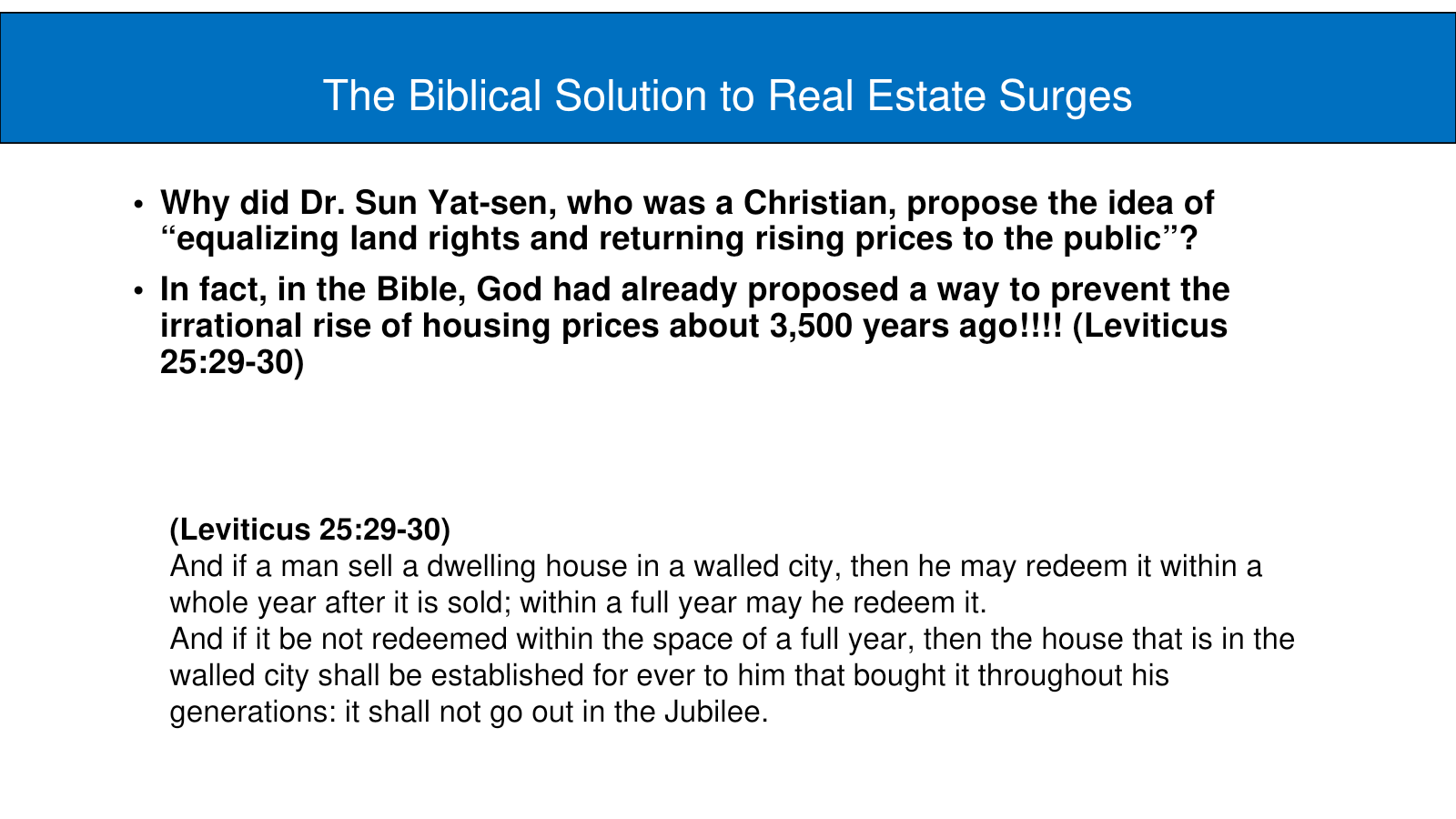
Historical Attachment 2 — The biblical right of redemption and real-estate ethics.
7.2 The One-Year Right to Redeem a House in a Walled City
Section titled “7.2 The One-Year Right to Redeem a House in a Walled City”Under Leviticus 25:29-30, the seller of a house in a walled city has one year in which to redeem it. If it is not redeemed during that year, it passes permanently to the purchaser and does not return at Jubilee. As a teaching analogy, such a redemption right could discourage some short-term speculation because a buyer could not treat appreciation during the redemption period as an assured gain if the original seller retained a right to recover the home.
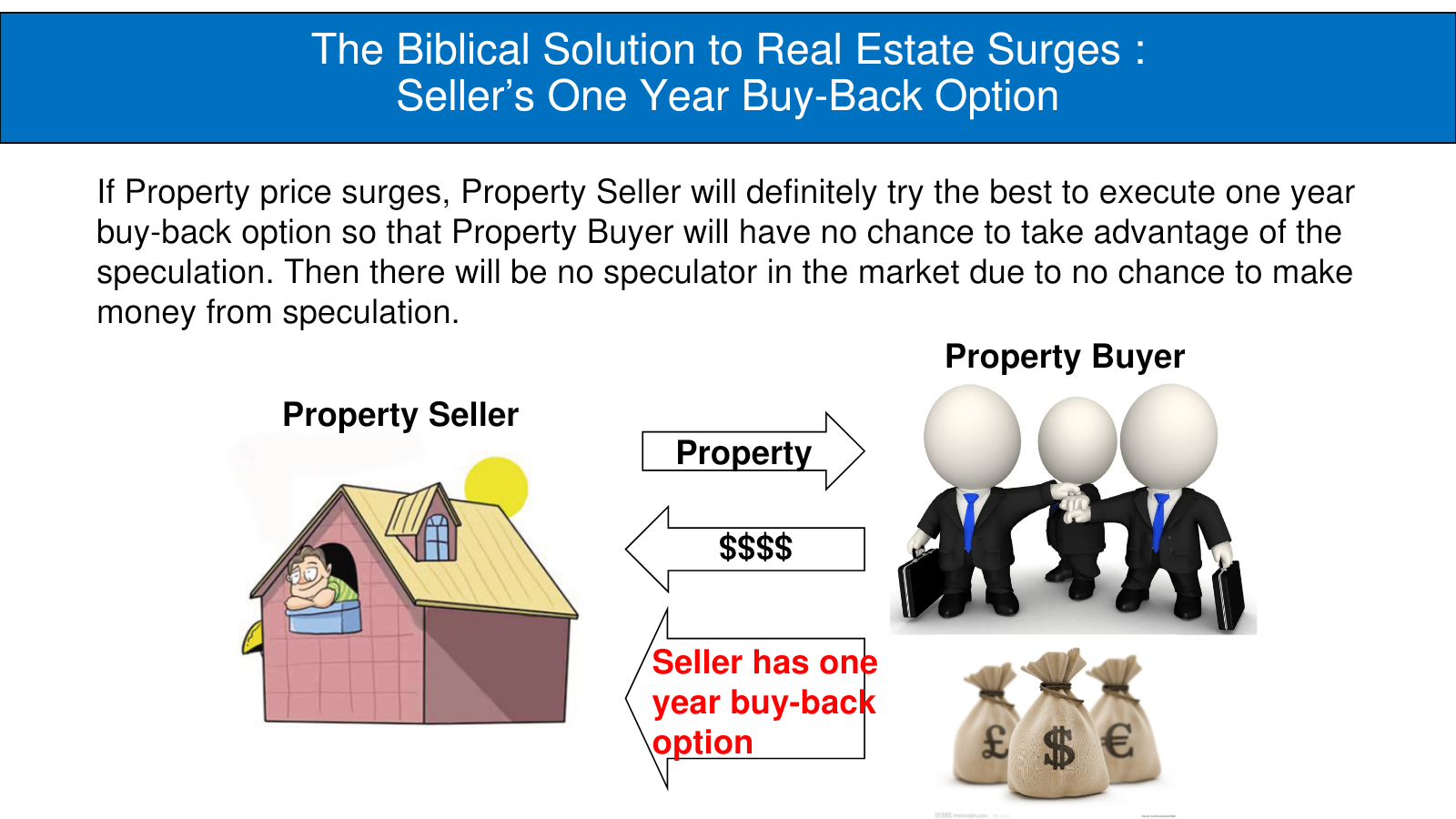
Historical Attachment 2, Figure 7-1 — A seller’s one-year repurchase right.
7.3 Necessary Distinctions in Modern Housing Policy
Section titled “7.3 Necessary Distinctions in Modern Housing Policy”A modern redemption regime would have to address mortgage priority, renovation and maintenance costs, tenancy rights, taxation, zoning, co-ownership, formula pricing, and access to reliable information. A one-year repurchase right alone cannot be assumed to eliminate speculation and could create new pricing and contracting risks. Its most defensible policy inspiration is the preservation of a path by which a household may recover a foundation for life, not the claim that one ancient deadline is already a complete contemporary housing policy.
7.4 Ultimate Ownership and Delegated Property Rights
Section titled “7.4 Ultimate Ownership and Delegated Property Rights”Leviticus 25:23 grounds the rule against permanent alienation in God’s declaration that the land is His. This creates two levels of ownership: God retains ultimate ownership, while human beings possess real but bounded rights of use, benefit, management, and inheritance under Him. Such stewardship opposes arbitrary seizure, but it also denies that land is an absolute power that may be accumulated without limit and used to exclude others permanently.
8. Household Economic Responses
Section titled “8. Household Economic Responses”Money is a tool, not the only source of purchasing power. Skills, knowledge, health, relationships, productive equipment, time, and trust can sustain households when currency loses value. The biblical talent can be used pedagogically to distinguish entrusted capacity from money alone, provided the original historical meaning is not ignored.
Households can cultivate income by developing gifts, producing genuine value, cooperating, and diversifying. They can steward expenditure through simplicity, maintenance, repair, reduced waste, direct relationships with producers, shared tools, and generosity. Living ‘as though money were not ultimate’ does not require abolishing exchange; it means refusing to let price determine every relationship.
8.1 Purchasing Power Beyond Cash
Section titled “8.1 Purchasing Power Beyond Cash”Because prices, interest rates, and policy alter the purchasing power of cash, resilience should also be measured by a household’s capacity to create genuine value, meet needs, and cooperate when money or payment systems fail.
8.2 “Talent” as Weight, Money, and Entrusted Capacity
Section titled “8.2 “Talent” as Weight, Money, and Entrusted Capacity”In Matthew 25:14-30, the Greek *talanton* denotes a weight or large monetary unit; the later English word *talent* gradually acquired the sense of an ability or gift. That semantic development supports the pedagogical application to entrusted resources, knowledge, skills, and opportunities while preserving the term’s historical meaning.
8.3 Three Directions on the Income Side
Section titled “8.3 Three Directions on the Income Side”-
Talent: develop distinctive gifts, professional competence, and problem-solving ability so that income is grounded in genuine value.
-
Property: obtain or steward assets that directly support life and production - tools, equipment, cultivable land, or energy-saving installations, for example. Their use matters more than speculative appreciation.
-
Giver: become a person who helps others, shares resources, and builds trust, so that economic relationships are not reduced to purchase and sale.
8.4 Five Directions on the Expenditure Side
Section titled “8.4 Five Directions on the Expenditure Side”-
Recycle: reuse, repair, remanufacture, and turn waste back into a resource.
-
Barter: exchange goods or skills where appropriate; churches and local communities can provide trusted matching and accountability.
-
Thrifty: practice frugality without treating every enjoyment as wrong, refusing waste, display, and anxiety-driven consumption.
-
Direct Purchase: use digital tools to connect producers and users and shorten supply chains while still paying producers, logistics providers, and service workers fairly.
-
Giver: return surplus goods, time, and skills to use by sharing them with others.
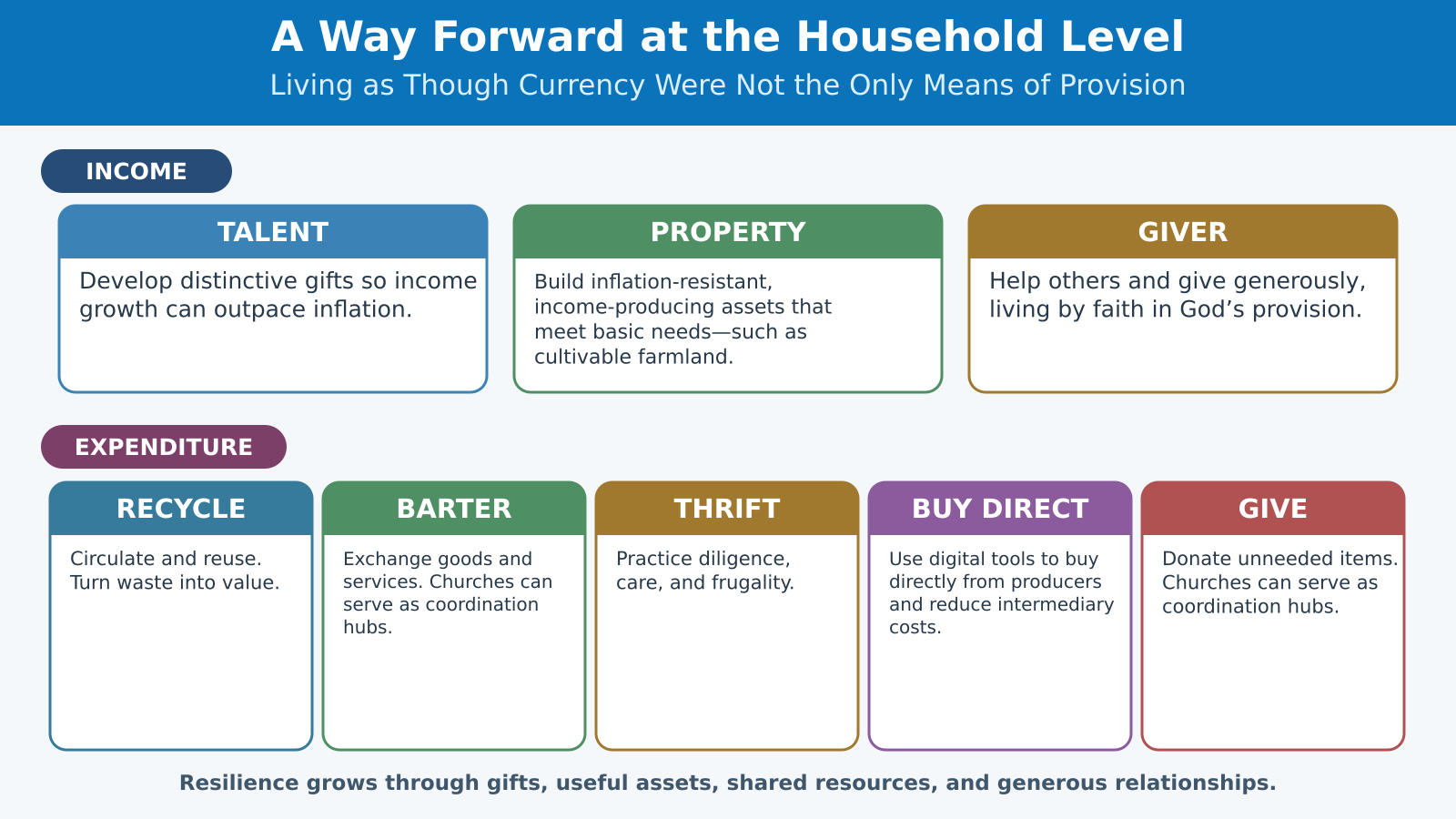
Historical Attachment 2 — Income, spending, sharing, and household resilience (English translation).
8.5 Living “As Though Money Were Not Ultimate”
Section titled “8.5 Living “As Though Money Were Not Ultimate””Households may still need prices, payments, and saving. The additional aim is to cultivate skills, tools, productive land, trusted relationships, exchange networks, and a culture of sharing so that a shortage of currency does not bring all household and community life to a halt.
9. Babylon, Concentrated Control, and Eschatological Economic Risk
Section titled “9. Babylon, Concentrated Control, and Eschatological Economic Risk”Revelation’s Babylon symbolizes a system of wealth, luxury, trade, power, deception, and violence under judgment. Modern readers should resist identifying one company, country, currency, or technology as the complete fulfillment without warrant. The more useful question is whether a system centralizes control of identity, payment, food, energy, data, and political power while removing meaningful exit and appeal.
Decentralization is not automatically righteous; local systems can also oppress. The goal is polycentric accountability: multiple centers, transparent authority, local backup, common standards of justice, and the ability to correct or replace institutions that fail.
9.1 Disasters and the Material Conditions of Life
Section titled “9.1 Disasters and the Material Conditions of Life”The wars, famines, earthquakes, fires, polluted waters, and disturbances in the heavens depicted in Matthew 24:6-12, Revelation 6 and 8, and Joel 2 are not merely abstract religious events. They affect food, energy, transport, water, labor, prices, and finance. Christian preparation should therefore move beyond speculative event-matching to mutual care, basic provision, local resilience, and a refusal to profit from fear.
9.2 Babylon and Its Political Alliance
Section titled “9.2 Babylon and Its Political Alliance”Babylon’s reach extends over “peoples and multitudes and nations and languages” (Revelation 17-18), yet the political allies that sustain it eventually turn against it. The warning is that political and economic centers which appear mutually reinforcing may ultimately destroy one another.
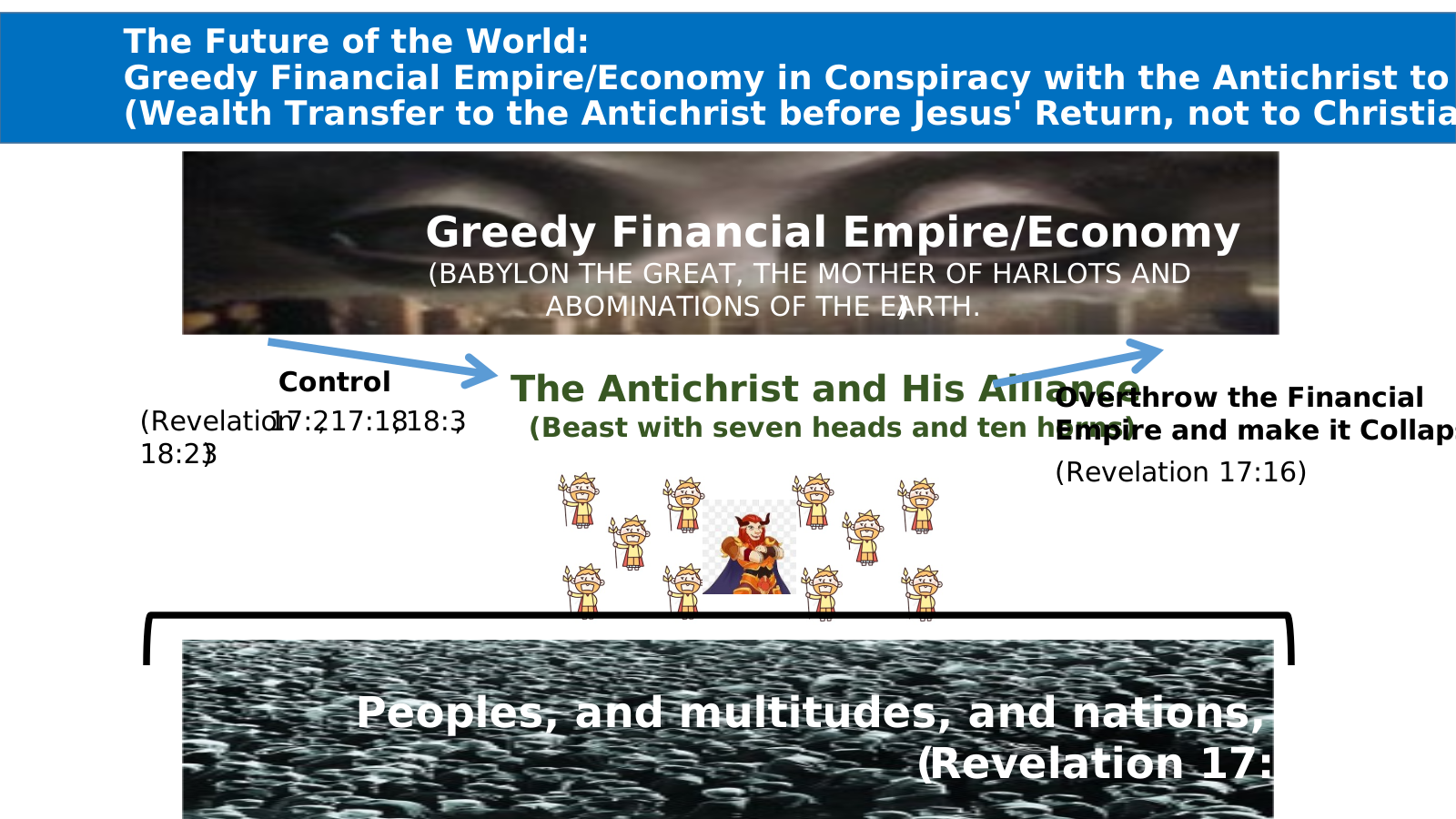
Historical Attachment 2, Figure 9-1 — Babylon, political alliance, and control of nations.
9.3 The Two Sides of Digital Concentration
Section titled “9.3 The Two Sides of Digital Concentration”Pandemic disruption and international conflict have simultaneously encouraged the regionalization of physical supply chains and accelerated the globalization of the digital economy. Digital platforms can reduce transaction costs and extend remote education and health care. They can also create a “control one point, affect the whole” vulnerability when data, payment, identity, and communications are concentrated in a few systems. Governance, permissions, transparency, meaningful exit, and viable alternatives are therefore decisive.
A technology with concentration risk should not on that ground alone be declared the mark of the beast. Conversely, convenience must not obscure the fragility created when control of data, identity, payment, and necessities converges.
10. Local Mutual Aid, Distributed Resilience, and the Church
Section titled “10. Local Mutual Aid, Distributed Resilience, and the Church”A virtual or distributed kibbutz can connect households without requiring common ownership of all property. Stable small groups, emergency contact trees, inventories of needs and skills, common funds, shared meals, tool lending, workplace cooperation, and educational support can create nonmonetary buffers.
The church should not withdraw from society or build an unaccountable parallel state. It can become a trustworthy local node that cooperates with professionals, public agencies, other churches, and community organizations while preserving consent, privacy, exit, and referral pathways.
10.1 Resilience Across Local, Regional, and Global Scales
Section titled “10.1 Resilience Across Local, Regional, and Global Scales”Localization and basic self-provision, regional economic cooperation, and global exchange are distinct but complementary levels. The issue is not opposition to all global cooperation; it is the danger that food, energy, money, identity, or information may depend on one irreplaceable center. A resilient order combines local basic capacity, regional complementarity, and global exchange without allowing globalization to become monopoly control.
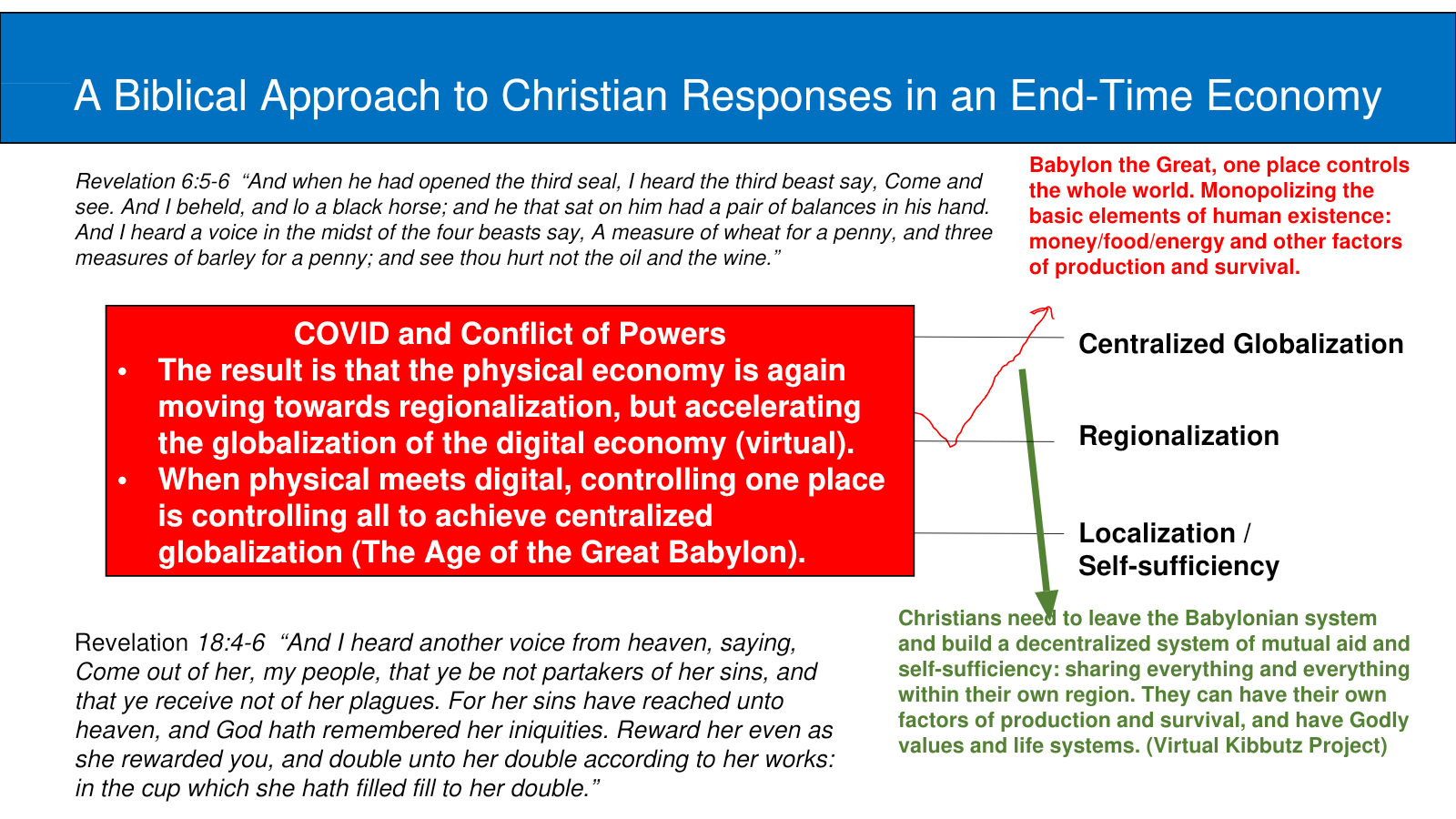
Historical Attachment 2 — Decentralized Christian resilience and mutual-aid networks.
10.2 A Virtual Kibbutz
Section titled “10.2 A Virtual Kibbutz”The Virtual Kibbutz Project describes a regional network in which households need not live communally or surrender all private property in order to share resources, skills, and productive capacity. In addition to the mutual-aid practices already described, its operating possibilities include:
-
transparent inventories and rules for sharing food, tools, medical supplies, and childcare items;
-
exchange of repair, caregiving, teaching, farming, legal, accounting, and digital skills;
-
common purchasing directly from producers or trusted suppliers to lower costs and stabilize supply;
-
household contact trees, a confidential roster of vulnerable members, backup communications, and assigned disaster-response roles; and
-
community gardens, repair equipment, backup energy, local processing, and microenterprise that preserve some productive capacity during disruption.
The church can serve as a trusted hub for collection and distribution, skill matching, purchasing, emergency support, and verification of information, subject to transparent rules and appropriate safeguards.
10.3 “Come Out of Her” Without Fleeing Society
Section titled “10.3 “Come Out of Her” Without Fleeing Society”The call, “Come out of her, my people” (Revelation 18:4), can be understood as leaving an exploitative and centrally controlled way of life. It need not require geographical isolation or rejection of every modern institution. Its ethical demand is to refuse complicity in deception, monopoly, exploitation, and profit made from fear, while building accountable alternatives through which people can share, assume responsibility, and retain meaningful options.
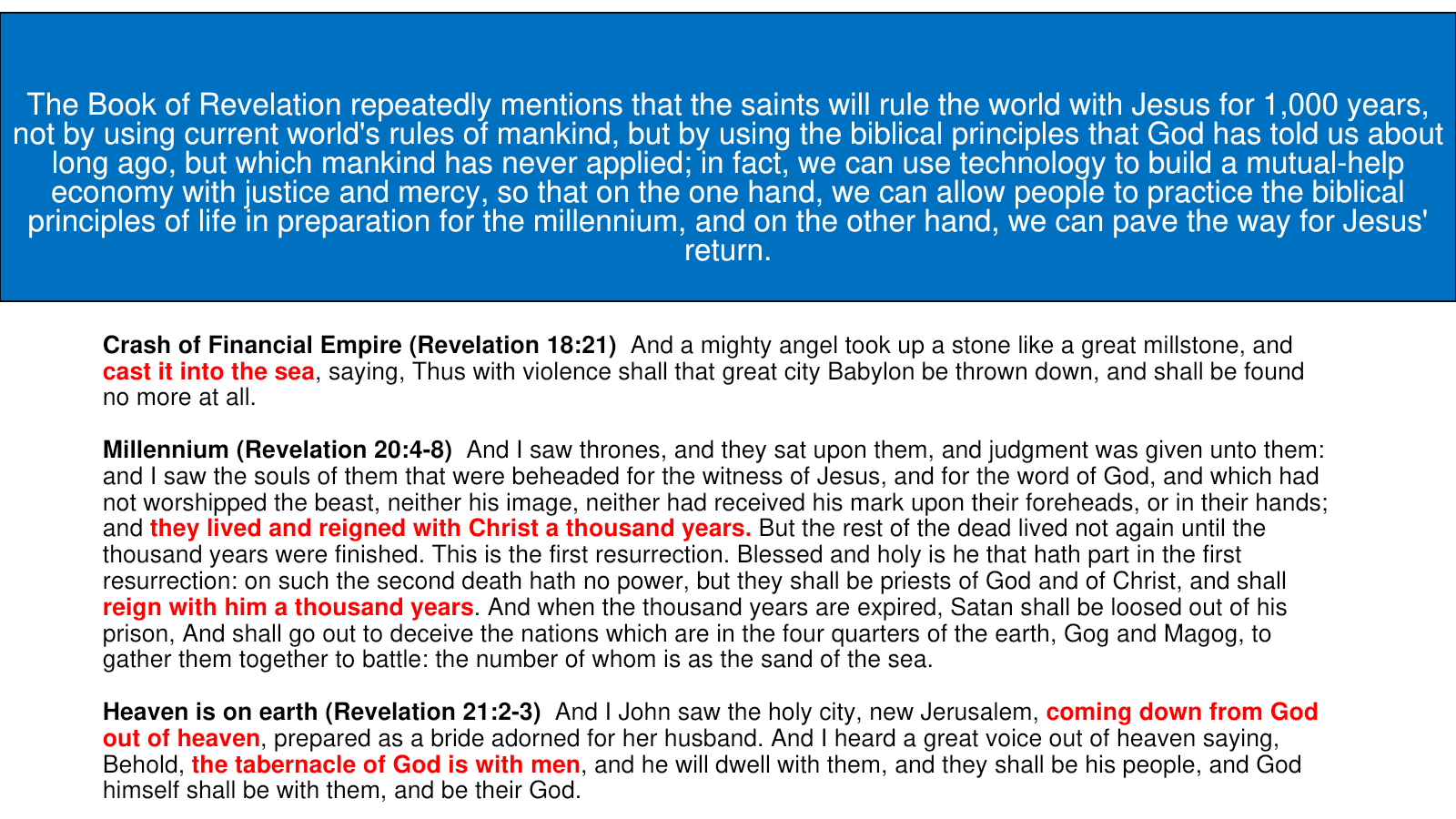
Historical Attachment 2, Figure 11-1 — From the fall of the financial empire to Christ’s reign and the New Creation.
11. Christ’s Millennial Kingdom and the New Creation
Section titled “11. Christ’s Millennial Kingdom and the New Creation”The collapse of unjust financial empires does not by itself create righteous governance. Christ must reign; authority must be accountable to Him; and hearts must be renewed. Money, law, corporations, technology, and education may have transitional functions in the Millennium, but none is the savior or the eternal endpoint.
The final New Creation removes death, curse, fear, and the conditions that drive survival accumulation. Present practice should therefore turn from rapid enrichment toward faithful stewardship: use temporary resources to serve people, restore creation, cultivate gifts, strengthen relationships, and bear fruit that the King remembers.
11.1 From the Fall of the Financial Empire to the Reign of Christ
Section titled “11.1 From the Fall of the Financial Empire to the Reign of Christ”Revelation 18, 20, and 21 form the attachment’s premillennial timeline: the Babylon-like financial empire falls; Christ returns; the saints are raised and reign with Him for a thousand years; at the end of the Millennium Satan is released and the final rebellion is judged; then the New Jerusalem descends and God dwells with humanity forever (Revelation 20:4-8; 21:1-5). The original slides organize this sequence as a premillennial timeline.
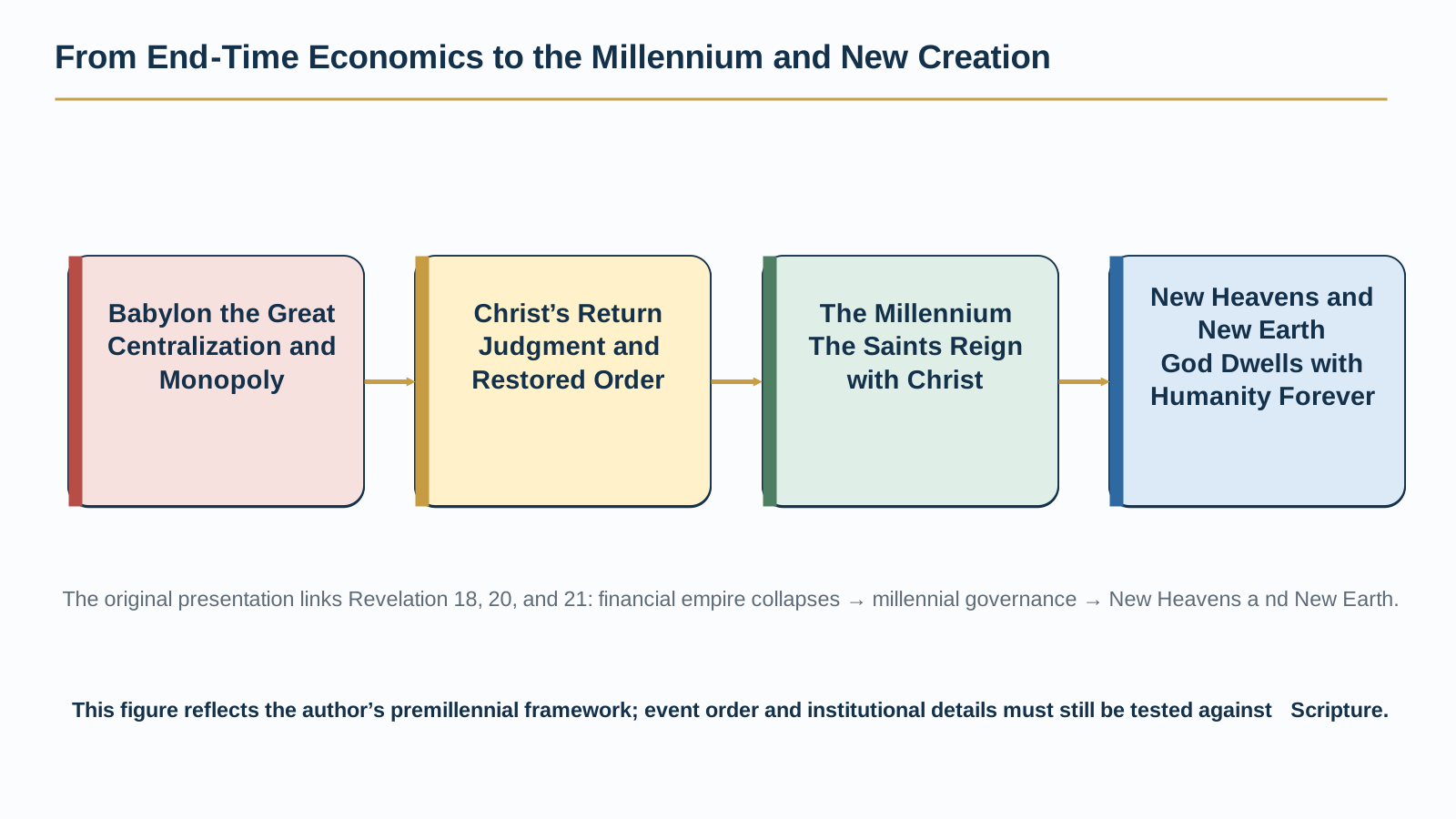
Historical Attachment 2 — From today’s financial order to Christ’s Millennium and the New Heavens and New Earth.
11.2 Millennial Governance and the “Elementary Principles of the World”
Section titled “11.2 Millennial Governance and the “Elementary Principles of the World””If the saints govern with Christ, millennial government should not simply extend present institutions unchanged. The attachment infers that society would be reorganized around principles Scripture has already revealed: justice, mercy, rest, stewardship, limits on debt, responsibility for land, and the possibility of a new beginning. This is a premillennial institutional inference; Revelation 20 does not itself provide a detailed economic policy code.
11.3 Technology as an Assistant, Not a Governor
Section titled “11.3 Technology as an Assistant, Not a Governor”Technology can assist an economy ordered toward justice and mercy. Public ledgers may make resource allocation more transparent; digital platforms may match skills and material needs; and artificial intelligence may support environmental monitoring, supply forecasting, and public administration. Technology cannot decide what justice is, replace Christ’s sovereignty or the judgment of the saints, or relieve human beings of responsibility for how it is used.
11.4 Present Practice as Preparation for the Millennium
Section titled “11.4 Present Practice as Preparation for the Millennium”Present practice has a double purpose: churches and Christians can learn to embody biblical principles now, and that learning can prepare them to receive Christ’s government. Preparation does not mean that human institutions can construct the Millennium. It means refusing now to organize family, church, business, and community life around greed, rapid enrichment, permanent debt, or resource monopoly, and cultivating faithfulness, mutual aid, rest, and stewardship instead.
11.5 The New Creation as the End
Section titled “11.5 The New Creation as the End”Revelation 21:2-3 depicts the New Jerusalem descending from God and God’s dwelling established with humanity. The end of economic ethics is therefore not that human beings possess more, but that God and humanity dwell together fully; money, land, and corporations are not the permanent end.
Conclusion: From Rapid Enrichment to Faithful Stewardship
Section titled “Conclusion: From Rapid Enrichment to Faithful Stewardship”Taken together, these principles recast economic life from unlimited production, monetary expansion, and private accumulation toward the stewardship, under God, of land, ability, time, wealth, and relationships.
This framework is not a finished model of modern economics, and it does not transfer every law of ancient Israel directly into a contemporary state. It instead presses a continuing set of institutional questions: Does the economy permit rest? Does debt have an endpoint? Can land be monopolized permanently? Can a person who fails truly begin again? Are the powers governing finance and technology transparent? Are people in need protected by the structure itself, or only by occasional charity?
The most immediate Christian response is not to wait for a perfect policy system. It is to work faithfully; reject deception and exploitation; rest rightly; restrain consumption; share resources; cultivate gifts; care for vulnerable neighbors; form local networks of mutual aid; and place technology and finance back under the calling to serve people, land, and God’s purposes.
Let us walk humbly with God and together create an economic system that better does justice, loves mercy, and gives people opportunities to rest and begin again.