Chapter 5 Christ, the Saints, and the Architecture of Global Governance
Chapter orientation Sovereignty belongs to Christ. The saints exercise delegated, accountable, service-oriented authority under the King rather than parallel sovereignty beside Him. |
|---|
5.1 Christ Is the Supreme Source of Law
Section titled “5.1 Christ Is the Supreme Source of Law”Tier B — Scriptural synthesis
That the saints reign with Christ does not make them equal sovereigns. Christ is King of kings, the supreme source of law, the righteous Judge, and the ultimate owner. The saints are commissioned governors whose authority is derived, limited, and accountable to Him (Psalm 2; Isaiah 9:6–7; Revelation 19:16; 20:4–6).
This distinction transforms political imagination. Authority is not private property, a hereditary entitlement, or an indefinite corporate asset. It is a trust for service, protection, judgment, and cultivation. Every exercise of power returns to the King for evaluation. Governance therefore requires humility, evidence, appeal, transparent decision-making, and the willingness to relinquish authority when a term or mission is complete.
5.2 Possible Levels of Governance
Section titled “5.2 Possible Levels of Governance”Tier C — Institutional inference
Luke 19 depicts differentiated responsibility through authority over ten cities and five cities. Isaiah 2 and Zechariah 14 preserve a relationship between Jerusalem and the nations. The biblical picture fits one supreme King governing multiple nations, regions, cities, and communities better than a single administrative machine that erases all local difference.
Possible levels include the direct kingship of Christ; entrusted governance by glorified saints; national and regional institutions; cities and local communities; households, guilds, schools, and other functional associations. Subsidiarity is appropriate: decisions should be made close to the people affected unless justice, coordination, expertise, or cross-regional impact requires a wider level. Local responsibility must never become an excuse for oppression, while central authority must not become unnecessary micromanagement.
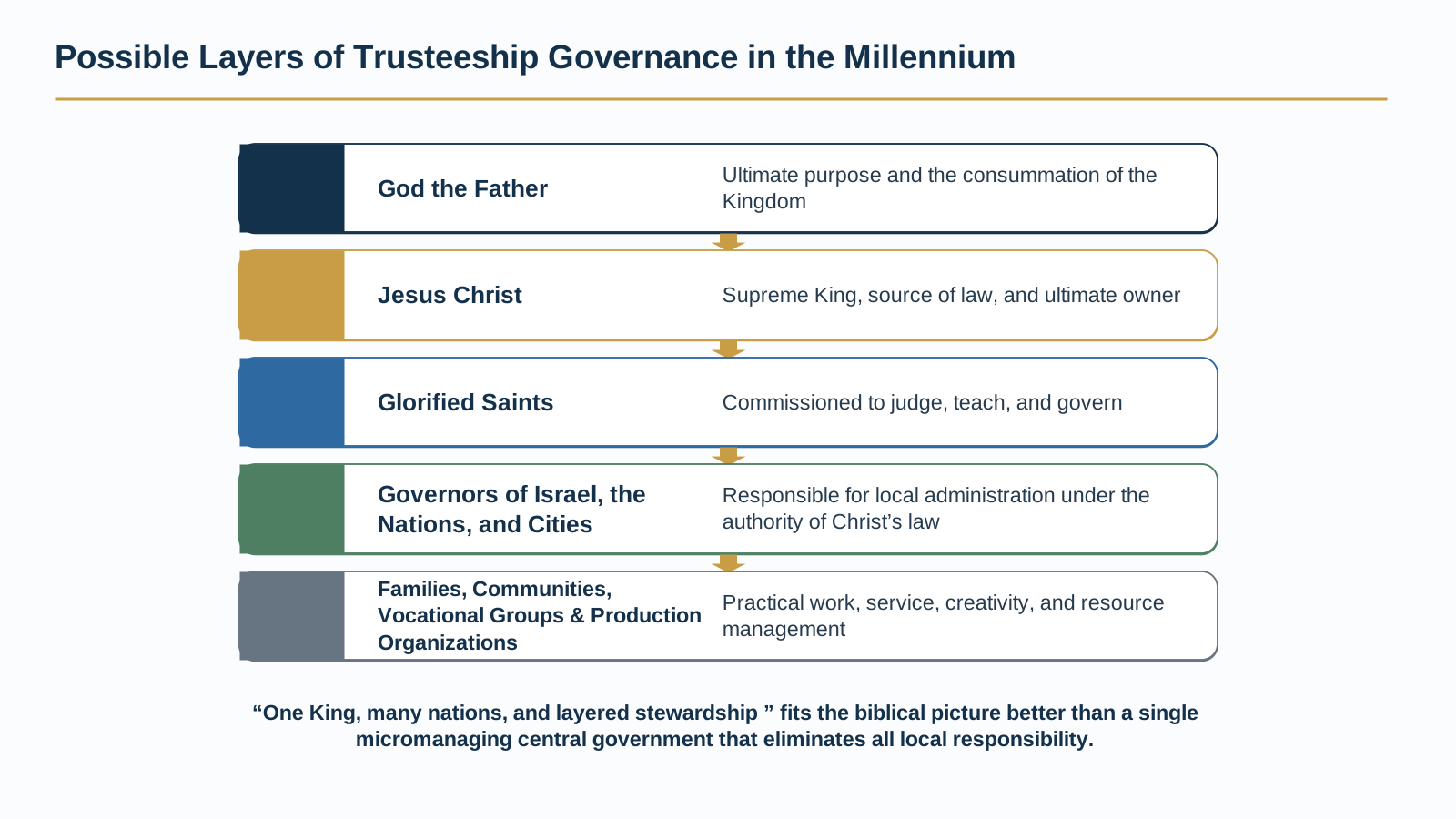
Figure — Possible delegated levels of millennial governance.
5.3 The Role of Jerusalem
Section titled “5.3 The Role of Jerusalem”Tier B–C — Scriptural synthesis and institutional inference
Jerusalem may simultaneously be the location of the Messiah’s throne, the highest center of instruction, a center for adjudicating disputes among nations, and an international center of worship and pilgrimage. Isaiah 2, Micah 4, and Zechariah 14 portray the nations coming to learn, worship, and receive judgment under the King.
A central role for Jerusalem does not imply that every school timetable, road repair, housing dispute, or agricultural decision is administered from one office. Nations and local communities may retain genuine responsibility under Christ’s law. Jerusalem’s centrality is theological and judicial: the source of authority and instruction is publicly visible, while implementation remains distributed and accountable.
5.4 Sources of Law and New-Covenant Internalization
Section titled “5.4 Sources of Law and New-Covenant Internalization”Tier B — Scriptural synthesis
The highest legal source is Christ’s direct command and righteous character. The instruction that goes forth from Zion, the law fulfilled in Christ, and the New Covenant promise of the law written on the heart together establish a public order of justice, mercy, truth, fidelity, responsibility for land, and protection of the vulnerable.
Internalization does not mean that every mortal resident is automatically regenerate or that external law is unnecessary. The final rebellion proves that outward peace can coexist with inward resistance. Public rules, education, evidence, and accountability remain necessary for mortal society, while the Spirit’s inward work is indispensable for willing obedience. The law cannot be reduced either to coercion alone or to private feeling alone.
5.5 Justice, Evidence, and Punishment
Section titled “5.5 Justice, Evidence, and Punishment”Tier C — Institutional inference under the King’s justice
A righteous ruler does not abolish procedure. Because mortal witnesses and administrators may still misunderstand, conceal, or act selfishly, judgments should be based on reliable evidence, transparent standards, opportunities to respond, proportionate remedies, and meaningful appeal. The authority of glorified saints does not justify arbitrary decisions by ordinary institutions claiming to represent them.
Punishment should protect the vulnerable, restrain ongoing harm, reveal truth, restore relationships where possible, and make responsibility real. It should not reproduce humiliation, torture, collective retaliation, debt peonage, or profit from incarceration. Some acts may require separation or strong restraint; other conflicts are better addressed through restitution, mediation, instruction, and supervised restoration.
5.6 Transparent Governance and Resistance to Corruption
Section titled “5.6 Transparent Governance and Resistance to Corruption”Tier C — Governance design
The personal righteousness of the King does not remove the need for transparent administration among mortal institutions. Authority, procurement, land allocation, data, financial flows, appointments, and disciplinary decisions should be disclosed to the extent compatible with legitimate privacy and security. Conflicts of interest must be declared; related-party transactions reviewed; decisions recorded; and residents given ways to question, recalculate, and appeal.
Rotation of office, separation of functions, external audit, public reporting, plural representation, and independent complaint mechanisms are not expressions of distrust in Christ. They are safeguards against ordinary people using the name of the King to centralize power. A government that cannot be questioned, reviewed, or corrected trains people in fear rather than faithful accountability.
5.7 Boundaries for Technology and AI in Governance
Section titled “5.7 Boundaries for Technology and AI in Governance”Tier C — Institutional inference
Technology and AI may assist translation, evidence, planning, environmental monitoring, and public records, but may never replace Christ’s sovereignty or human moral responsibility. They must not assign faith, character, punishment, or eligibility through opaque profiling. Consequential systems must be explainable, appealable, auditable, data-minimal, human-reviewed, correctable, and locally backed up. Efficiency serves justice; it is never the highest law.