Chapter 4 The Nature, Duration, Residents, and Daily Life of Christ’s Millennial Kingdom
Chapter orientation The Millennium is real and finite. Different embodied populations coexist, so daily life, education, law, and personal allegiance remain meaningful. |
|---|
4.1 A Real Kingdom and a Transitional Age
Section titled “4.1 A Real Kingdom and a Transitional Age”Tier B — Scriptural synthesis
Christ’s Millennial Kingdom is not merely an inner spiritual symbol. It follows His public return, includes the binding of Satan, the reign of the saints, the continued existence of nations, and an eventual release of Satan and rebellion. It is therefore a real historical kingdom in which the Messiah’s authority becomes publicly manifest on earth.
It is also transitional. Mortal people still need instruction, judgment, work, health care, family life, and opportunities to respond to the King. Death has not yet been abolished, and a final rebellion remains possible. The Millennium anticipates the New Creation, but does not equal it. Its justice is real; its institutions are accountable; its endpoint is known.
4.2 The One-Thousand-Year Limit and Public Awareness of Time
Section titled “4.2 The One-Thousand-Year Limit and Public Awareness of Time”Tier A with Tier C institutional inference
Revelation 20 repeatedly identifies the duration as one thousand years. The number is not merely private information for theologians; within this working model it becomes a public horizon for governance. Every officeholder, resident, institution, and long-term project knows that the existing millennial order will not continue indefinitely beyond the final judgment.
A known endpoint disciplines accumulation and power. Land rights, corporate charters, public concessions, debt claims, offices, and investment arrangements cannot honestly be valued as perpetual private claims. Public awareness of time also creates moral urgency: remaining years are not a reason for reckless consumption, but a summons to convert temporary resources into faithful service before the account is rendered.
4.3 How Jesus Is Present on Earth
Section titled “4.3 How Jesus Is Present on Earth”Tier B — Scriptural synthesis with acknowledged uncertainty
The New Testament presents the return of Christ as public, visible, embodied, and royal. The risen Jesus possesses a real glorified body, can be seen and touched, eats with His disciples, and ascends bodily; the angels promise that He will return in the same manner (Luke 24:36–43; Acts 1:9–11). The Millennium therefore cannot be reduced to an invisible moral influence.
Scripture does not disclose every logistical detail of His presence, movement, or daily audience with the nations. Jerusalem may be the center of His throne, teaching, adjudication, and worship without implying that He personally manages every routine local decision. Delegated governance by glorified saints and real responsibility among nations and cities are consistent with one supreme King. Claims about transportation, physical location at every moment, or the use of technology remain speculative.
4.4 Glorified Saints, Mortal Survivors, and Descendants Born during the Millennium
Section titled “4.4 Glorified Saints, Mortal Survivors, and Descendants Born during the Millennium”Tier B — High-confidence population synthesis
Three groups must not be collapsed into one. First are the glorified saints who share in the first resurrection and reign with Christ; their bodies are imperishable and their allegiance to the King is not in question. Second are mortal survivors who enter the Kingdom with ordinary bodies, family relationships, work, and mortality. Third are descendants born during the Millennium, raised under a just order but still responsible to respond personally to Christ.
This distinction is essential for understanding housing, marriage, education, health, law, discipline, and the final rebellion. Many apparent contradictions disappear once the texts concerning resurrection life are not indiscriminately applied to ordinary mortal residents. The final rebellious multitude is far more plausibly associated with unregenerate mortal descendants than with glorified saints.
| Resident group | Embodied condition | Primary responsibilities | Why the distinction matters |
|---|---|---|---|
| Glorified saints | Resurrected and imperishable; reigning with Christ. | Delegated governance, teaching, judgment, service, and example. | They should not be treated as subject to mortality, marriage, or final apostasy in the same way as ordinary residents. |
| Mortal survivors | Natural bodies, ordinary family life, work, aging, and possible death. | Live under the King, learn justice, rebuild, cultivate, and raise households. | They explain the continued need for health, law, work, education, and social administration. |
| Millennial descendants | Born within the restored order but still morally responsible. | Receive instruction, develop gifts, and respond personally to Christ. | They help explain population growth and the possibility of a final rebellious multitude. |
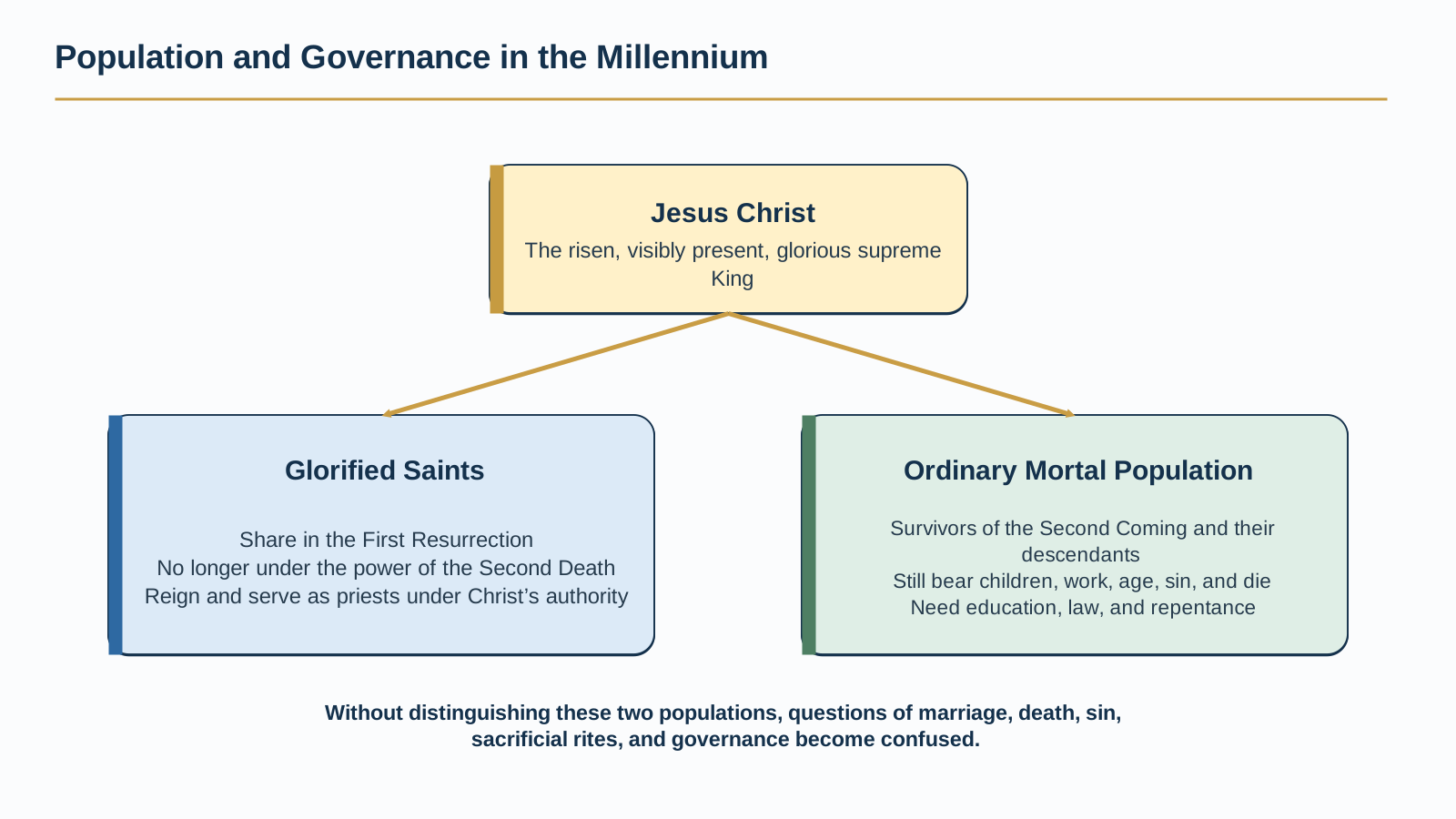
Figure — Population structure during Christ’s Millennial Kingdom.
4.5 Aging, Illness, Death, and Medicine
Section titled “4.5 Aging, Illness, Death, and Medicine”Tier B with Tier C inference
Isaiah 65 suggests extraordinary longevity and a profound reduction in premature death, while still preserving death among ordinary residents. The prophetic vision of restored creation, abundant food, peace, and just governance supports the expectation that many present causes of disease and early mortality will be greatly reduced. It does not require the conclusion that medicine becomes unnecessary for every mortal person.
Health care may shift from commercial scarcity and crisis intervention toward prevention, restoration, public sanitation, nutrition, rehabilitation, care for birth and aging, and the responsible use of knowledge. Glorified saints should not be assumed to require medical treatment, but Scripture does not authorize detailed claims about their biological processes. The appropriate posture is confident about resurrection and cautious about unrevealed physiology.
4.6 Family, Marriage, and Kinship
Section titled “4.6 Family, Marriage, and Kinship”Tier B — Population-sensitive synthesis
Mortal residents and their descendants may marry, bear children, establish homes, and maintain kinship networks. Glorified saints, by contrast, belong to resurrection life, which Jesus says is not organized through marrying and being given in marriage in the same way as the present age. These two conditions must be distinguished without reducing either group’s capacity for love, fellowship, or service.
Family life in the Millennium should be protected from exploitation, debt bondage, violence, abandonment, and the marketization of basic care. Yet family must not become an absolute private sovereignty that shields abuse or excludes public justice. Education, inheritance, housing, care for elders and children, and community support all require a balance between household responsibility and wider covenantal accountability.
4.7 Education and the Human Heart
Section titled “4.7 Education and the Human Heart”Tier B–C — Scriptural synthesis and institutional inference
Education remains necessary because mortal people and new generations still need to learn redemptive history, the identity of the King, the meaning of the one-thousand-year horizon, the final test, responsibility for land and resources, and the difference between outward order and inward regeneration. A just environment does not make every heart new automatically.
Education therefore cannot be reduced to vocational sorting or technical competence. It joins worship, truth, character, gifts, public responsibility, creation care, and governance practice. Its purpose is to make truth publicly accessible, responsibility clear, and a genuine response to Christ possible. Knowledge can expose rebellion and restrain deception; it cannot save without grace and personal allegiance to the King.
4.8 Crime, Idleness, and Social Relations
Section titled “4.8 Crime, Idleness, and Social Relations”Tier C — Institutional inference
Satan’s binding greatly reduces deception of the nations and systemic evil, but ordinary people may still act selfishly, refuse legitimate work, neglect public responsibilities, exploit relationships, or resist worship. The Millennium therefore still requires instruction, mediation, adjudication, proportional discipline, restoration, and, where necessary, punishment.
A just system must distinguish unwillingness from inability. Second Thessalonians 3:10 warns against refusing to work; it does not authorize abandonment of people who are ill, disabled, displaced, caregiving, or otherwise unable to contribute in ordinary ways. Social policy should protect the vulnerable, identify gifts, offer restorative pathways, and prevent both exploitation of the weak and manipulation of communal provision.