Historical Attachment 4 A Kibbutz Without a Shared Roof: New Possibilities for Faith-Based Mutual-Aid Communities
Edited English translation. The kibbutz is treated as a comparative source of institutional learning, not as prophecy, an idealized history, or a compulsory form for every church.
1. Why Study the Kibbutz?
Section titled “1. Why Study the Kibbutz?”The kibbutz offers an observable example of how a community can share responsibility for housing, health, education, child care, employment, and crisis risk. Its importance is not that every kibbutz is equal, successful, or free of conflict. It is that mutual responsibility, common facilities, and long relationships can prevent an economic shock from falling entirely on one household.
A church can learn from these mechanisms without copying common ownership of all assets. The central question is how households can remain distinct while becoming capable of sheltering one another from unemployment, illness, inflation, disaster, and family crisis.
The original presentation described the kibbutz as a form of community resilience—an institutional “insurance system” that can sometimes absorb shocks more effectively than isolated market participation. Its central claim was not that kibbutz members were necessarily wealthier. Rather, their institutional design gave them a stronger buffer in times of crisis: losses could be shared, basic needs could be protected, and no household had to face unemployment or a sudden fall in income entirely alone.
The slides located this comparison in Israel’s experience from the 1970s through the 1990s, when the country passed through periods of high inflation, rising housing prices, increasing unemployment, and agricultural recession. Kibbutzim were not immune. They also faced falling export prices, agricultural surpluses, the departure of members, and pressure from bank debt. The presentation nevertheless reported that members commonly retained greater stability of daily life, stronger educational provision, and a higher sense of social security than the national average. These historical claims should be read as the original presentation’s comparative evidence and independently checked before being used as current statistics.
Historical Attachment 4, source slide 1 — Kibbutz resilience as a community risk-sharing system (English translation).
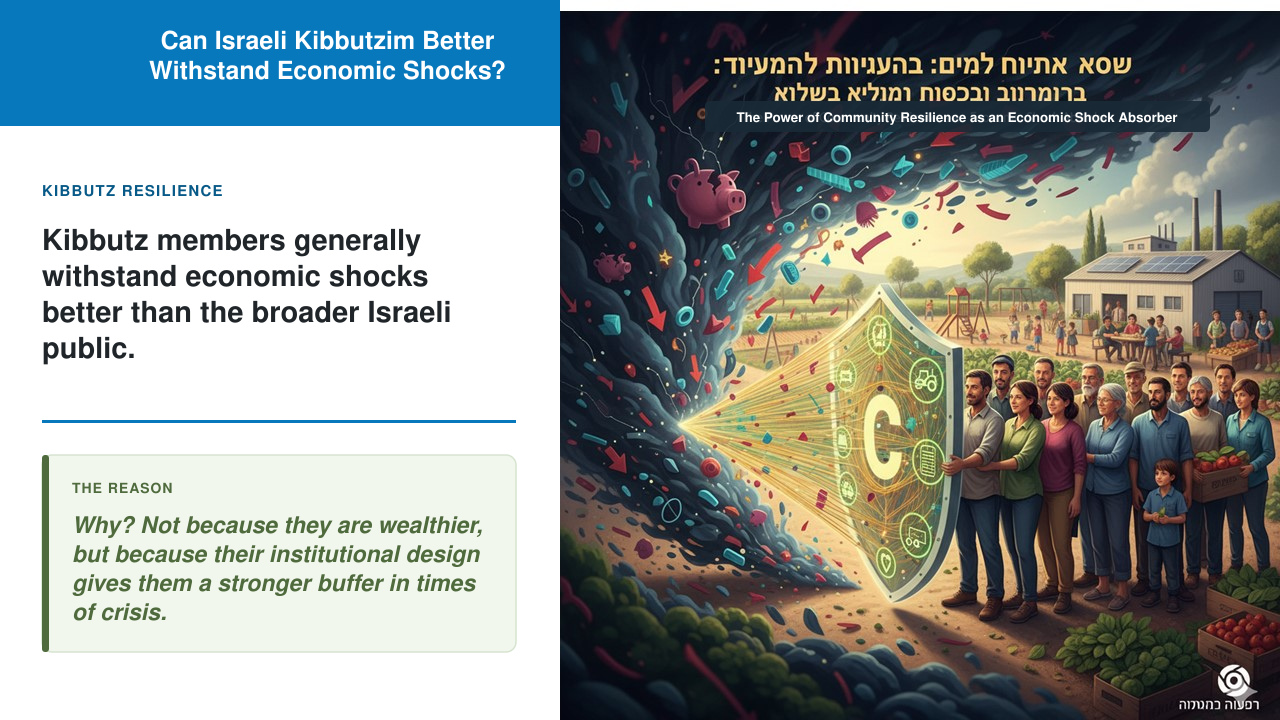
Historical Attachment 4, source slide 2 — Institutional buffering rather than greater individual wealth (English translation).
2. Institutional Sources of Resilience
Section titled “2. Institutional Sources of Resilience”Resilience may arise from diversified activities, pooled reserves, common kitchens and facilities, shared transport, mutual care, reduced duplication, flexible compensation during crisis, and long-term investment in children and education. Relational culture is itself a form of insurance: people know whom to call, who has capacity, and how to mobilize help.
Statistics about individual kibbutzim and historical periods should be verified independently. The institutional lesson is comparative: resilience depends on both assets and relationships, both rules and trust, both basic protection and differentiated responsibility.
The internal safety net was concrete. The community could assume or subsidize members’ medical expenses, education expenses, and basic living costs. A member who lost work or experienced financial difficulty therefore did not necessarily fall immediately into poverty, whereas an ordinary household that depended upon one wage earner could lose its principal source of income at once. The original slides cited a 1998 report of Israel’s Central Bureau of Statistics as indicating that, during the recession of the early 1990s, the poverty rate among kibbutz households was less than one-half of the national average. That claim should be independently verified before publication as a present factual finding.
Diversification also spread risk. A kibbutz might operate agriculture, manufacturing, tourism, education, and other activities at the same time. Weakness in one division could therefore be partly offset by another. The slides gave Kibbutz Yotvata as an example: when dairy-product prices fell, tourism and lodging income could help sustain the overall surplus. An ordinary household, by contrast, often depends upon a single occupation or employer and thus has less capacity to absorb a sector-specific shock.
Community solidarity functioned as a nonmonetary insurance mechanism. During an economic crisis, members might accept temporary reductions in compensation, eat together, share child care, and help one another through a difficult period. The presentation connected this practice with Amitai Etzioni’s idea of a “moral economy”: even when markets cease to function well, ethical obligation and social bonds can continue to support persons. Common kitchens, laundries, child-care centers, and shared transportation can also reduce duplicated spending and soften the effect of inflation on each household.
Long-horizon investment in education was another buffer. Kibbutzim often continued to invest substantial resources in members’ education, especially the formation of younger people, thereby strengthening the next generation’s social mobility and future earning capacity. The contrast proposed by the slides was that an isolated household under severe financial pressure may cut education expenditure first, even though doing so weakens its longer-term prospects.
The presentation also described changes after 2000. Many kibbutzim combined differentiated compensation with continuing social protection, a dual system that reportedly helped them remain stable during the 2008 global financial crisis. Compensation could vary according to market value, professional competence, and scope of responsibility. The illustrative formula in the slides was:
individual net income = salary − national taxes − kibbutz taxes − progressive mutual-aid contribution.
The kibbutz levy was described as supporting housing, health, education, and a guaranteed minimum standard of living. The ownership structure was likewise mixed: land and water rights could remain common, dwellings could be privately held, and shares in community enterprises could be allocated to members even though those enterprises had originally been held collectively. The slides stated that almost no kibbutzim closed during the financial crisis and that some even expanded; Kibbutz Sasa’s plastics enterprise was offered as an example. These examples and quantitative claims should be verified independently, but they clarify the institutional argument: a community can absorb and distribute a crisis without pretending that the crisis never occurred.
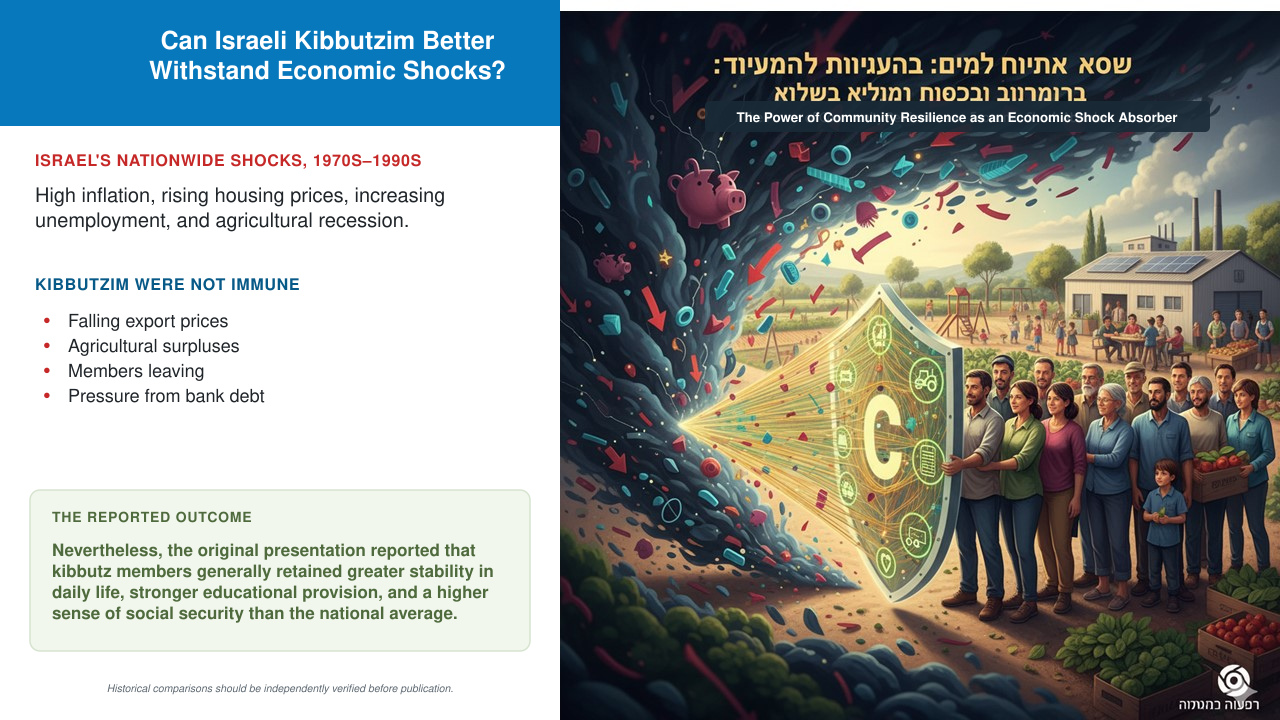
Historical Attachment 4, source slide 3 — Israel’s economic shocks and kibbutz resilience (English translation).
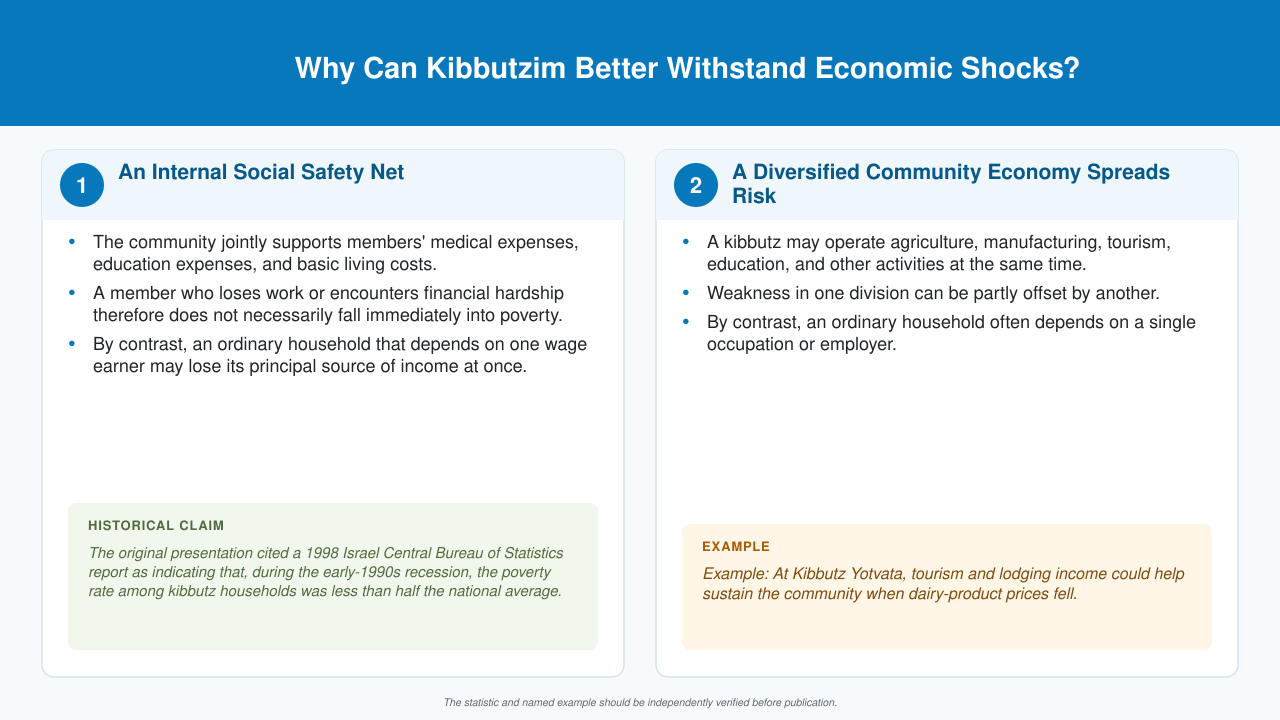
Historical Attachment 4, source slide 4 — Internal safety net and diversified community economy (English translation).
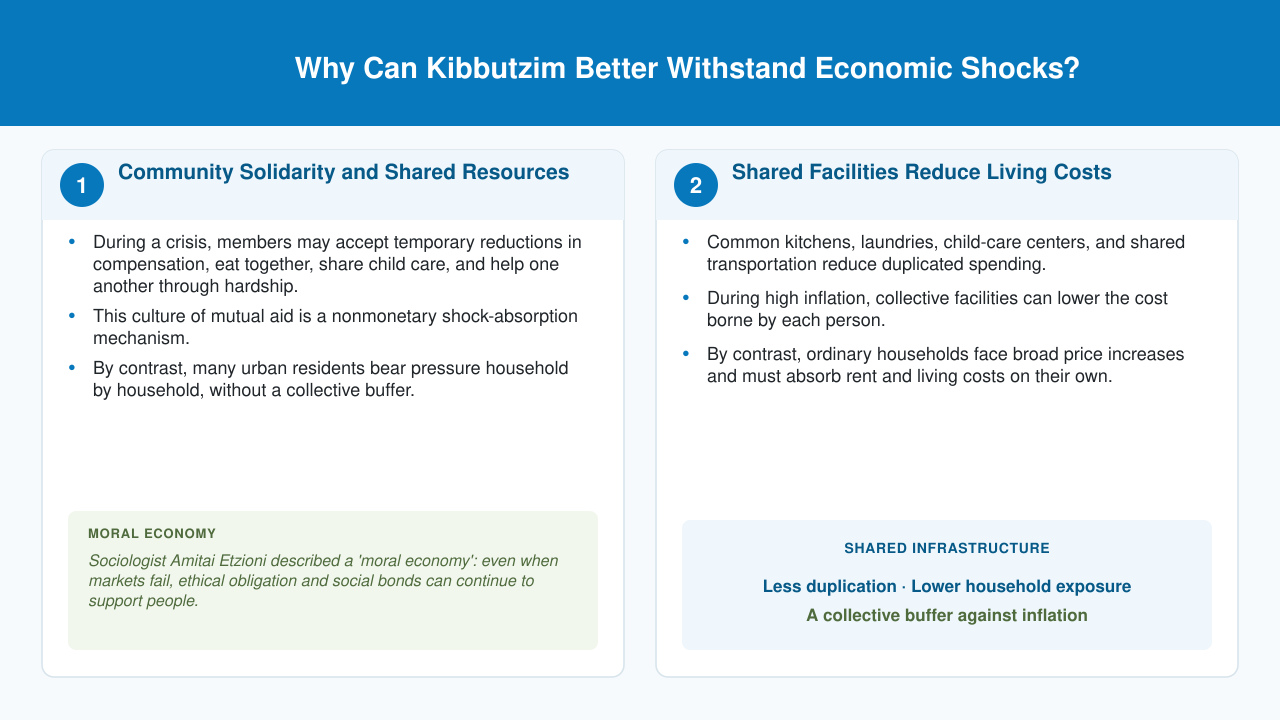
Historical Attachment 4, source slide 5 — Solidarity and shared resources as nonmonetary shock absorption (English translation).
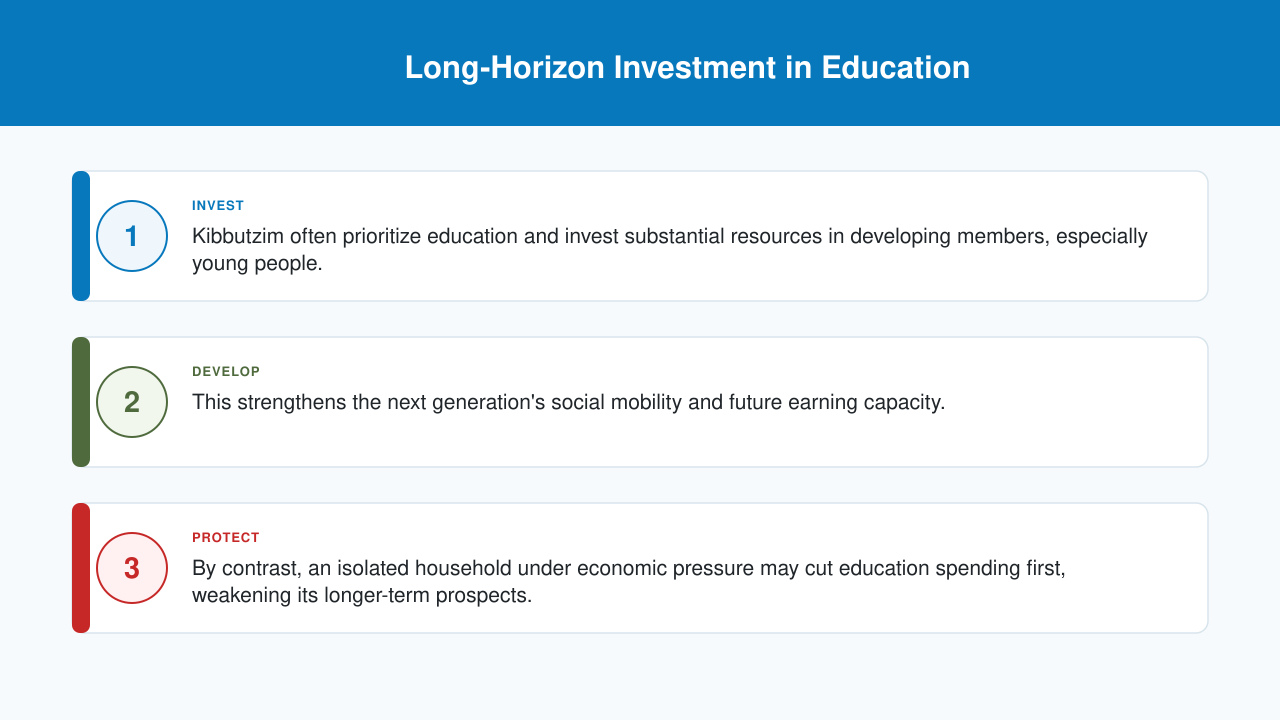
Historical Attachment 4, source slide 6 — Long-horizon investment in education (English translation).
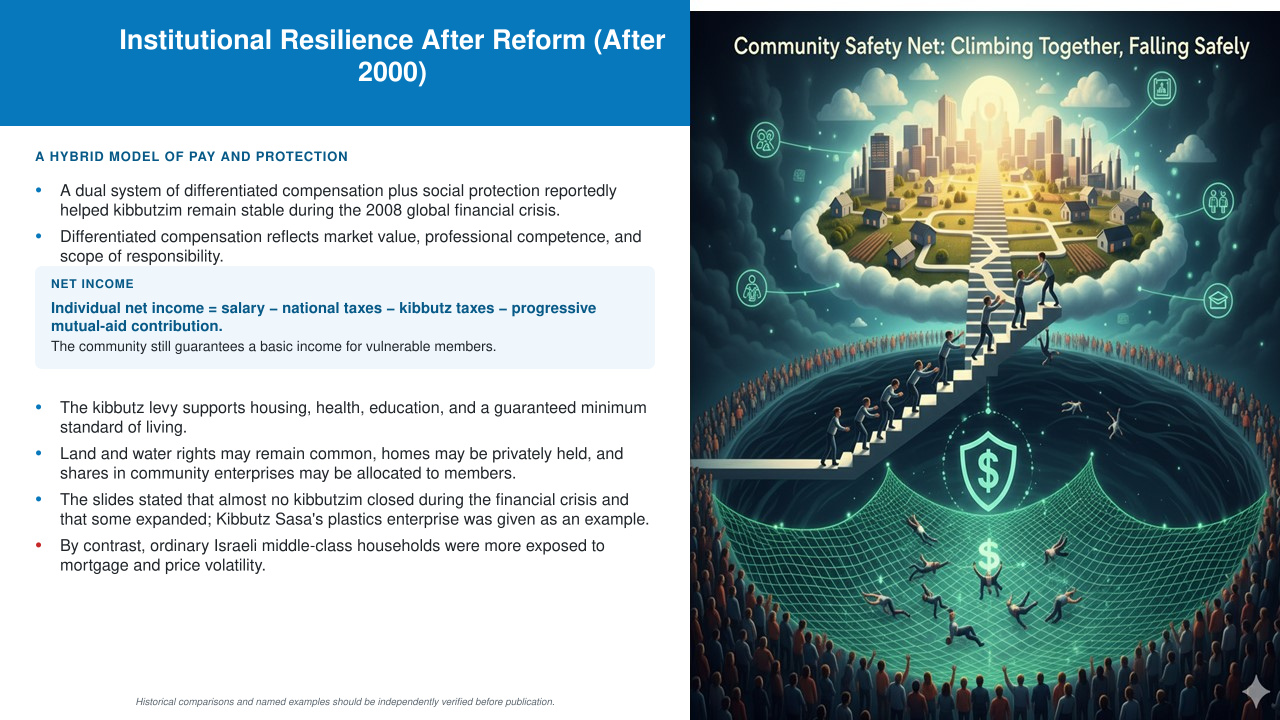
Historical Attachment 4, source slide 7 — Post-2000 hybrid compensation and social protection (English translation).
3. Basic Provision and Differentiated Stewardship
Section titled “3. Basic Provision and Differentiated Stewardship”A dual-track design can combine a basic-provision tier with a gift-and-development tier. The basic tier secures food, housing, health, education, emergency support, and care for those unable to work. The development tier preserves differences in professional skill, creativity, responsibility, effort, and re-allocable margin.
Equality of dignity does not require identical roles or identical provision. Difference becomes unjust when it allows control over basic needs, hides privilege, or externalizes risk. It becomes service when greater capacity carries greater accountability and contributes to the security and development of the whole community.
| Basic-provision tier | Gift-and-development tier |
|---|---|
| Secures food, housing, health care, education, emergency help, and care for people unable to work. | Recognizes differences in gifts, expertise, responsibility, creativity, and work outcomes. |
| Purpose: no person must surrender freedom merely to survive. | Purpose: encourage learning, excellence, innovation, service, and greater entrusted responsibility. |
| Supported by common funds, shared facilities, public trusts, mutual aid, or insurance. | Expressed through role-based provision, mission resources, re-allocable margin, and accountable reward. |
The original slides characterized the contemporary kibbutz as a hybrid rather than a pure socialist or capitalist form. A floor of basic provision is combined with space for initiative, differentiated responsibility, and varied outcomes. In the presentation’s house-shaped model, the lower level was “basic or equal provision”: essential conditions of life—food, clothing, housing, transportation, medicine, and education—were secured through common provision or sharing. The upper level was “equality of development opportunity”: people were to receive a genuine opportunity to cultivate their gifts, while outcomes could still differ according to calling, effort, competence, service, and faithfully exercised stewardship. Required contributions supported the common floor; voluntary offerings and additional generosity could enlarge opportunity without turning generosity into compulsion.
The presentation related this mixed model to the biblical rhythms of Sabbath, sabbatical release, and Jubilee. Its aim was to combine mercy toward the poor with room for responsible initiative, while preventing either accumulated wealth or entrenched poverty from becoming a permanent inheritance. This is a theological application of biblical principles rather than a direct command that churches reproduce one economic constitution.
Equal provision under exceptional conditions
Section titled “Equal provision under exceptional conditions”The slides appealed to the Jerusalem church as an example of extensive sharing suited to particular conditions, including persecution, displacement, or war. Acts 2:44–45 describes the believers remaining together, holding possessions for common use, selling property, and distributing the proceeds according to each person’s need. Acts 4:32–35 similarly portrays the believers as united in heart and soul; they did not treat possessions as exclusively their own, and proceeds from sold land and houses were laid before the apostles for distribution according to need. Acts 4:36–37 gives Barnabas as a concrete example: he sold a field and placed the money at the apostles’ feet.
These texts show radical generosity and need-based provision. The presentation did not require every congregation in every circumstance to abolish all private use. Rather, it treated comprehensive sharing as especially intelligible where survival, persecution, or extraordinary crisis makes a strong common floor necessary.
Equality of development opportunity when basic survival is secure
Section titled “Equality of development opportunity when basic survival is secure”Where basic survival is not in danger, equality need not mean identical results. Second Corinthians 9:6–7 connects sowing generously with reaping generously, while insisting that each person give as resolved in the heart, not reluctantly or under compulsion, because God loves a cheerful giver. The principle protects both generosity and freedom: contribution should bear fruit, but it must not be extracted through spiritual pressure.
Luke 19:11–27 adds the principle of differentiated stewardship. In the parable of the minas, servants receive an entrustment, render different results, and are assigned correspondingly different responsibilities—authority over ten cities or five—while the servant who refuses to use what was entrusted is held accountable. The institutional application is not that wealth proves righteousness. It is that a just community may secure equal dignity and basic provision while still recognizing faithfulness, developed capacity, and greater responsibility.
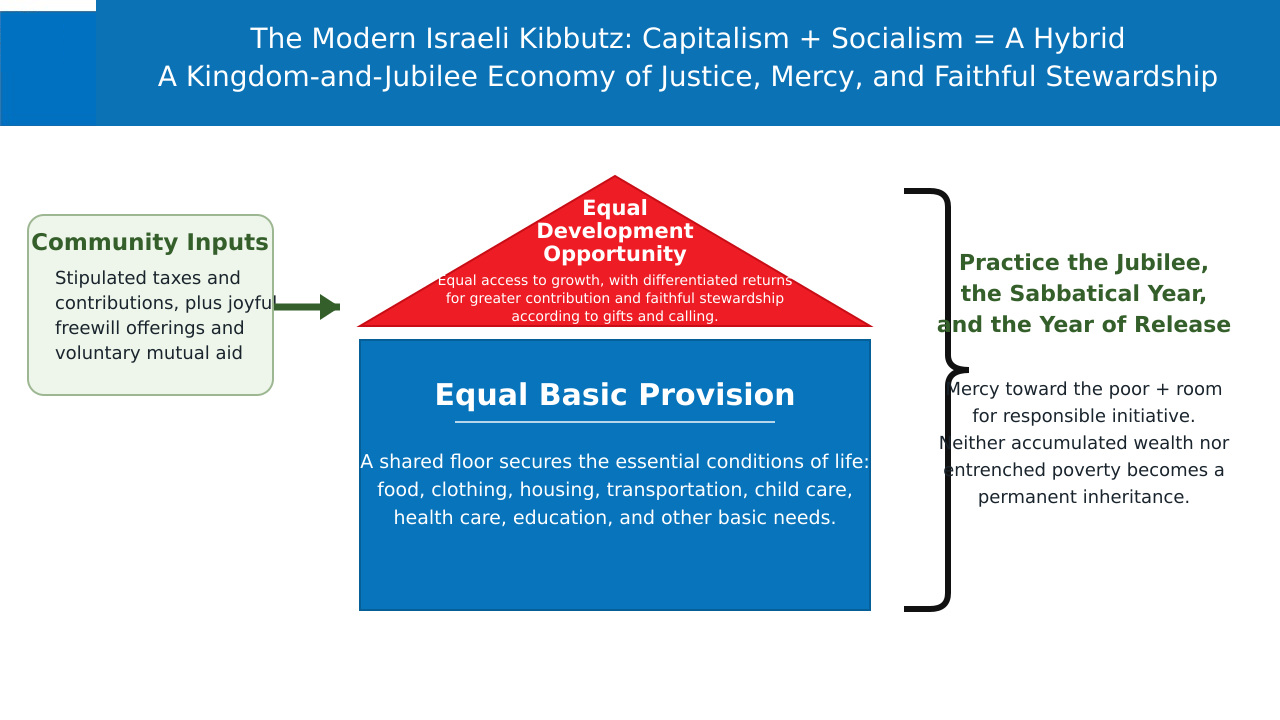
Historical Attachment 4, source slide 10 — Basic provision and equal development opportunity (English translation).
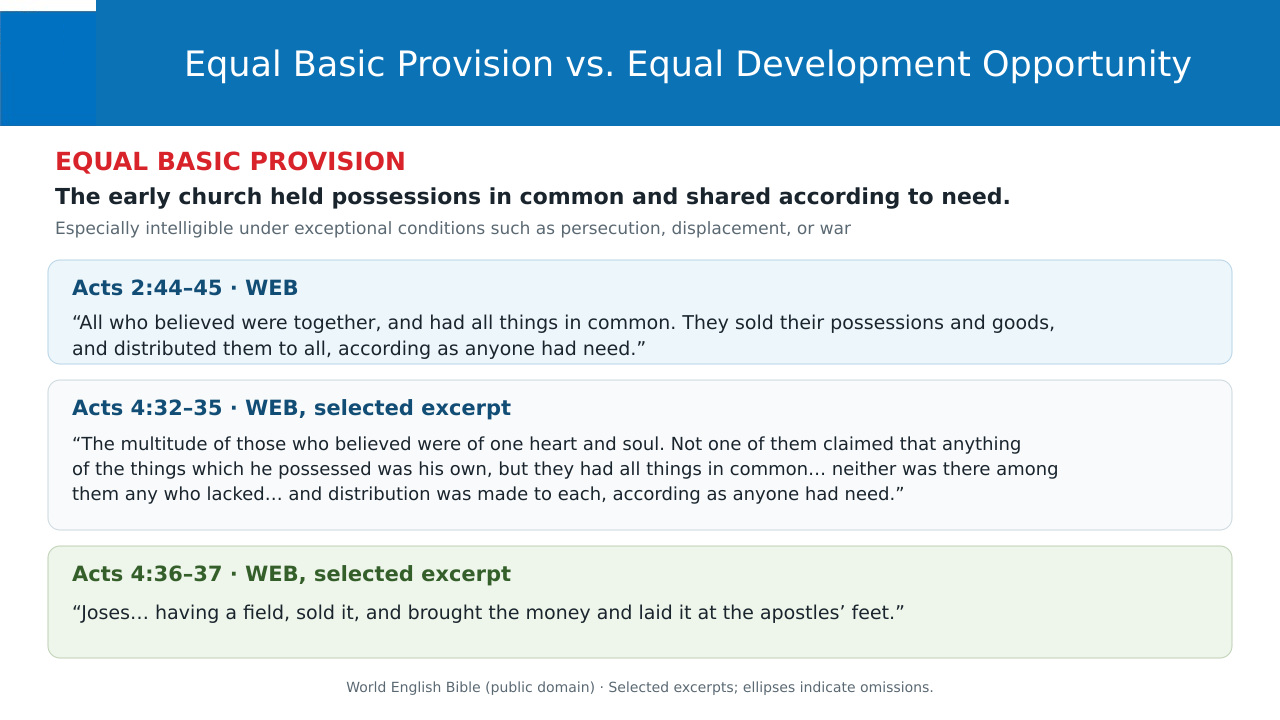
Historical Attachment 4, source slide 11 — Extensive sharing under exceptional conditions; Acts 2 and 4 (English translation).
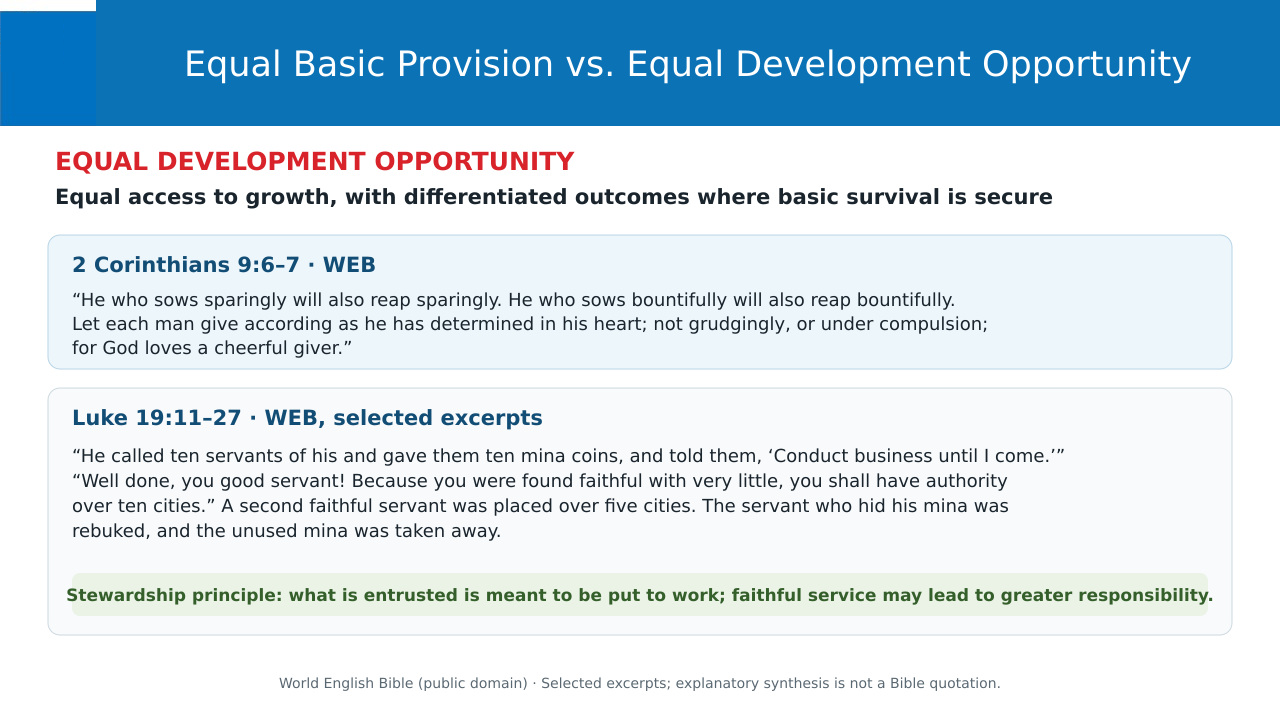
Historical Attachment 4, source slide 12 — Voluntary giving and differentiated stewardship; 2 Corinthians 9 and Luke 19 (English translation).
4. “Without a Shared Roof”
Section titled “4. “Without a Shared Roof””An urban church may possess no common land and need not require members to live in one neighborhood. ‘Without a shared roof’ moves the essence of mutual aid from a single compound into a network of households. Stable small groups, local coordinators, digital tools, and city-to-city cooperation can connect people while preserving local responsibility.
Participation may include network members who cooperate through local groups and digital platforms, as well as co-resident members in specific communities. Every level requires clear consent, scope, privacy, exit, appeals, and prevention of platform monopoly.
The Taiwanese proposal in the original presentation imagined the church as the center of a symbiotic community whose members need not occupy one compound. A network can connect households through shared worship, mutual aid, learning, emergency coordination, resource exchange, and practical service. Its promise was summarized visually: even in a world without one common roof, households can still shelter one another from wind and rain.
The slides then extended the idea beyond one city. Faith-based mutual-aid communities and social enterprises in different countries could form a federated network while retaining their own local rules. Cooperation could include student exchange or transfer, goods and services, economic collaboration, and exchange concerning faith, culture, values, and personnel. Two membership modes were distinguished: network or “cloud” members who cooperate without living together, and co-resident members who actually share a locality or community. Such a federation should remain plural and locally accountable; it must not become a centralized platform monopoly or an authority able to override consent, privacy, or exit.
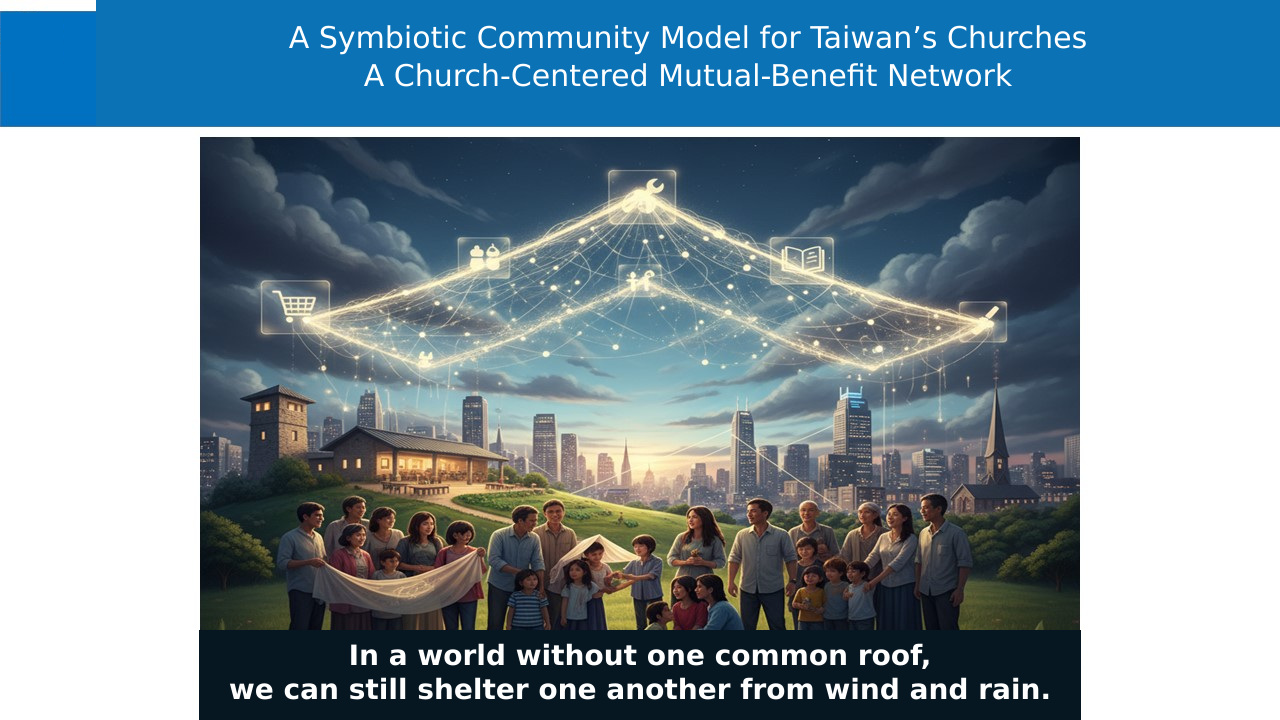
Historical Attachment 4, source slide 9 — A church-centered mutual-aid network without common residence (English translation).
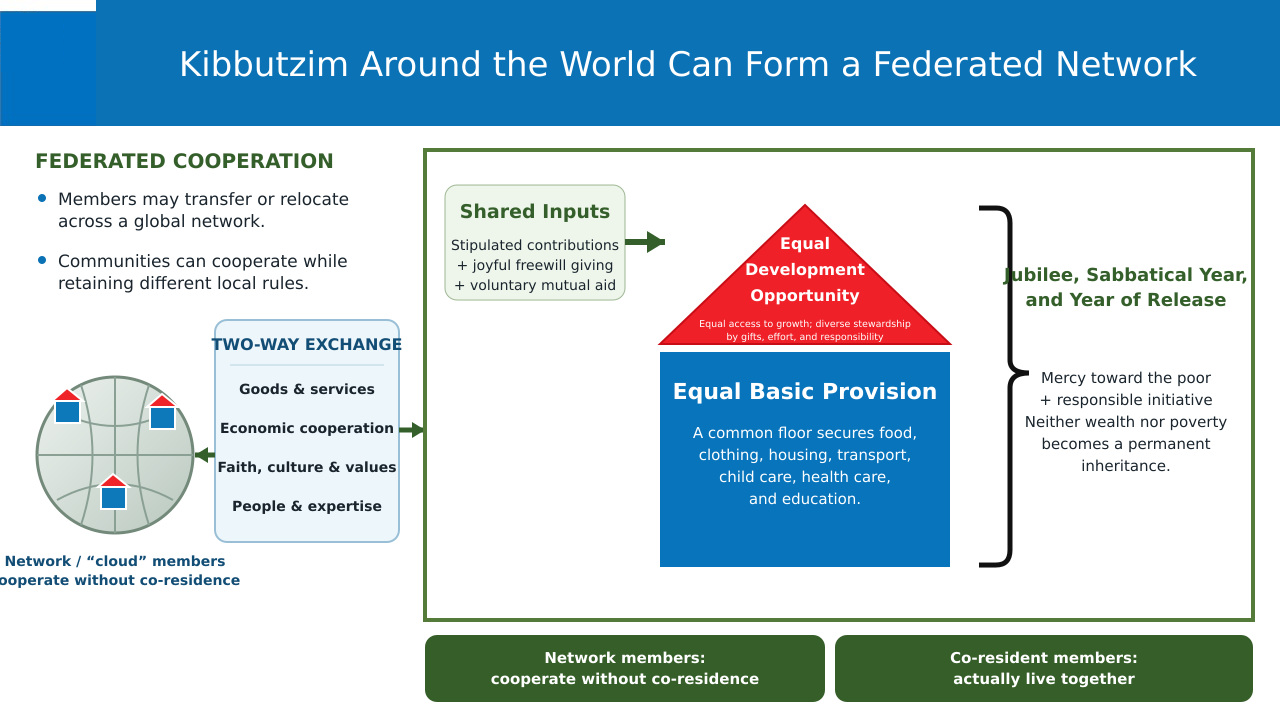
Historical Attachment 4, source slide 14 — A federated worldwide mutual-aid network (English translation).
5. Eight Forms of Mutual Aid that Can Begin Now
Section titled “5. Eight Forms of Mutual Aid that Can Begin Now”| Area | Possible practice | Purpose and governance priority |
|---|---|---|
| Spiritual connection | Regular Scripture study, sharing of difficulties, and intercessory prayer. | Keep the community centered on Christ rather than transactional advantage. |
| Shared meals and fellowship | Rotating household meals or community love feasts. | Build trust, reduce isolation, and notice needs naturally. |
| Emergency response | Coordinators, contact trees, and consent-based registries of vulnerable people. | Mobilize rapid help without concentrating information in one person. |
| Inventory of needs and capabilities | Record available and needed transport, repairs, care, legal help, accounting, lodging, and other support. | Bring nonmonetary gifts into the mutual-aid cycle. |
| Common fund | Published rules, multiple-person oversight, tiered uses, and regular reporting. | Address emergency, education, and shared equipment while preventing misuse. |
| Resource sharing | Lend tools, infant supplies, vehicles, space, and equipment. | Reduce duplicate purchases, living costs, and waste. |
| Workplace mutual aid | Professional collaboration, referrals, job matching, and entrepreneurship support. | Develop a vocational ecosystem based on trust rather than monopoly. |
| Educational support | Shared teaching by parents and professionals with intergenerational mentoring. | Cultivate the next generation’s gifts and reduce isolated household burdens. |
The source slides added several practical details to the eight-part framework. Spiritual-connection groups could meet weekly or every two weeks for Scripture, honest sharing, intercession, and mutual care. Shared meals could rotate among households or take the form of a church love feast or potluck. Each small group could appoint one or two trained emergency coordinators. A consent-based needs-and-capabilities roster could be paired with group purchasing. Resource-sharing channels could use familiar tools such as LINE or WhatsApp rather than requiring a new centralized platform. Educational support could draw regularly on parents and professionals with expertise in music, the arts, finance, trades, and other fields to teach or mentor children from several households.
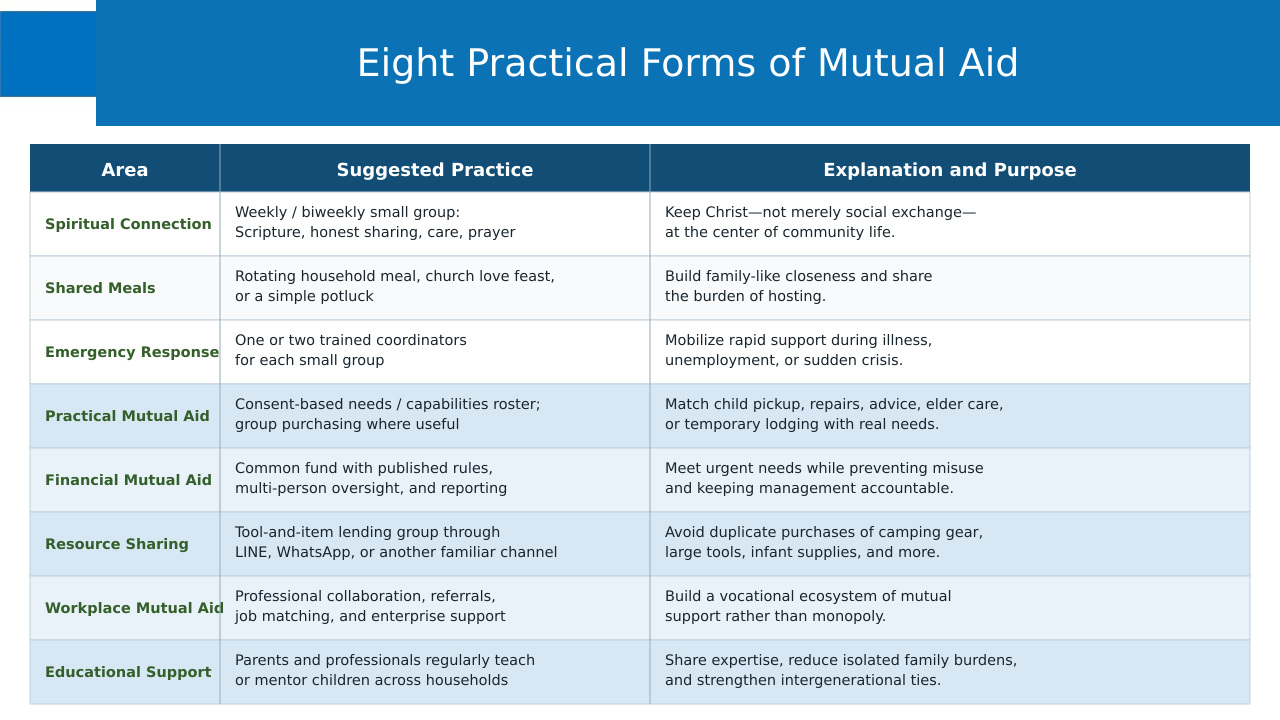
Historical Attachment 4, source slide 13 — Eight immediately practicable forms of mutual aid (English translation).
6. Relationships, Trust, and Mutual-Aid Capacity as Nonmonetary Capital
Section titled “6. Relationships, Trust, and Mutual-Aid Capacity as Nonmonetary Capital”People may share equipment, accept temporary reductions, care for children and older adults, visit the sick, open homes, teach skills, and invest in the next generation. These acts cannot be fully converted into cash, yet they sustain life when formal markets fail. They belong to the Time-Stewardship and Kingdom-Faithfulness Ledgers as well as to the material economy.
Trust should not be romanticized. It must be supported by clear roles, records, multiple-person oversight, conflict procedures, and the ability to say no. Mature mutual aid combines relationship with governance.
The comparison table in the source presentation contrasted an isolated household with a kibbutz member across six dimensions: source of income, economic buffering, living costs, education and health, social support, and overall resilience. An ordinary household may rely on one occupation, bear inflation directly, finance education and health alone, and depend primarily on the nuclear family. A community member can draw upon diversified activities, a social safety net, shared facilities, collective educational and health support, and a wider circle of mutual responsibility.
The conclusion was not that members avoid all shocks. It was that the shock is partially “socialized”: risk is distributed across a community, so an individual is less likely to remain isolated at the moment of greatest need. This capacity is itself a form of nonmonetary capital, but it lasts only when trust is joined to the safeguards already identified in this attachment.
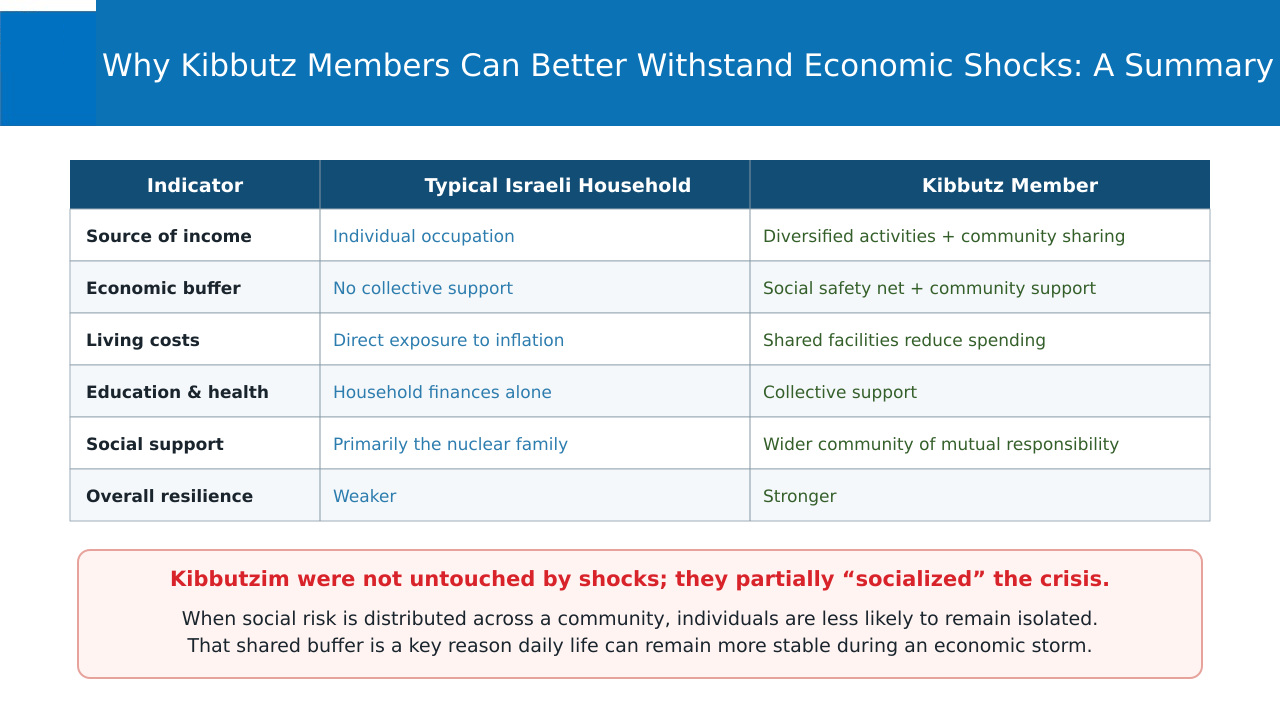
Historical Attachment 4, source slide 8 — Household and kibbutz-member resilience compared (English translation).
7. Taxes, Dues, Offerings, and Charitable Provision
Section titled “7. Taxes, Dues, Offerings, and Charitable Provision”A mutual-aid community must distinguish compulsory public taxes, voluntary contractual dues, freewill offerings, emergency mobilization, and additional generosity. Making offerings compulsory easily produces spiritual control. Making every common responsibility voluntary can produce free riding and leave the most conscientious members overburdened.
The community should disclose what each contribution funds, who decides, how conflicts are handled, whether assistance creates obligations, and how privacy is protected. No person’s spiritual standing should be scored by the amount contributed.
In the dual-track model, the source presentation placed stipulated taxes, dues, or agreed contributions alongside joyful, voluntary offerings. The distinction matters. Predictable contributions can finance the basic-provision floor and make mutual obligations transparent; offerings can express generosity beyond that floor. Neither should be disguised as the other, and no voluntary gift should be converted into a spiritual assessment of the giver.
8. Common Ownership, Sharing, and Private Use Rights
Section titled “8. Common Ownership, Sharing, and Private Use Rights”Not every asset must be commonly owned. Tools, rooms, vehicles, gardens, funds, and facilities can be shared under different arrangements: common ownership, cooperative ownership, pooled purchasing, time-limited lending, scheduled access, or private ownership with voluntary availability. The best form depends on maintenance, liability, scarcity, and user responsibility.
The key is not a slogan of public or private ownership but a transparent bundle of rights: who may use, decide, maintain, benefit, transfer, withdraw, and bear loss. Basic security and voluntary generosity should not become a pretext for intrusive control of households.
The later kibbutz examples in the presentation illustrated a deliberately mixed bundle of rights: land and water could be held in common, homes could be privately held, and shares in factories could be allocated to members. This is important precisely because “community” does not require one uniform title for every asset. The relevant questions are which resources are foundational to everyone’s survival, which assets require private responsibility, which returns may properly be distributed, and which rights remain reviewable for the common good.
9. Risks and Safeguards
Section titled “9. Risks and Safeguards”| Risk | Safeguard principle |
|---|---|
| Charismatic control or spiritual pressure | Multiple leaders, published rules, external accountability, informed consent, and protected exit. |
| Misuse of funds or favoritism | Segregated accounts, independent review, conflict disclosure, and regular reporting. |
| Dependency and loss of responsibility | Time-limited assistance plans, capability development, and distinction between inability and refusal. |
| Privacy breaches | Data minimization, consent, role-based access, retention limits, and deletion rights. |
| Insularity and echo chambers | Cooperate with other churches, communities, professionals, and public institutions; preserve referral pathways. |
| A digital platform becoming a new monopoly | Portable data, distributed backups, transparent permissions, open standards, and local alternatives. |
| Burnout of a few caregivers | Rotate responsibility, provide respite, measure load, and recognize limits. |
The presentation’s claim that community can be “stronger than the market” should therefore be read narrowly. Community does not abolish recession, debt, inflation, poor management, or conflict. It changes who bears the first impact and whether basic life can continue while members adjust. Without transparent accounts, differentiated roles, freedom of exit, independent review, privacy protection, and limits on spiritual authority, the same structure that distributes risk could instead concentrate control.
10. Present Age, Millennium, and New Creation
Section titled “10. Present Age, Millennium, and New Creation”In the present age, mutual aid is voluntary practice within institutions still affected by sin, scarcity, and the failures of leaders. In Christ’s Millennial Kingdom, righteous public governance may secure basic provision, justice, and responsibility for land and resources while mortal residents still need instruction and repentance. In the New Creation, death, debt, oppression, and fear for survival are gone, and governance becomes pure service, creativity, cultivation, and fellowship.
The kibbutz spirit is neither salvation nor the only valid institution. It is a rehearsal of shared faith, responsibility, and care. In a world without one common roof, households can still shelter one another from life’s storms.
One source slide asked whether people can experience on earth, before Jesus returns, something that anticipates life under heaven’s rule. The responsible answer is “as a sign and rehearsal, not as fulfillment.” A church cannot manufacture the Kingdom, remove sin, or guarantee prosperity through communal design. It can nevertheless embody shared faith, mutual assistance, and shared responsibility in ways that offer a truthful foretaste of neighbor-love and reduce the false choice between isolated individual prosperity and coercive collectivism.
The future of a faith-based community therefore does not depend upon reproducing the outward form of a kibbutz. The kibbutz “spirit” described by the presentation is a practice: people trust one another, help one another, accept responsibility for one another, and build institutions that make such care durable. Even without a shared roof, the church can become a network in which households help shelter one another from life’s storms.
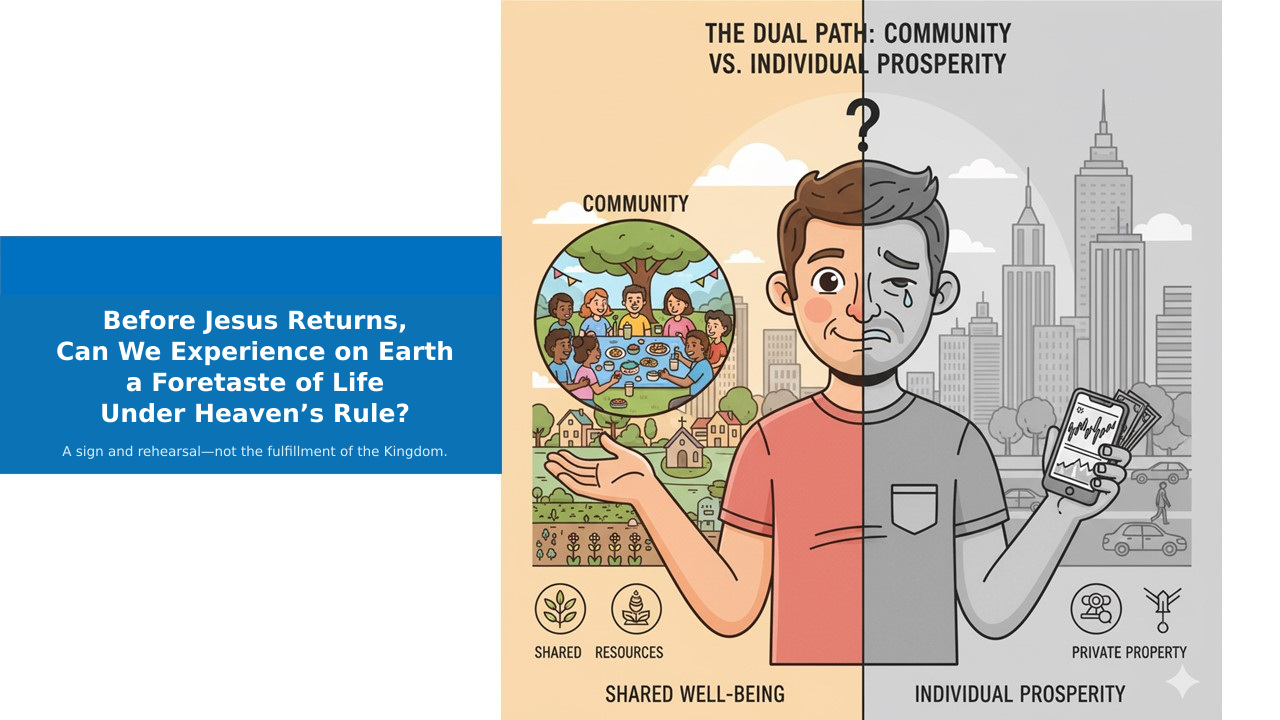
Historical Attachment 4, source slide 15 — A present sign and rehearsal, not realized fulfillment (English translation).
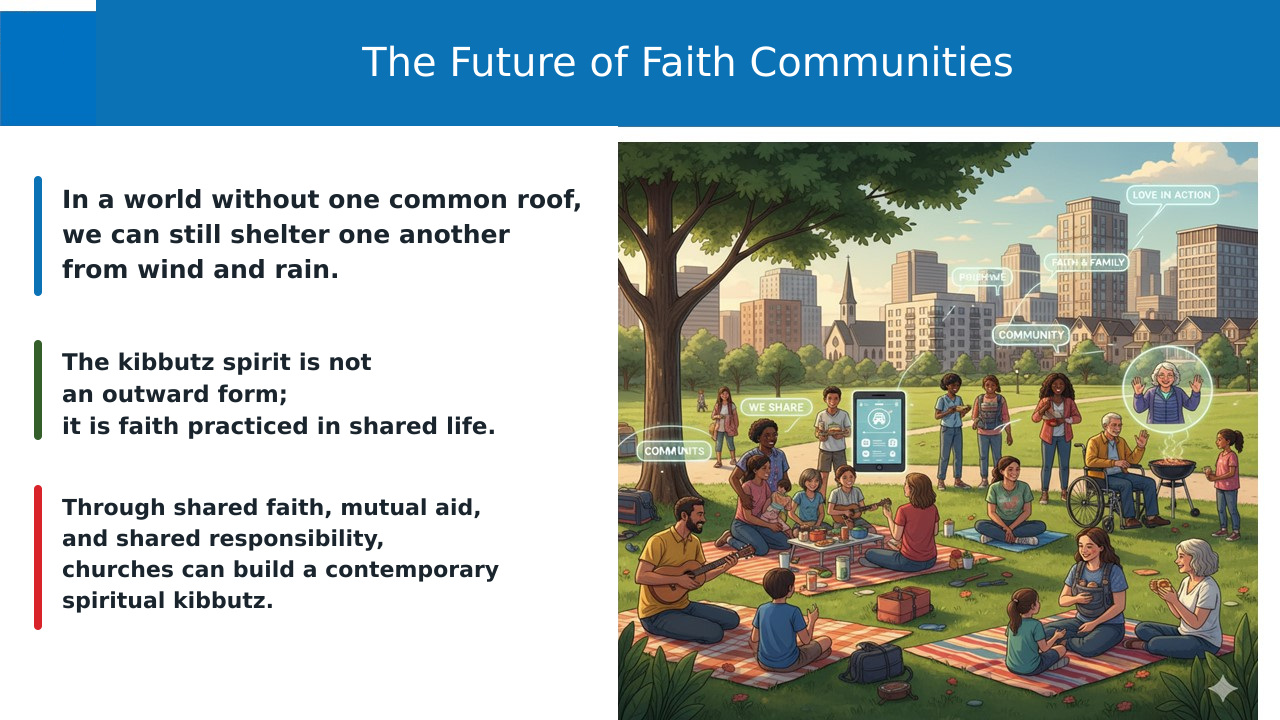
Historical Attachment 4, source slide 16 — The kibbutz spirit as shared faith, mutual aid, and responsibility (English translation).