Chapter 2 Eschatological Backcasting: From the New Heavens and New Earth to Christ’s Millennial Kingdom
Chapter orientation The New Creation is the final reference point. Every proposed institution in the Millennium must be tested by whether it serves, anticipates, or obstructs that endpoint. |
|---|
2.1 Why Begin with the Eschatological Endpoint
Section titled “2.1 Why Begin with the Eschatological Endpoint”Tier B — High-confidence scriptural synthesis
If interpretation begins with today’s institutions, it is easy to project modern nation-states, perpetual corporations, banks, money, technological platforms, and private property indefinitely into the future. The result may be little more than the present world with better leaders. A sounder approach begins with the New Creation that God Himself brings about and asks which institutions are eternal in direction, which are temporary instruments, and which exist only because sin, death, scarcity, deception, and corruption still require restraint.
This method does not erase history. It clarifies it. The Millennium is evaluated as a real historical kingdom with a beginning and an end. The New Heavens and New Earth are evaluated as the final state in which the reasons for many defensive institutions have disappeared. Present practice is then backcast from these two horizons: the church prepares not by imitating every imagined future mechanism, but by cultivating holiness, wisdom, gifts, accountability, mutual care, and the ability to steward real resources under the authority of Christ.
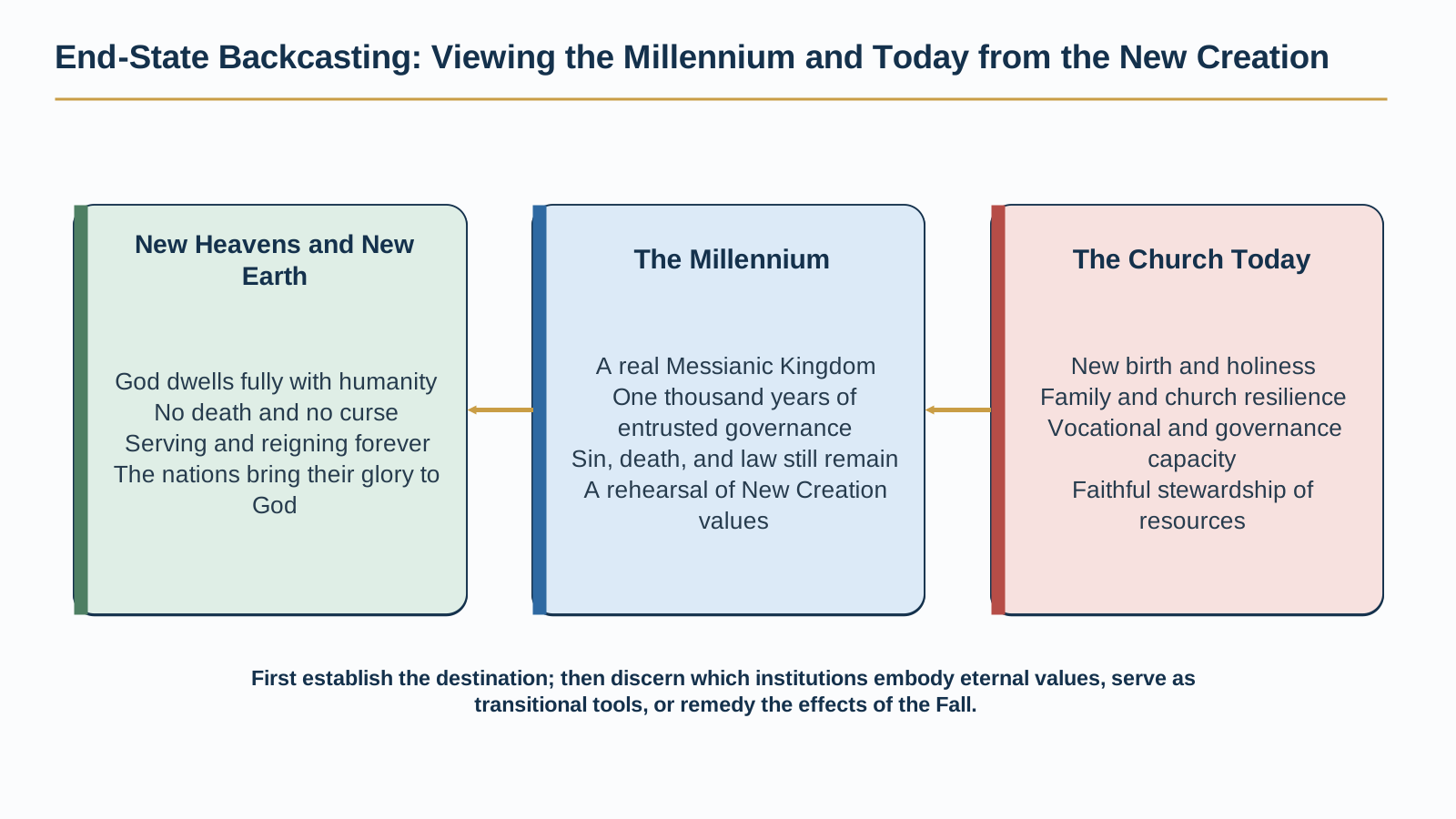
Figure — Eschatological backcasting: reasoning from the final New Creation toward the Millennium and the present.
2.2 The New Heavens and New Earth Are Not a Disembodied Heaven That Abandons Creation
Section titled “2.2 The New Heavens and New Earth Are Not a Disembodied Heaven That Abandons Creation”Tier A — Explicit scriptural direction
Revelation portrays the New Jerusalem descending from God out of heaven and God’s dwelling coming among humanity. Romans 8 portrays creation itself being liberated from corruption into the freedom of the glory of God’s children. The ultimate Christian hope is therefore not the permanent escape of souls from the earth, but the renewal of creation so that heaven and earth meet fully in God’s presence (Revelation 21:1–5; Romans 8:18–25).
Continuity does not mean simple preservation of every present form. Second Peter 3 uses the language of judgment and fire, warning against the assumption that every building, institution, border, account, and technology passes into eternity unchanged. The resurrection body is a more fitting analogy: the same person is raised, yet corruption gives way to incorruption (1 Corinthians 15:35–54). The church therefore takes creation seriously without idolizing its present arrangements.
2.3 The New Jerusalem and the Full Presence of God
Section titled “2.3 The New Jerusalem and the Full Presence of God”Tier A — Explicit Scripture
The defining reality of the New Jerusalem is not its materials or dimensions but the unhindered presence of God and the Lamb. God dwells with His people; they see His face; His name is on them; night is gone; and His servants reign forever (Revelation 21:3; 22:3–5). The city is holy because nothing false, exploitative, violent, or defiling remains within it.
This endpoint is the ultimate test of governance. Political authority, economic coordination, worship institutions, education, law, and technology are not ends in themselves. They are justified only insofar as they serve truth, love, justice, fellowship, creativity, care for creation, and joyful service under God. The New Jerusalem exposes the limits of every system that secures order by fear, opacity, debt bondage, monopolized access, or permanent exclusion.
2.4 Residents, Bodies, and Relationships in the New Creation
Section titled “2.4 Residents, Bodies, and Relationships in the New Creation”Tier A with Tier B synthesis
The residents of the New Creation are redeemed, resurrected, and imperishable. Death, mourning, crying, pain, curse, and final separation from God are gone. Jesus teaches that resurrection life is not organized by marriage in the same manner as the present age (Matthew 22:30), yet personal identity, embodied existence, community, service, and recognition are not erased.
Scripture does not provide a complete sociology of eternal kinship. It is therefore unwise either to claim that every present family structure continues unchanged or to imagine that love and personal relationship disappear. The safer conclusion is that all relationships are healed, purified, and ordered directly under God. No person needs to secure status, inheritance, protection, or identity through domination of another.
2.5 Work and Governance Continue, but Their Character Is Transformed
Section titled “2.5 Work and Governance Continue, but Their Character Is Transformed”Tier A–B — Explicit texts and synthesis
Revelation says that God’s servants serve Him and reign forever. Work is therefore not abolished. Genesis already presents cultivation, creativity, naming, fruitfulness, and governance before the Fall. Sin introduced toil, futility, exploitation, violence, and death—not work itself. In the New Creation, work becomes worship, creativity, cultivation, relationship, discovery, and service without fear for survival or competitive domination.
Governance likewise becomes pure stewardship rather than coercive sovereignty. The saints’ eternal reign cannot mean rival kingdoms struggling over resources. It points to participation in God’s wise ordering of creation, the exercise of gifts, and the joyful coordination of shared life. Institutions that exist primarily to restrain crime, deception, disease, or corruption may no longer be necessary, while forms of teaching, creativity, administration, and care may reach their fullest expression.
2.6 Nations, Culture, and Glory
Section titled “2.6 Nations, Culture, and Glory”Tier A with Tier B synthesis
Revelation 21 continues to speak of the nations and the kings of the earth and says that their glory and honor are brought into the Holy City. Redemption therefore need not erase all cultural difference. Languages, artistic forms, wisdom, craftsmanship, memory, and creative achievement may be purified and offered to God rather than enclosed as private or national trophies.
The nations of the New Creation are not military sovereignties competing for borders, strategic advantage, or control of scarce resources. Their diversity exists in fellowship within the light of God and the Lamb. The glory of the nations is not ultimately hoarded, monetized, or weaponized. It is returned in worship and shared as part of a reconciled human civilization.
2.7 Economic Implications of the New Heavens and New Earth
Section titled “2.7 Economic Implications of the New Heavens and New Earth”Tier B — Scriptural synthesis
Scripture does not explicitly say whether the New Creation uses a medium of exchange, numerical accounting, or systems of resource measurement. It does make clear that the principal reasons for defensive accumulation have disappeared: aging, illness, unemployment anxiety, death, inheritance insecurity, theft, fraud, war, and competition for political power are no more. The water of life is given freely and the tree of life provides continually (Revelation 21:6; 22:1–2).
Even if eternity still involves allocation, comparison, reciprocal exchange, or coordinated projects, it cannot be organized around fear for survival, security through compound interest, permanent debt claims, or monopoly over basic necessities. The economic direction of the New Creation is abundance under stewardship, transparent fellowship, and the offering of achievement back to God. This does not justify careless planning today; it reveals the end toward which planning should be ordered.
2.8 What Can Pass through the Final Judgment
Section titled “2.8 What Can Pass through the Final Judgment”Tier B — High-confidence synthesis
Scripture gives its clearest assurances concerning faithfulness, labor in the Lord, and works tested by Christ: they are not in vain, and God will reward each person according to his or her work (1 Corinthians 3:8–15; 15:58; Revelation 14:13; 22:12). Scripture does not promise that any corporation, currency, bank ledger, road, building, software platform, database, or present political border will enter the New Earth in its current form.
A distinction must therefore be made between the preservation of a physical or legal form and God’s remembrance of the love, justice, mercy, culture, restored creation, and faithfulness embodied through the work. A project’s eternal significance does not depend on its present institution surviving unchanged. It depends on whether the work bears witness to the King and anticipates the values of the new creation.
2.9 Christ’s Millennial Kingdom and the New Heavens and New Earth Compared
Section titled “2.9 Christ’s Millennial Kingdom and the New Heavens and New Earth Compared”Tier B — Scriptural synthesis
The Millennium is not simply another name for the New Creation. It is a more righteous historical order under the public reign of Christ, yet mortal residents, law, education, work, death, and the possibility of rebellion remain. The New Heavens and New Earth are eternal, all residents are redeemed and imperishable, Satan and death are removed forever, and God’s presence is unmediated.
Maintaining this two-stage distinction prevents three errors: treating millennial longevity as immortality; projecting a possible millennial temple directly into the New Jerusalem, where no separate temple exists; and treating transitional institutions such as money, law, corporations, or debt as eternal arrangements.
| Dimension | Christ’s Millennial Kingdom | New Heavens and New Earth |
|---|---|---|
| Duration | One thousand years with a defined endpoint. | Eternal, with no subsequent age. |
| Residents | Glorified saints plus ordinary mortal residents and descendants. | All are redeemed, resurrected, and imperishable. |
| Sin and death | Sin, disobedience, aging, and death remain possible; a final rebellion follows. | No sin, curse, rebellion, or death. |
| Governance | Instruction, adjudication, restraint, restoration, and delegated authority remain necessary. | Service, creativity, cultivation, and eternal stewardship without coercive rivalry. |
| Nations | Nations may retain identity and limited self-government and may still disobey. | Diverse peoples walk fully in God’s light and bring their glory into the Holy City. |
| Temple | A temple may exist; interpretations differ. | No separate temple, for God and the Lamb are its temple. |
| Economy | May include money, organizations, discretionary resources, and releasable debt arrangements. | Survival-driven accumulation disappears; the precise form of exchange is not revealed. |
| Environment | Substantially restored, while death remains. | Curse, corruption, pain, and death are entirely gone. |
| Marriage and procreation | Mortal residents may marry and bear descendants during the Millennium. | In resurrection life people neither marry nor are given in marriage; the redeemed community is complete. |
| Satan | Bound for the thousand years, then released briefly before the final rebellion. | Finally judged and permanently removed; no later deceiver or rebellion remains. |