Chapter 12 Environment, Technology, and Artificial Intelligence
Chapter orientation Technology is not sovereign. Its legitimacy depends on who controls it, what purpose it serves, how risk is distributed, and whether people retain responsibility, appeal, and alternative access. |
|---|
12.1 Crisis, Forced Rest, and Environmental Breathing Space
Section titled “12.1 Crisis, Forced Rest, and Environmental Breathing Space”Tier C — Interpretive reflection with empirical caution
Periods of crisis can temporarily reduce transport, industrial activity, and certain forms of pollution, revealing how strongly environmental pressure is connected to the pace and structure of economic activity. Such observations can function as a parable of forced rest: when production slows, air, water, beaches, wildlife, and human communities may receive temporary relief.
A crisis is not a desirable environmental policy. Lockdowns and disasters impose unequal suffering, and emissions may rebound when activity resumes. The appropriate lesson is not to wait for catastrophe to force rest, but to build rhythms of maintenance, ecological limits, land rest, clean technology, repair, and reduced waste into ordinary governance. Empirical claims about particular events require independent verification and must not be converted into simplistic theological causation.
12.2 Supernatural Restoration and Human Stewardship Work
Section titled “12.2 Supernatural Restoration and Human Stewardship Work”Tier B–C — Scriptural synthesis and institutional inference
Prophetic visions of the Messianic Kingdom include healed land, abundant water, peace among creatures, and renewed fertility. God’s supernatural action establishes conditions that human beings cannot produce by technique alone. Yet the original vocation to cultivate and keep creation remains. Divine restoration does not turn human beings into passive spectators.
The Millennium can therefore be understood as cooperation under grace: God restores order and gives life; people cultivate, rebuild, conserve, teach, measure, repair, and govern in obedience. Human projects do not manufacture the New Heavens and New Earth, but faithful restoration can witness to the King’s character and prepare mortal societies to live responsibly within renewed creation.
12.3 Land, Water, Forests, Oceans, and Animals
Section titled “12.3 Land, Water, Forests, Oceans, and Animals”Tier C — Creation-stewardship inference
Environmental governance must treat land, water, forests, oceans, biodiversity, and animals as entrusted creation rather than raw material for unlimited extraction. Restoration includes soil fertility, watershed protection, reforestation, pollution removal, habitat connectivity, humane treatment of animals, and resilient food systems.
Rights of use may be real and locally held, but they remain bounded by ecological carrying capacity and effects on neighbors and future generations. Monitoring, maintenance, seasonal limits, common-resource trusts, and cross-border cooperation are compatible with stewardship. The aim is not to freeze nature in a museum but to cultivate flourishing without treating living systems as permanent private inventory.
12.4 Three Categories of Technology
Section titled “12.4 Three Categories of Technology”Tier C — Analytical framework
Technology can be grouped by purpose. Fall-remediation technologies respond to war, fraud, crime, disease, pollution, and financial instability; their role may shrink as those conditions recede. Creation-stewardship technologies serve water, soil, agriculture, ecology, transport, cities, construction, energy, and resource coordination; these may remain highly important. Creative-cultural technologies support art, language, exploration, knowledge, craft, and collaboration; these align closely with humanity’s enduring creative vocation.
The categories are not a prophetic inventory. The same tool can serve different purposes depending on governance. A sensor can protect a watershed or create surveillance. A platform can share knowledge or monopolize access. Technology must therefore be tested by necessity, purpose, affected parties, control, data, reversibility, environmental cost, and its direction toward faithful stewardship.
| Category | Illustrative uses | Likely trajectory | Primary ethical test |
|---|---|---|---|
| Fall-remediation technology | Weapons control, antifraud systems, crime monitoring, disease treatment, pollution cleanup, financial risk control. | May shrink as deception, violence, disease, and corruption recede. | Does the tool repair harm without creating new domination? |
| Creation-stewardship technology | Water, soil, agriculture, ecology, transport, cities, energy, construction, and resource coordination. | May remain central to responsible cultivation and restoration. | Does it serve carrying capacity, life, and transparent public responsibility? |
| Creative-cultural technology | Art, music, language, exploration, knowledge, craft, education, and collaboration. | May become increasingly important as fear and extraction recede. | Does it cultivate truth, beauty, fellowship, and responsible creativity? |
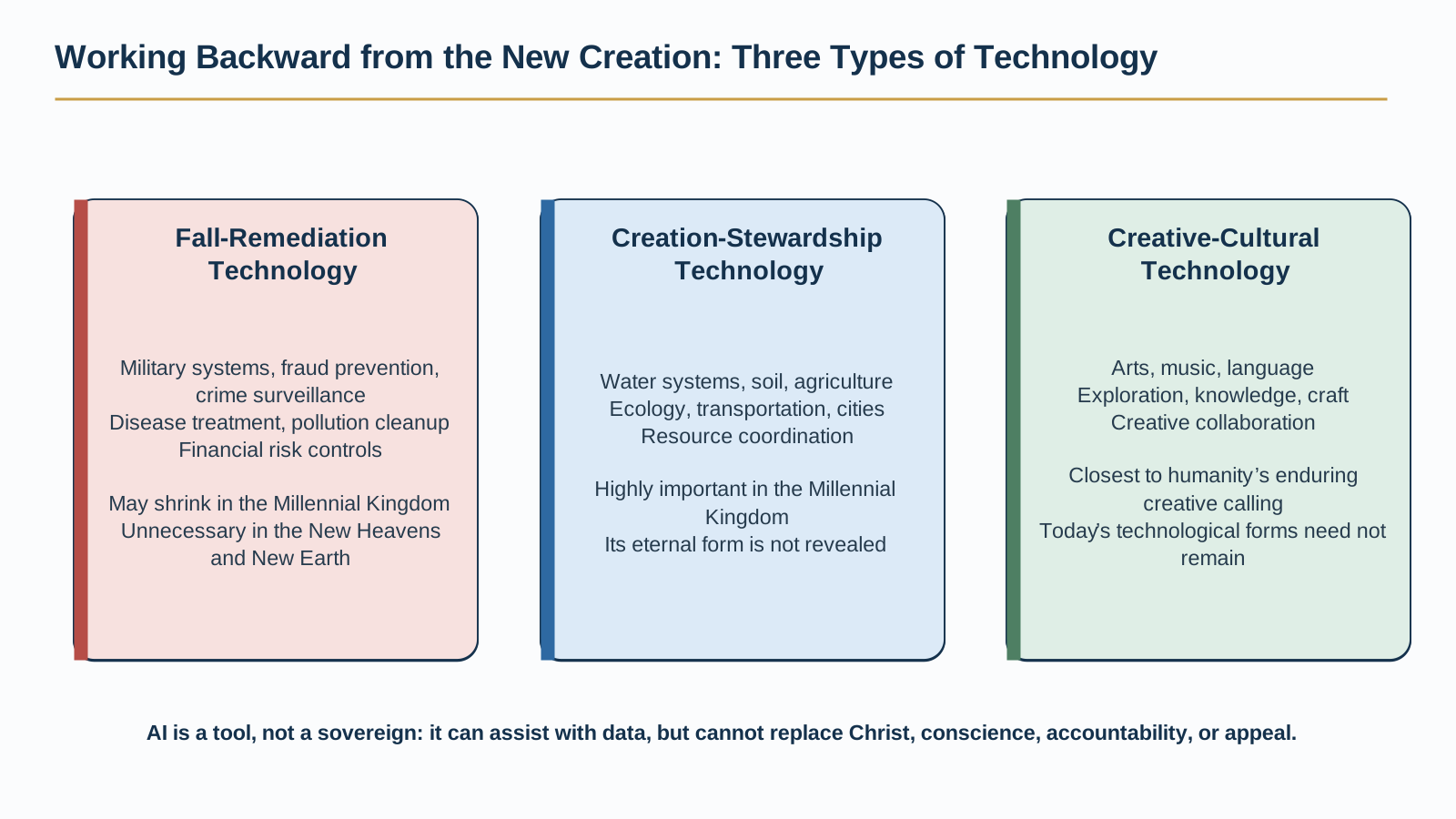
Figure — Three categories of technology: destructive, exchange-enabling, and creation-restoring.
12.5 Possible Roles and Red Lines for AI
Section titled “12.5 Possible Roles and Red Lines for AI”Tier C — Institutional inference
AI may assist agricultural optimization, climate and water monitoring, translation, education, transport, public administration, maintenance, land records, risk detection, and coordination across languages and regions. Its purpose should move away from manipulation, addiction, military escalation, surveillance for profit, and financial arbitrage toward service, restoration, truth, and stewardship.
AI must not replace Christ, conscience, or human moral responsibility. It must not place efficiency above justice, use centralized data to create new forms of exclusion, or automatically determine faith, character, guilt, punishment, employment, housing, or access to basic needs. Every consequential model, dataset, and decision should be explainable, contestable, auditable, correctable, and subject to human judgment. Local backup and the ability to operate without a single platform are essential.
12.6 Digital Centralization and the Mark of the Beast
Section titled “12.6 Digital Centralization and the Mark of the Beast”Tier C — Governance boundary, not identification of a specific technology
Digital identity, payments, platforms, and concentrated data can serve unjust powers, but Scripture does not authorize calling a particular digital system the mark of the beast merely because it is digital. Ask who controls identity, transactions, food, energy, data, and mobility, and whether people retain refusal, appeal, correction, local backup, and access to necessities. Technology is judged by purpose, governors, and accountability.