Historical Attachment 3 Transformation of Finance, Education, Music, and the Arts in Christ’s Millennial Kingdom
Edited English translation. Technical formulas are retained as thought experiments and are not presented as revealed descriptions of future institutions.
1. From Human-Centered Credit to Stewardship under Divine Law
Section titled “1. From Human-Centered Credit to Stewardship under Divine Law”A financial system governed by a known release horizon would behave differently from one that assumes perpetual enforceability of claims. Lenders would shorten maturities, increase reserves, share more risk, or replace some fixed debt with equity, leasing, mutual aid, or project-based participation. The precise outcome depends on law, expectations, enforcement, and the treatment of depositors and public obligations.
Money Multiplier = [1 + Cash-to-Deposit Ratio] ÷ [Required Reserve Ratio + Excess Reserve Ratio + Cash-to-Deposit Ratio] Traditional behavioral illustration. |
|---|
Excess Reserve Ratio(t) = Risk-Aversion Coefficient × Expected Debt-Release Rate(t) Thought experiment: anticipated release may increase precautionary reserves. |
Adjusted Money Multiplier(t) = [1 + Cash-to-Deposit Ratio] ÷ [Required Reserve Ratio + Excess Reserve Ratio(t) + Cash-to-Deposit Ratio] Illustrative extension—not a forecast or revealed millennial formula. |
The source contrasts a present order driven by permanent property monopolies and intergenerational credit claims with a Christ-centered order of finite stewardship. The paradigm shift examined here arises from the interaction of two recurring horizons: the release of eligible debts every seven years, associated with the sabbatical year, and the reset or reassignment of asset rights at the fifty-year Jubilee. The scenario assumes that both the saints who reign with Christ and the mortal peoples who survive into the millennial age will need intelligible rules for economic stewardship. These horizons are therefore used below as constraints in a conditional model, not as a revealed institutional blueprint.
For purposes of analysis, the model provisionally assumes that the millennial economy still has: (1) a medium of exchange analogous to money; (2) income that individuals may direct; (3) organized enterprises; (4) intermediary platforms that coordinate the allocation of resources; and (5) a medium of exchange that carries purchasing power. A different possibility must remain open: a monetary medium may not be necessary at all, goods and services may be assessed according to kingdom value, and the ordinary population’s necessities may be supplied through the government of Christ and the service of the saints. Scripture does not settle these institutional details.
In symbolic form, let
-
m = the money multiplier;
-
c = the currency-to-deposit, or cash-leakage, ratio;
-
r_d = the required-reserve ratio; and
-
e = the excess-reserve ratio.
The traditional behavioral expression is
m=(1+c) / (r_d+e+c).
Under a strict seven-year release rule, the source anticipates two reinforcing behavioral responses as the release date approaches. Financial institutions, expecting that an unrecovered loan may be discharged, would raise e, contract lending, refuse some renewals, and accumulate liquidity. Depositors, recognizing that a deposit is also a claim against a bank, may raise c by withdrawing funds or preferring cash and physical goods. In the proposed scenario, these responses extinguish the ordinary expansion of deposit credit.
To make the timing explicit, let t be the average age of outstanding loans, where 0≤ t≤7; let P(t) be the expected probability that a loan will be released as the seventh year approaches; and let α be the financial institution’s risk-aversion coefficient. The proposed behavioral adjustment is
e(t)=α P(t),
and therefore
m(t)=(1+c) / (r_d+α P(t)+c).
The source describes the cycle in three stages. In years one through three, P(t) remains near zero and ordinary credit behavior may continue. In years five and six, P(t) rises sharply; institutions begin to call in funds, refuse rollovers, restrict new lending, and hold more cash. At t=7, the model sets P(7)=1 and treats deposit-based credit creation as having reached its no-expansion boundary.
The Chinese source describes this boundary as m(7)→1. Strictly speaking, that limiting value depends on how c and e(t) change relative to one another; if excess reserves dominate, the expression can fall below one. Likewise, the disappearance of bank-credit multiplication would remove one source of monetary expansion, but by itself would not prove that all inflation has ceased. The formula should therefore remain a behavioral thought experiment rather than a quantitative forecast.
The accompanying Chinese figure is also illustrative rather than numerically consistent with the prose. Its plotted curve shows m(t) falling from approximately 3.0 at t=0 to approximately 1.45 at t=7, while P(t) rises from approximately 0 to approximately 0.78. The prose, by contrast, states P(7)=1 and describes m(7)→1. If the figure is retained, its assumed functional forms and parameters should be supplied, or its caption should make clear that the curves are schematic and not calculated from the stated seventh-year boundary conditions.
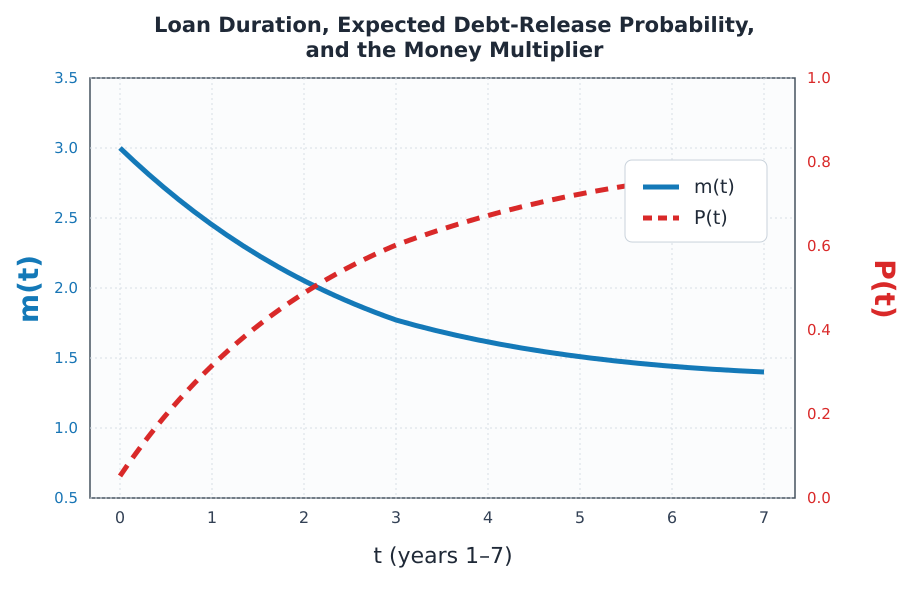
Historical Attachment 3 — Dynamic behavior of the illustrative money multiplier as the release horizon approaches (English translation).
The historical pruzbul, also spelled prozbul and associated with Hillel the Elder, responded to the reluctance to lend before the sabbatical year by placing private claims under the authority of a court, allowing collection to continue without treating the claim as an ordinary private debt. The present scenario assumes that no comparable legal circumvention would survive under Christ’s righteous rule. In the source’s strongest version, traditional bank lending therefore ends rather than merely contracts. A financial intermediary would cease to evaluate a person primarily by “creditworthiness” and would instead examine the productive or service flow of an asset during its remaining term, together with the project’s justice, purpose, and kingdom value.
2. Separation of Social Assistance and Productive Risk Capital
Section titled “2. Separation of Social Assistance and Productive Risk Capital”Loans to people in distress should not monetize desperation. Assistance may take the form of grants, interest-free support, contingent repayment, shared community responsibility, or release after a defined term. Productive projects with uncertain outcomes may be financed through risk-sharing equity, leasing, revenue participation, or time-limited mission capital rather than fixed compound claims regardless of success.
No instrument is automatically just. Equity can still concentrate control, leasing can extract rent, and securitization can hide risk. Each design must be tested by term, purpose, basic needs, informed consent, loss sharing, transparency, and public accountability.
At the assistance end of the spectrum, any nominal loan made to meet basic needs would have to be budgeted as though it might become a gift at the release date. The giver would relinquish any presumption of profiting from distress and would place the amount within a charitable or shared-responsibility budget. What returns to the giver, if anything, would be gratitude, mutual responsibility, restored relationship, and spiritual fruit—not a legally compounding claim on a vulnerable person.
At the productive end, the source argues that a fixed debt promise assumes a degree of certainty about future commercial outcomes that belongs to God alone. An investment posture instead permits participants to work under Christ’s providence while sharing both gain and loss. A capital provider may therefore become an equity participant with a finite right to govern or operate the enterprise, potentially for one fifty-year Jubilee term. No enterprise should acquire permanent ownership or permanent use of a factor of production merely by converting debt into equity.
Leasing offers a second finite-term structure. An intermediary may acquire equipment or a production site and lease its use to an enterprise; if industrial land is involved, the intermediary itself holds only the permitted finite land-use right. The enterprise receives use, not perpetual title, and no lease can extend beyond the asset’s authorized term or the remaining millennial horizon. If rent is no longer paid, the use right ends and the asset may be reassigned, without leaving the user burdened by a residual unsecured debt. The thousand-year limit in the source is an outer eschatological horizon, not a scripturally specified commercial lease term.
3. Long-Lived Assets: Housing and Public Infrastructure
Section titled “3. Long-Lived Assets: Housing and Public Infrastructure”Housing finance can shift from the fiction that every buyer becomes an absolute owner through a long mortgage toward the purchase of transparent, finite, remaining-term rights. Public infrastructure can be financed by project assets, service payments, public trusts, or mission-linked capital rather than by indefinite debt claims detached from the life of the project.
The key distinction is between financing a useful asset and creating a permanent rent stream. Term, maintenance, access, public subsidy, residual rights, and end-of-term transfer must be disclosed from the beginning.
Housing: purchasing a residual right of use
Section titled “Housing: purchasing a residual right of use”On a strict application of seven-year release, a conventional twenty- or thirty-year mortgage could not function as it does today. The source expects leverage-driven housing prices to contract toward a non-speculative cash value: the value of the dwelling’s remaining authorized use, rather than a price premised on perpetual appreciation. Holding condition, location, and services constant, that residual value declines as the end of the permitted term approaches and ultimately expires with the millennial horizon.
The two time horizons should not be silently conflated. The Chinese text treats the end of the thousand-year reign as the outer limit of every real-property right, while elsewhere placing productive land, enterprise, and governing concessions under fifty-year review. It does not clearly state whether a fully purchased residential use right is also reauthorized at every Jubilee. That question should remain open unless the governance framework defines the relationship between the fifty-year review and the thousand-year outer limit.
The source also applies the one-year redemption rule for a house in a walled city in Leviticus 25:29–30 as an additional restraint on rapid speculation. If a seller retains a meaningful right to redeem during that year, a buyer cannot safely assume that a sudden price increase will become a realizable windfall. This is an application of the biblical text to the scenario; it should not be presented as a complete modern housing code.
One possible instrument is a “lease with an option to purchase the residual use right.” The occupant pays rent while retaining the option to purchase, at any point, the dwelling’s remaining use value in a lump sum. That amount is calculated from the time remaining and may be lower than the aggregate of all future periodic rents. Before the residual right has been purchased, an occupant who stops paying incurs no continuing mortgage debt; the occupant relinquishes the use right, moves out, and the institution may lease the dwelling to another household. The Chinese source further reasons that a faithful steward may choose not to immobilize surplus resources in a private residence, trusting the King’s provision for housing and directing available resources toward kingdom service.
Public infrastructure: finite project participation
Section titled “Public infrastructure: finite project participation”A state could no longer rely on ten- to thirty-year sovereign credit bonds or other general-obligation debt to defer taxation across generations. For a major transport or utility project, it could instead place the project in a separate public-purpose entity and issue time-limited, asset-backed revenue trust units—described in the source as REIT-like participation. Tolls, fares, or other service revenue would be distributed proportionally to participants. Because essential infrastructure serves basic needs, the revenue rights themselves would remain term-limited, and the entity’s authority to operate would be reviewed before a new term is granted.
Airports, ports, energy systems, and similar projects could likewise be organized through shorter build-operate-transfer or concession periods, such as a fifty-year operating term. Government would move from the role of a large borrower and macro-financial sponsor toward the role of grantor, matchmaker, performance evaluator, and guardian of access. The governing contrast is therefore not simply “public” versus “private,” but intergenerational unsecured credit versus finite, disclosed participation in the service flow of a particular asset.
4. From an Asset-Owner Class to a Stewardship Class
Section titled “4. From an Asset-Owner Class to a Stewardship Class”When all rights share an endpoint, the social status of permanent owners loses its ultimate foundation. Authority should attach to faithful service, competence, character, and accountability rather than to the indefinite accumulation of claims. Managers and investors may still receive differentiated provision and reward, but their rights remain mission-bound and subject to review.
The Time-Hourglass Effect describes how remaining years of control drain away. A system can preserve productive equipment, knowledge, and institutional memory while resetting who controls them, for what purpose, and for whose benefit. Reset is not indiscriminate destruction; it is renewed authorization.
In this framework, no individual—including the leader of a large multinational enterprise—is a capitalist or landowner in the sense of possessing an asset forever. Each is a steward or manager whose transferable economic interest consists principally of the years remaining in an authorized term.
The source gives a concrete fifty-year illustration of the Time-Hourglass Effect. A use right is most valuable in year one, when all fifty years remain. In year forty-nine, with only one year left, its residual value approaches zero, all else being equal. Mere passage of time therefore cannot support a claim of perpetual appreciation. Expiration removes the foundation for gains based solely on indefinite control, although it does not imply that every short-term price difference, improvement value, or speculative impulse will automatically disappear.
The source’s summary diagram presents the transition in three steps: modern society is credit- and debt-driven; the seven-year release shifts financing toward finite asset rights and equity participation; and the fifty-year Jubilee places both within an explicitly God-centered order of trusteeship and stewardship. This sequence is a conceptual map of the proposed transition, not a claim that every institution will pass through three mechanically distinct historical stages.
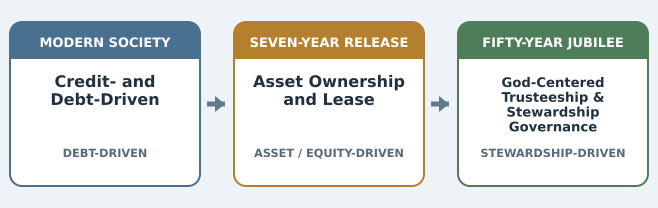
Historical Attachment 3 — From debt-driven society through asset/equity claims toward stewardship (English translation).
5. Inheritance Lock, Basic Resources, and Rentier Power
Section titled “5. Inheritance Lock, Basic Resources, and Rentier Power”Perpetual claims allow control of land, water, energy, housing, platforms, and debt to compound across generations. A finite-term order limits this inheritance lock. Families may pass on love, knowledge, gifts, responsibility, and legitimate use rights, but no generation can assume an eternal private sovereignty over the foundations of everyone else’s life.
The goal is not to eliminate every difference of provision or every payment for service. It is to prevent a rentier class from receiving permanent income merely because it controls irreplaceable necessities. Returns should correspond to real service, maintenance, risk, and finite entrustment.
For rights governed by the Jubilee cycle, control of the underlying asset returns at each fifty-year reset for review and reassignment. An heir may inherit formation, knowledge, relationships, and a record of service, but does not automatically inherit the parent’s operating authority over land or a monopoly enterprise. The heir must receive renewed authorization on present fitness and purpose. This is intended to interrupt the “Matthew effect” by which an initial advantage compounds across generations and gradually hardens into hereditary class power.
Water, land, and energy illustrate the rule most clearly. Rights to operate these necessities would be granted only as finite concessions, such as a fifty-year term. Exploitative pricing, neglect, or persistently poor service could justify withdrawal even before the term ends; at expiry, the authority could be reassigned to a more public-minded steward. The point is to keep the means of survival answerable to their purpose rather than to make basic life dependent on an unreviewable private monopoly.
The same mechanism weakens rentier power. A person could not collect land or resource rent forever merely because an earlier generation secured exclusive control of a scarce natural asset. As residual terms shorten and automatic inheritance ends, capital must seek returns through genuine maintenance, innovation, and productive service rather than through the passive capitalization of permanent scarcity.
6. Education, Gifts, and Portable Kingdom Capital
Section titled “6. Education, Gifts, and Portable Kingdom Capital”If material rights are finite, knowledge, wisdom, character, skills, gifts, trust, relationships, teaching capacity, and a history of faithfulness become increasingly significant. Education should therefore move beyond competitive credential sorting toward formation, gift discernment, governance practice, intergenerational learning, and care for creation.
These forms of capital are not a currency of salvation. They cannot be priced by the state or AI. They describe what kind of steward a person has become and how that person can serve through changing assignments and institutional reset cycles.
The source names ecological knowledge, governing wisdom, artistic mastery, cultivated gifts, and—above all—a deep understanding of the order of God’s creation as forms of wealth that survive an institutional reset. A field, factory, or governing concession may return for reassignment, but formation acquired through faithful practice remains with the person. In that limited sense, wisdom and character are portable capital: they are not confiscated when an external term expires.
Each fifty-year boundary is consequently imagined as both an asset reset and a stewardship review before Christ. The measure is not how much money the steward accumulated during the preceding term, but whether that person acted as a “good and faithful servant”: developing entrusted gifts and exercising responsibility with love, justice, and mercy. In the next cycle, proven stewards may receive enlarged responsibility—evoked by the charge over “ten cities” or wider care for water, land, and energy—while those who bury their gifts or refuse to learn may receive a narrower assignment or lose it altogether. This applies the parable of the talents to the scenario; Scripture does not reveal a fifty-year administrative scoring procedure.
Millennial education is also envisioned as learning across the whole communion of the saints. Figures such as Paul, the Twelve, Elijah, and Moses, together with saints from every generation, would serve under Christ during the same thousand-year reign. Mortal peoples and resurrected saints could therefore learn God’s ways in an intergenerational community whose historical memory is present rather than merely archival.
7. Music, the Arts, and Cultural Creation
Section titled “7. Music, the Arts, and Cultural Creation”When culture is freed from manipulation, addiction, status competition, and rapid monetization, music and the arts may flourish as worship, memory, truth telling, beauty, lament, celebration, reconciliation, and shared creativity. The glory of the nations can be brought before the King rather than enclosed as a private trophy.
Authorship and attribution still matter because responsibility, truth, and gratitude matter. Intellectual property may become less centered on perpetual exclusion and more centered on recognition, stewardship, fair provision for creators, access, education, and the return of cultural fruit to the common good.
Once access to basic necessities is no longer controlled by permanent monopolies, creators need not shape every work around subsistence, market fashion, an algorithm, or the preferences of a buyer. The source imagines artistic motivation being freed from the pressure to court degrading attention or to make immediate marketability the condition of creation.
Greatly extended life also changes the time scale of cultural work. An artist might spend fifty years refining a single work, while several generations of masters might labor over centuries on a sculpted city designed in ecological harmony with its setting. Music, architecture, craft, and public memory could thus become long-horizon, communal offerings rather than rapidly monetized products.
In this vision, cultural creativity and spiritual wisdom function as a metaphorical “social currency.” Highly gifted creators gain honor by sharing generously instead of enclosing every insight behind a permanent patent or exclusive claim. Faithful transmission becomes part of the steward’s account, and the source imagines that generosity may lead to deeper creative responsibility and inspiration in a later cycle.
8. Glorified Saints and the Limits of Speculation
Section titled “8. Glorified Saints and the Limits of Speculation”Scripture teaches that resurrected saints reign with Christ and possess transformed, incorruptible bodies. It does not reveal a complete physics of their movement, nutrition, communication, or administrative capacity. The risen Jesus could be touched and ate with His disciples, yet also appeared in ways that surpassed ordinary bodily limitations.
Specific claims about DNA, instantaneous travel, or technological replacement belong to Tier D speculation unless directly supported. Their proper use is to ask whether glorified governors could serve widely and faithfully—not to construct a detailed supernatural bureaucracy.
The Chinese source links the role of the saints of the first resurrection to two familiar governance problems: agency risk, in which delegated power is diverted to private gain, and terminal-horizon neglect, in which a manager exploits or abandons a common good near the end of a term. Revelation 20:6 describes those who share in the first resurrection as blessed and holy, beyond the power of the second death, serving as priests of God and Christ and reigning with Him for a thousand years. The source therefore expects their rule to be free from corrupt self-dealing. That expectation is a theological inference from their sanctified identity; the verse does not disclose a complete administrative mechanism or justify importing the phrase “zero corruption risk” as a measurable institutional variable.
A fuller exploration of possible bodily capacities must preserve the distinction between narrated events and generalized powers:
-
John 20:19 reports that the risen Jesus stood among the disciples while the doors were locked. This may invite questions about freedom from ordinary barriers, but the text does not explain the mechanism or state that every glorified saint will routinely pass through solid matter.
-
Luke 24:31 reports that Jesus vanished from the disciples’ sight. It does not by itself establish unrestricted instantaneous travel over any distance at will.
-
Acts 1:9 narrates Christ’s ascension, and 1 Corinthians 15:43–44 contrasts the body sown in dishonor and weakness with the body raised in glory and power as a spiritual body. These texts affirm profound transformation; they do not supply a physics of gravity, spatial movement, or material interaction.
-
Revelation 20:6 establishes holiness, priestly and royal vocation, and freedom from the second death. It does not specify the saints’ speed of communication, geographic reach, logistical needs, or day-to-day supervisory methods.
These Tier D possibilities may be used to ask whether glorified governors could guide mortal communities across a wide territory or overcome constraints that limit present administration. They may not be converted into categorical claims that the saints possess a particular transport mechanism, can appear anywhere on demand, or render institutions and technology unnecessary.
9. Conclusion: Relationship Reordered around God
Section titled “9. Conclusion: Relationship Reordered around God”The deepest transformation is not technical. Finance, education, and culture are reordered because God is recognized as owner, Christ as King, people as neighbors and stewards, and creation as entrusted rather than disposable. Fixed extraction gives way to service; permanent claims give way to accountable terms; fear gives way to provision; and talent is directed toward worship and the common good.
The ultimate purpose of the millennium is not to make human society more convenient, materially advanced, or comfortable, nor to make limitless technological achievement or space exploration a new human-centered end. Its theological purposes are broader: to manifest Christ’s kingship, fulfill God’s promises to Israel, govern the nations, bring the saints into their royal vocation, restore creation, display righteous government, teach the mortal population, expose the dispositions of human hearts, subdue hostile powers, and prepare the transition to the new creation.
For glorified saints, the millennium is the first historical stage of their everlasting reign. For obedient mortal peoples, it is a period of formation and preparation. For those who remain unwilling to submit, it is a period of disclosure. For creation, it is a foretaste of restoration.
Revelation 20:7–8 supplies the decisive warning. Even after a thousand years of Christ’s righteous rule, the release of Satan is followed by a rebellion whose participants are described as numerous as the sand of the sea. The episode shows that an ideal environment, just administration, abundant provision, advanced knowledge, and comfortable conditions do not save the human heart. Millennial institutions can teach, restrain, provide, and reveal; they cannot replace reconciliation with God.
The seven-year release, the fifty-year reset, and the cultivation of gifts are therefore not ends in themselves. They form disciplines through which people learn in ordinary life what it means to dwell and work with Jesus. Science, art, administration, and study cease to be instruments of extraction or self-exaltation and become practices through which people know and fear God, serve what He has made, and render a faithful account to the King.